

436
12 Small Nitrogenous Compounds
able to substitute various analogues for choline
during lipid synthesis [30]. Acetylation of choline
uses acetyl-CoA as the donor; the corresponding
acetyltransferases have been isolated from fish,
insects, the xiphosuran Limulus, molluscs and
mammals [10]. These enzymes are all very similar
in their physical and catalytic properties; for
example, both the enzyme from the brain of
Loligo pealei and that of bovine brain show a tendency to aggregate. A cDNA for choline acetyltransferase has been cloned from Drosophila
melanogaster. The sequence of 728 amino acids is
about 50-100 amino acids longer than that predicted by the 67-kDa mass of the active enzyme;
it would appear that a larger, enzymatically inactive pro-enzyme is formed [116].
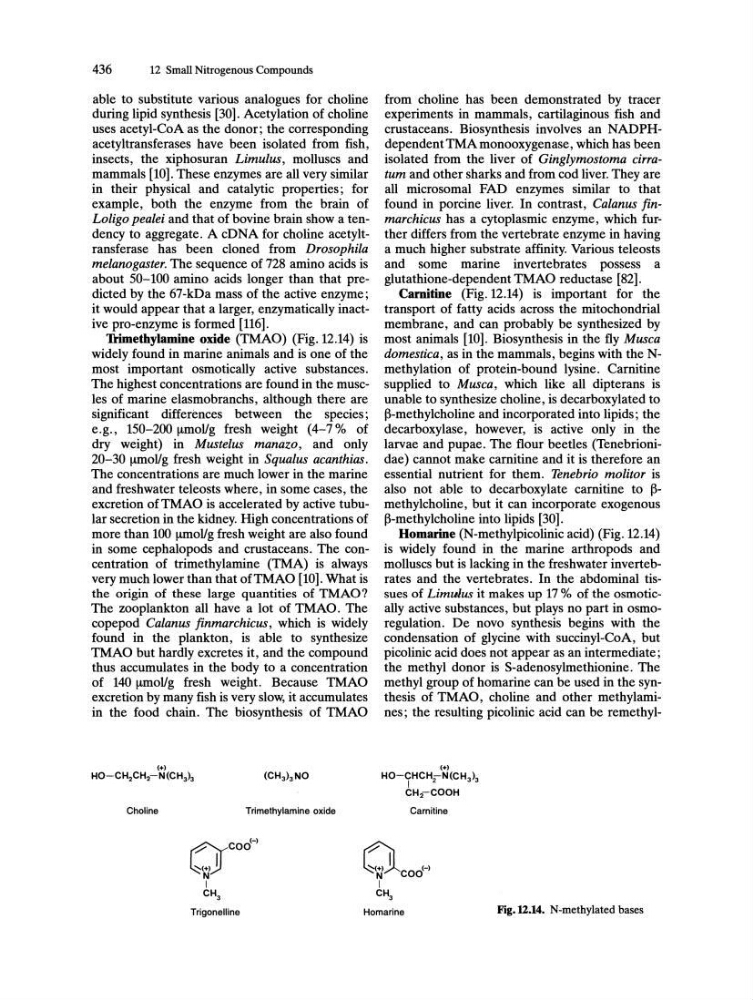
'fiimethylamine oxide (TMAO) (Fig. 12.14) is
widely found in marine animals and is one of the
most important osmotically active substances.
The highest concentrations are found in the muscles of marine elasmobranchs, although there are
significant differences between the species;
e.g., 150-200 ILmollg fresh weight (4-7% of
dry weight) in Mustelus manazo, and only
20-30 ILmollg fresh weight in Squalus acanthias.
The concentrations are much lower in the marine
and freshwater teleosts where, in some cases, the
excretion of TMAO is accelerated by active tubular secretion in the kidney. High concentrations of
more than 100 ILmollg fresh weight are also found
in some cephalopods and crustaceans. The concentration of trimethylamine (TMA) is always
very much lower than that ofTMAO [10]. What is
the origin of these large quantities of TMAO?
The zooplankton all have a lot of TMAO. The
copepod Calanus finmarchicus, which is widely
found in the plankton, is able to synthesize
TMAO but hardly excretes it, and the compound
thus accumulates in the body to a concentration
of 140 ILmollg fresh weight. Because TMAO
excretion by many fish is very slow, it accumulates
in the food chain. The biosynthesis of TMAO
(+)
HO-CH2CH2-N(CH 3 )3
Choline
Trimethylamine oxide
from choline has been demonstrated by tracer
experiments in mammals, cartilaginous fish and
crustaceans. Biosynthesis involves an NADPHdependent TMA monooxygenase, which has been
isolated from the liver of Ginglymostoma cirratum and other sharks and from cod liver. They are
all microsomal FAD enzymes similar to that
found in porcine liver. In contrast, Calanus finmarchicus has a cytoplasmic enzyme, which further differs from the vertebrate enzyme in having
a much higher substrate affinity. Various teleosts
and some marine invertebrates possess a
glutathione-dependent TMAO reductase [82].
Camitine (Fig.12.14) is important for the
transport of fatty acids across the mitochondrial
membrane, and can probably be synthesized by
most animals [10]. Biosynthesis in the fly Musca
domestica, as in the mammals, begins with the Nmethylation of protein-bound lysine. Carnitine
supplied to Musca, which like all dipterans is
unable to synthesize choline, is decarboxylated to
~-methylcholine and incorporated into lipids; the
decarboxylase, however, is active only in the
larvae and pupae. The flour beetles (Tenebrionidae) cannot make carnitine and it is therefore an
essential nutrient for them. Tenebrio molitor is
also not able to decarboxylate carnitine to ~methylcholine, but it can incorporate exogenous
~-methylcholine into lipids [30].
Homarine (N-methylpicolinic acid) (Fig. 12.14)
is widely found in the marine arthropods and
molluscs but is lacking in the freshwater invertebrates and the vertebrates. In the abdominal tissues of Limulus it makes up 17 % ofthe osmotically active substances, but plays no part in osmoregulation. De novo synthesis begins with the
condensation of glycine with succinyl-CoA, but
picolinic acid does not appear as an intermediate;
the methyl donor is S-adenosylmethionine. The
methyl group of homarine can be used in the synthesis of TMAO, choline and other methylamines; the resulting picolinic acid can be remethyl(+)
HO-CHCH 2 N(CH)3
I
CH 2-COOH
Carnitine
~cod-)
~':L,!J
P)
~~coo(-)
I
N
I
CH 3
Trigonelline
CH 3
Homarine
Fig.12.14. N-methylated bases
12 Small Nitrogenous Compounds
able to substitute various analogues for choline
during lipid synthesis [30]. Acetylation of choline
uses acetyl-CoA as the donor; the corresponding
acetyltransferases have been isolated from fish,
insects, the xiphosuran Limulus, molluscs and
mammals [10]. These enzymes are all very similar
in their physical and catalytic properties; for
example, both the enzyme from the brain of
Loligo pealei and that of bovine brain show a tendency to aggregate. A cDNA for choline acetyltransferase has been cloned from Drosophila
melanogaster. The sequence of 728 amino acids is
about 50-100 amino acids longer than that predicted by the 67-kDa mass of the active enzyme;
it would appear that a larger, enzymatically inactive pro-enzyme is formed [116].
'fiimethylamine oxide (TMAO) (Fig. 12.14) is
widely found in marine animals and is one of the
most important osmotically active substances.
The highest concentrations are found in the muscles of marine elasmobranchs, although there are
significant differences between the species;
e.g., 150-200 ILmollg fresh weight (4-7% of
dry weight) in Mustelus manazo, and only
20-30 ILmollg fresh weight in Squalus acanthias.
The concentrations are much lower in the marine
and freshwater teleosts where, in some cases, the
excretion of TMAO is accelerated by active tubular secretion in the kidney. High concentrations of
more than 100 ILmollg fresh weight are also found
in some cephalopods and crustaceans. The concentration of trimethylamine (TMA) is always
very much lower than that ofTMAO [10]. What is
the origin of these large quantities of TMAO?
The zooplankton all have a lot of TMAO. The
copepod Calanus finmarchicus, which is widely
found in the plankton, is able to synthesize
TMAO but hardly excretes it, and the compound
thus accumulates in the body to a concentration
of 140 ILmollg fresh weight. Because TMAO
excretion by many fish is very slow, it accumulates
in the food chain. The biosynthesis of TMAO
(+)
HO-CH2CH2-N(CH 3 )3
Choline
Trimethylamine oxide
from choline has been demonstrated by tracer
experiments in mammals, cartilaginous fish and
crustaceans. Biosynthesis involves an NADPHdependent TMA monooxygenase, which has been
isolated from the liver of Ginglymostoma cirratum and other sharks and from cod liver. They are
all microsomal FAD enzymes similar to that
found in porcine liver. In contrast, Calanus finmarchicus has a cytoplasmic enzyme, which further differs from the vertebrate enzyme in having
a much higher substrate affinity. Various teleosts
and some marine invertebrates possess a
glutathione-dependent TMAO reductase [82].
Camitine (Fig.12.14) is important for the
transport of fatty acids across the mitochondrial
membrane, and can probably be synthesized by
most animals [10]. Biosynthesis in the fly Musca
domestica, as in the mammals, begins with the Nmethylation of protein-bound lysine. Carnitine
supplied to Musca, which like all dipterans is
unable to synthesize choline, is decarboxylated to
~-methylcholine and incorporated into lipids; the
decarboxylase, however, is active only in the
larvae and pupae. The flour beetles (Tenebrionidae) cannot make carnitine and it is therefore an
essential nutrient for them. Tenebrio molitor is
also not able to decarboxylate carnitine to ~methylcholine, but it can incorporate exogenous
~-methylcholine into lipids [30].
Homarine (N-methylpicolinic acid) (Fig. 12.14)
is widely found in the marine arthropods and
molluscs but is lacking in the freshwater invertebrates and the vertebrates. In the abdominal tissues of Limulus it makes up 17 % ofthe osmotically active substances, but plays no part in osmoregulation. De novo synthesis begins with the
condensation of glycine with succinyl-CoA, but
picolinic acid does not appear as an intermediate;
the methyl donor is S-adenosylmethionine. The
methyl group of homarine can be used in the synthesis of TMAO, choline and other methylamines; the resulting picolinic acid can be remethyl(+)
HO-CHCH 2 N(CH)3
I
CH 2-COOH
Carnitine
~cod-)
~':L,!J
P)
~~coo(-)
I
N
I
CH 3
Trigonelline
CH 3
Homarine
Fig.12.14. N-methylated bases