

found in widely varying concentrations in the
toxin-producing posterior salivary glands of
cephalopods and in the skin of amphibians. The
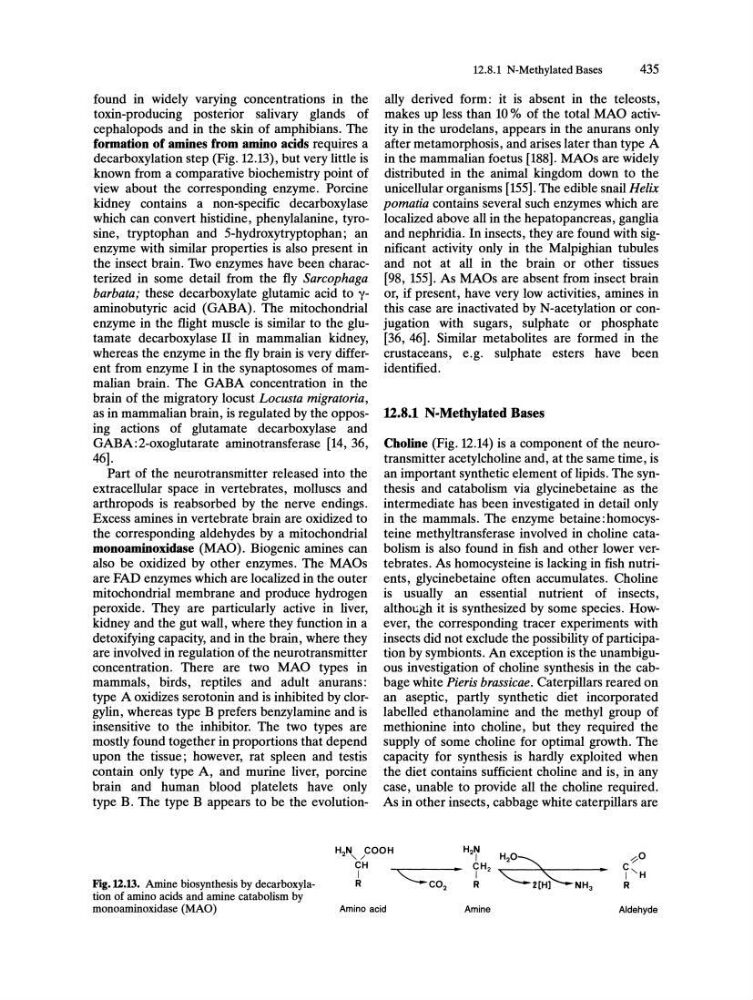
formation of amines from amino acids requires a
decarboxylation step (Fig. 12.13), but very little is
known from a comparative biochemistry point of
view about the corresponding enzyme. Porcine
kidney contains a non-specific decarboxylase
which can convert histidine, phenylalanine, tyrosine, tryptophan and 5-hydroxytryptophan; an
enzyme with similar properties is also present in
the insect brain. Two enzymes have been characterized in some detail from the fly Sarcophaga
barbata; these decarboxylate glutamic acid to yaminobutyric acid (GABA). The mitochondrial
enzyme in the flight muscle is similar to the glutamate decarboxylase II in mammalian kidney,
whereas the enzyme in the fly brain is very different from enzyme I in the synaptosomes of mammalian brain. The GABA concentration in the
brain of the migratory locust Locusta migratoria,
as in mammalian brain, is regulated by the opposing actions of glutamate decarboxylase and
GABA:2-oxoglutarate aminotransferase [14,36,
46].
Part of the neurotransmitter released into the
extracellular space in vertebrates, molluscs and
arthropods is reabsorbed by the nerve endings.
Excess amines in vertebrate brain are oxidized to
the corresponding aldehydes by a mitochondrial
monoaminoxidase (MAO). Biogenic amines can
also be oxidized by other enzymes. The MADs
are FAD enzymes which are localized in the outer
mitochondrial membrane and produce hydrogen
peroxide. They are particularly active in liver,
kidney and the gut wall, where they function in a
detoxifying capacity, and in the brain, where they
are involved in regulation of the neurotransmitter
concentration. There are two MAO types in
mammals, birds, reptiles and adult anurans:
type A oxidizes serotonin and is inhibited by clorgylin, whereas type B prefers benzylamine and is
insensitive to the inhibitor. The two types are
mostly found together in proportions that depend
upon the tissue; however, rat spleen and testis
contain only type A, and murine liver, porcine
brain and human blood platelets have only
type B. The type B appears to be the evolution12.8.1 N-Methylated Bases
435
ally derived form: it is absent in the teleosts,
makes up less than 10 % of the total MAO activity in the urodelans, appears in the anurans only
after metamorphosis, and arises later than type A
in the mammalian foetus [188]. MADs are widely
distributed in the animal kingdom down to the
unicellular organisms [155]. The edible snail Helix
pomatia contains several such enzymes which are
localized above all in the hepatopancreas, ganglia
and nephridia. In insects, they are found with significant activity only in the Malpighian tubules
and not at all in the brain or other tissues
[98, 155]. As MADs are absent from insect brain
or, if present, have very low activities, amines in
this case are inactivated by N-acetylation or conjugation with sugars, sulphate or phosphate
[36,46]. Similar metabolites are formed in the
crustaceans, e.g. sulphate esters have been
identified.
12.S.1 N.Methylated Bases
Choline (Fig. 12.14) is a component of the neurotransmitter acetylcholine and, at the same time, is
an important synthetic element of lipids. The synthesis and catabolism via glycinebetaine as the
intermediate has been investigated in detail only
in the mammals. The enzyme betaine:homocysteine methyltransferase involved in choline catabolism is also found in fish and other lower vertebrates. As homocysteine is lacking in fish nutrients, glycinebetaine often accumulates. Choline
is usually an essential nutrient of insects,
although it is synthesized by some species. However, the corresponding tracer experiments with
insects did not exclude the possibility of participation by symbionts. An exception is the unambiguous investigation of choline synthesis in the cabbage white Pieris brassicae. Caterpillars reared on
an aseptic, partly synthetic diet incorporated
labelled ethanolamine and the methyl group of
methionine into choline, but they required the
supply of some choline for optimal growth. The
capacity for synthesis is hardly exploited when
the diet contains sufficient choline and is, in any
case, unable to provide all the choline required.
As in other insects, cabbage white caterpillars are
~co 2
'i'0
C
I'H
R
Fig.U.13. Amine biosynthesis by decarboxylation of amino acids and amine catabolism by
monoaminoxidase (MAO)
Amino acid
Amine
Aldehyde
toxin-producing posterior salivary glands of
cephalopods and in the skin of amphibians. The
formation of amines from amino acids requires a
decarboxylation step (Fig. 12.13), but very little is
known from a comparative biochemistry point of
view about the corresponding enzyme. Porcine
kidney contains a non-specific decarboxylase
which can convert histidine, phenylalanine, tyrosine, tryptophan and 5-hydroxytryptophan; an
enzyme with similar properties is also present in
the insect brain. Two enzymes have been characterized in some detail from the fly Sarcophaga
barbata; these decarboxylate glutamic acid to yaminobutyric acid (GABA). The mitochondrial
enzyme in the flight muscle is similar to the glutamate decarboxylase II in mammalian kidney,
whereas the enzyme in the fly brain is very different from enzyme I in the synaptosomes of mammalian brain. The GABA concentration in the
brain of the migratory locust Locusta migratoria,
as in mammalian brain, is regulated by the opposing actions of glutamate decarboxylase and
GABA:2-oxoglutarate aminotransferase [14,36,
46].
Part of the neurotransmitter released into the
extracellular space in vertebrates, molluscs and
arthropods is reabsorbed by the nerve endings.
Excess amines in vertebrate brain are oxidized to
the corresponding aldehydes by a mitochondrial
monoaminoxidase (MAO). Biogenic amines can
also be oxidized by other enzymes. The MADs
are FAD enzymes which are localized in the outer
mitochondrial membrane and produce hydrogen
peroxide. They are particularly active in liver,
kidney and the gut wall, where they function in a
detoxifying capacity, and in the brain, where they
are involved in regulation of the neurotransmitter
concentration. There are two MAO types in
mammals, birds, reptiles and adult anurans:
type A oxidizes serotonin and is inhibited by clorgylin, whereas type B prefers benzylamine and is
insensitive to the inhibitor. The two types are
mostly found together in proportions that depend
upon the tissue; however, rat spleen and testis
contain only type A, and murine liver, porcine
brain and human blood platelets have only
type B. The type B appears to be the evolution12.8.1 N-Methylated Bases
435
ally derived form: it is absent in the teleosts,
makes up less than 10 % of the total MAO activity in the urodelans, appears in the anurans only
after metamorphosis, and arises later than type A
in the mammalian foetus [188]. MADs are widely
distributed in the animal kingdom down to the
unicellular organisms [155]. The edible snail Helix
pomatia contains several such enzymes which are
localized above all in the hepatopancreas, ganglia
and nephridia. In insects, they are found with significant activity only in the Malpighian tubules
and not at all in the brain or other tissues
[98, 155]. As MADs are absent from insect brain
or, if present, have very low activities, amines in
this case are inactivated by N-acetylation or conjugation with sugars, sulphate or phosphate
[36,46]. Similar metabolites are formed in the
crustaceans, e.g. sulphate esters have been
identified.
12.S.1 N.Methylated Bases
Choline (Fig. 12.14) is a component of the neurotransmitter acetylcholine and, at the same time, is
an important synthetic element of lipids. The synthesis and catabolism via glycinebetaine as the
intermediate has been investigated in detail only
in the mammals. The enzyme betaine:homocysteine methyltransferase involved in choline catabolism is also found in fish and other lower vertebrates. As homocysteine is lacking in fish nutrients, glycinebetaine often accumulates. Choline
is usually an essential nutrient of insects,
although it is synthesized by some species. However, the corresponding tracer experiments with
insects did not exclude the possibility of participation by symbionts. An exception is the unambiguous investigation of choline synthesis in the cabbage white Pieris brassicae. Caterpillars reared on
an aseptic, partly synthetic diet incorporated
labelled ethanolamine and the methyl group of
methionine into choline, but they required the
supply of some choline for optimal growth. The
capacity for synthesis is hardly exploited when
the diet contains sufficient choline and is, in any
case, unable to provide all the choline required.
As in other insects, cabbage white caterpillars are
~co 2
'i'0
C
I'H
R
Fig.U.13. Amine biosynthesis by decarboxylation of amino acids and amine catabolism by
monoaminoxidase (MAO)
Amino acid
Amine
Aldehyde