

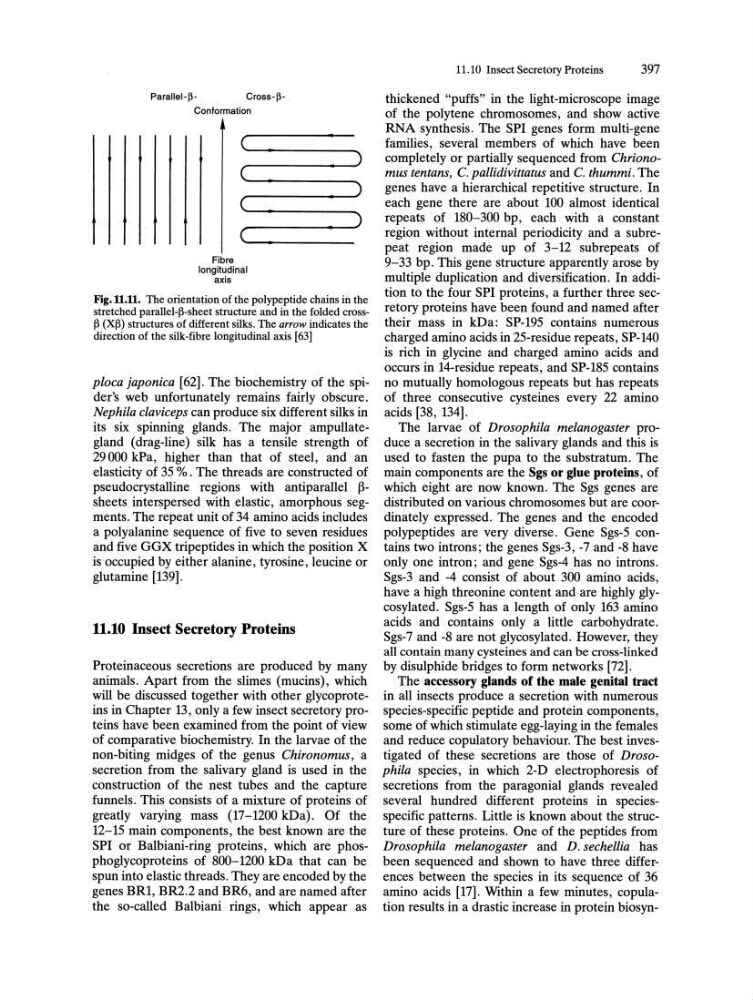
Cross-~Conformation
Fibre
longitudinal
axis
Fig.ll.ll. The orientation of the polypeptide chains in the
stretched parallel-f3-sheet structure and in the folded crossf3 (Xf3) structures of different silks. The arrow indicates the
direction of the silk-fibre longitudinal axis [63]
ploca japonica [62]. The biochemistry of the spider's web unfortunately remains fairly obscure.
Nephila claviceps can produce six different silks in
its six spinning glands. The major ampullategland (drag-line) silk has a tensile strength of
29000 kPa, higher than that of steel, and an
elasticity of 35 %. The threads are constructed of
pseudocrystalline regions with antiparallel ~sheets interspersed with elastic, amorphous segments. The repeat unit of 34 amino acids includes
a polyalanine sequence of five to seven residues
and five GGX tripeptides in which the position X
is occupied by either alanine, tyrosine, leucine or
glutamine [139].
11.10 Insect Secretory Proteins
Proteinaceous secretions are produced by many
animals. Apart from the slimes (mucins), which
will be discussed together with other glycoproteins in Chapter 13, only a few insect secretory proteins have been examined from the point of view
of comparative biochemistry. In the larvae of the
non-biting midges of the genus Chironomus, a
secretion from the salivary gland is used in the
construction of the nest tubes and the capture
funnels. This consists of a mixture of proteins of
greatly varying mass (17-1200 kDa). Of the
12-15 main components, the best known are the
SPI or Balbiani-ring proteins, which are phosphoglycoproteins of 800-1200 kDa that can be
spun into elastic threads. They are encoded by the
genes BRl, BR2.2 and BR6, and are named after
the so-called Balbiani rings, which appear as
11.10 Insect Secretory Proteins
397
thickened "puffs" in the light-microscope image
of the polytene chromosomes, and show active
RNA synthesis. The SPI genes form multi-gene
families, several members of which have been
completely or partially sequenced from Chrionomus tentans, C. pallidivittatus and C. thummi. The
genes have a hierarchical repetitive structure. In
each gene there are about 100 almost identical
repeats of 180-300 bp, each with a constant
region without internal periodicity and a subrepeat region made up of 3-12 subrepeats of
9-33 bp. This gene structure apparently arose by
multiple duplication and diversification. In addition to the four SPI proteins, a further three secretory proteins have been found and named after
their mass in kDa: SP-195 contains numerous
charged amino acids in 25-residue repeats, SP-140
is rich in glycine and charged amino acids and
occurs in 14-residue repeats, and SP-185 contains
no mutually homologous repeats but has repeats
of three consecutive cysteines every 22 amino
acids [38, 134].
The larvae of Drosophila melanogaster produce a secretion in the salivary glands and this is
used to fasten the pupa to the substratum. The
main components are the Sgs or glue proteins, of
which eight are now known. The Sgs genes are
distributed on various chromosomes but are coordinately expressed. The genes and the encoded
polypeptides are very diverse. Gene Sgs-5 contains two introns; the genes Sgs-3, -7 and -8 have
only one intron; and gene Sgs-4 has no introns.
Sgs-3 and -4 consist of about 300 amino acids,
have a high threonine content and are highly glycosylated. Sgs-5 has a length of only 163 amino
acids and contains only a little carbohydrate.
Sgs-7 and -8 are not glycosylated. However, they
all contain many cysteines and can be cross-linked
by disulphide bridges to form networks [72].
The accessory glands of the male genital tract
in all insects produce a secretion with numerous
species-specific peptide and protein components,
some of which stimulate egg-laying in the females
and reduce copulatory behaviour. The best investigated of these secretions are those of Drosophila species, in which 2-D electrophoresis of
secretions from the paragonial glands revealed
several hundred different proteins in speciesspecific patterns. Little is known about the structure of these proteins. One of the peptides from
Drosophila melanogaster and D. sechellia has
been sequenced and shown to have three differences between the species in its sequence of 36
amino acids [17]. Within a few minutes, copulation results in a drastic increase in protein biosyn-
Fibre
longitudinal
axis
Fig.ll.ll. The orientation of the polypeptide chains in the
stretched parallel-f3-sheet structure and in the folded crossf3 (Xf3) structures of different silks. The arrow indicates the
direction of the silk-fibre longitudinal axis [63]
ploca japonica [62]. The biochemistry of the spider's web unfortunately remains fairly obscure.
Nephila claviceps can produce six different silks in
its six spinning glands. The major ampullategland (drag-line) silk has a tensile strength of
29000 kPa, higher than that of steel, and an
elasticity of 35 %. The threads are constructed of
pseudocrystalline regions with antiparallel ~sheets interspersed with elastic, amorphous segments. The repeat unit of 34 amino acids includes
a polyalanine sequence of five to seven residues
and five GGX tripeptides in which the position X
is occupied by either alanine, tyrosine, leucine or
glutamine [139].
11.10 Insect Secretory Proteins
Proteinaceous secretions are produced by many
animals. Apart from the slimes (mucins), which
will be discussed together with other glycoproteins in Chapter 13, only a few insect secretory proteins have been examined from the point of view
of comparative biochemistry. In the larvae of the
non-biting midges of the genus Chironomus, a
secretion from the salivary gland is used in the
construction of the nest tubes and the capture
funnels. This consists of a mixture of proteins of
greatly varying mass (17-1200 kDa). Of the
12-15 main components, the best known are the
SPI or Balbiani-ring proteins, which are phosphoglycoproteins of 800-1200 kDa that can be
spun into elastic threads. They are encoded by the
genes BRl, BR2.2 and BR6, and are named after
the so-called Balbiani rings, which appear as
11.10 Insect Secretory Proteins
397
thickened "puffs" in the light-microscope image
of the polytene chromosomes, and show active
RNA synthesis. The SPI genes form multi-gene
families, several members of which have been
completely or partially sequenced from Chrionomus tentans, C. pallidivittatus and C. thummi. The
genes have a hierarchical repetitive structure. In
each gene there are about 100 almost identical
repeats of 180-300 bp, each with a constant
region without internal periodicity and a subrepeat region made up of 3-12 subrepeats of
9-33 bp. This gene structure apparently arose by
multiple duplication and diversification. In addition to the four SPI proteins, a further three secretory proteins have been found and named after
their mass in kDa: SP-195 contains numerous
charged amino acids in 25-residue repeats, SP-140
is rich in glycine and charged amino acids and
occurs in 14-residue repeats, and SP-185 contains
no mutually homologous repeats but has repeats
of three consecutive cysteines every 22 amino
acids [38, 134].
The larvae of Drosophila melanogaster produce a secretion in the salivary glands and this is
used to fasten the pupa to the substratum. The
main components are the Sgs or glue proteins, of
which eight are now known. The Sgs genes are
distributed on various chromosomes but are coordinately expressed. The genes and the encoded
polypeptides are very diverse. Gene Sgs-5 contains two introns; the genes Sgs-3, -7 and -8 have
only one intron; and gene Sgs-4 has no introns.
Sgs-3 and -4 consist of about 300 amino acids,
have a high threonine content and are highly glycosylated. Sgs-5 has a length of only 163 amino
acids and contains only a little carbohydrate.
Sgs-7 and -8 are not glycosylated. However, they
all contain many cysteines and can be cross-linked
by disulphide bridges to form networks [72].
The accessory glands of the male genital tract
in all insects produce a secretion with numerous
species-specific peptide and protein components,
some of which stimulate egg-laying in the females
and reduce copulatory behaviour. The best investigated of these secretions are those of Drosophila species, in which 2-D electrophoresis of
secretions from the paragonial glands revealed
several hundred different proteins in speciesspecific patterns. Little is known about the structure of these proteins. One of the peptides from
Drosophila melanogaster and D. sechellia has
been sequenced and shown to have three differences between the species in its sequence of 36
amino acids [17]. Within a few minutes, copulation results in a drastic increase in protein biosyn-