

394
11 Extracellular Structural and Secretory Proteins
amongst all Drosophila species and also in the
medfly Ceratitis capitata [34, 71]. The number of
chorion genes in the follicle cells is amplified
(see Fig. 2.6, p.28) about 20-fold in the Xchromosome cluster and 60- to 80-fold in the cluster on chromosome 3 [105]. In both clusters, a
stretch of 80-100 kb is amplified and this far
exceeds the chorion protein locus (8 kb) in size.
The amplification is caused by an "amplification
control element" of 510 bp, which is probably the
start of replication, as well as by several amplification enhancers [124]. Amplification of the
chorion genes has also been detected in Ceratitis
capitata [71]. The gene families of the silk moth
chorion proteins, with up to 200 genes, belong to
the largest known multi-gene families; they are
particularly suitable for the study of evolutionary
processes such as gene duplication, rearrangement and conversion [119]. Bombyx mori has one
pseudogene each for the type A and Hc proteins;
the latter makes an mRNA which, however, is not
translated [36].
11.9 Silk Proteins
Silk is produced by spiders, some mites and, in
particular, insect larvae; it is found only rarely in
adult insects, e.g. in the ovipositor of the green
lacewing Chrysopa and other Neuroptera, the
cocoons of Hydrophilus and other beetles, or the
ootheca of the praying mantis (Mantidae). The
silk of the spiders is synthesized in special spinning glands in the abdomen, and that of insect larvae is usually produced in silk glands in the head
region; these are derived from salivary glands.
The silk-like material of adult insects is produced
in glands associated with the oviduct (HydrophiIus, Mantis) or the Malpighian tubules (Chrysopa). In some beetles (e.g. Ptinus) it is actually
material of the peritrophic membranes, and is a
form of chitin (y chitin) not otherwise found in
the arthropods. Silk and silk production have, for
obvious reasons, been studied most thoroqghly in
the silk moth Bombyx mori. At the end of the
fifth stage, the silkworm makes a cocoon, in
which it pupates, by spinning a single thread that
is 2 !Lm thick and 1000-1500 m long. The cocoon
has a dry weight of 300-500 mg, of which twothirds consists of the fibrillar protein fibroin. The
fibroin thread which makes up the cocoon is
enveloped in a gelatinous layer, formed largely of
the protein sericin. Both these proteins have a
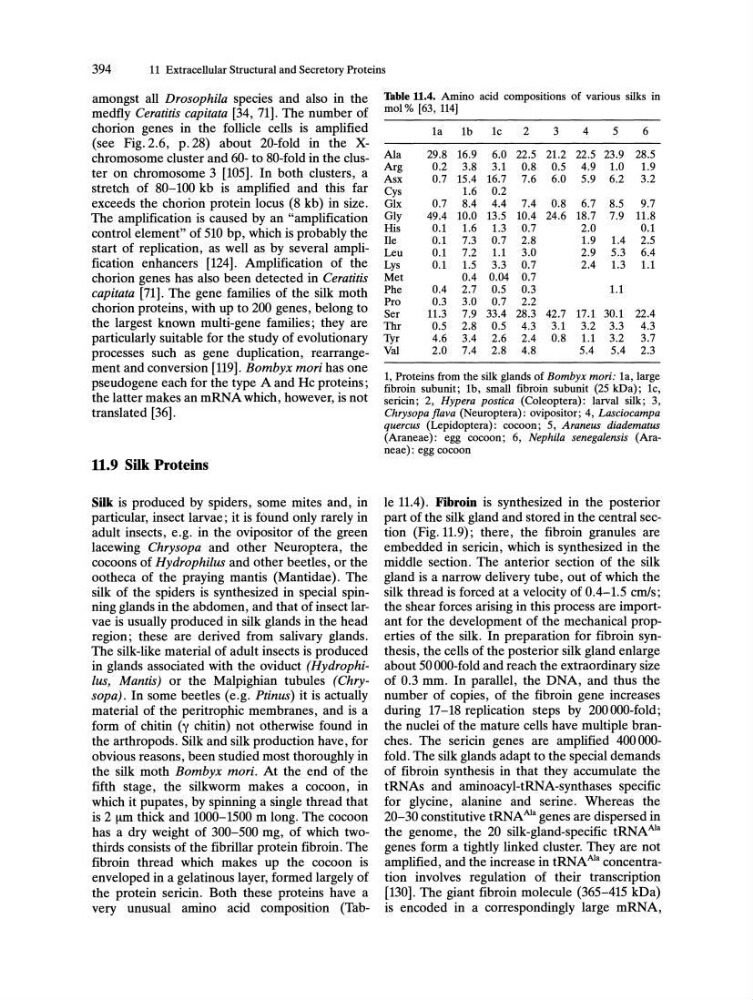
very unusual amino acid composition (TabTable 11.4. Amino acid compositions of various silks in
mol % [63, 114]
1a
1b
1c
2
3
4
5
6
Ala
29.8 16.9 6.0 22.5 21.2 22.5 23.9 28.5
Arg
0.2 3.8 3.1 0.8 0.5 4.9 1.0
1.9
Asx
0.7 15.4 16.7 7.6 6.0 5.9 6.2
3.2
Cys
1.6 0.2
Glx
0.7 8.4 4.4 7.4 0.8 6.7 8.5
9.7
Gly
49.4 10.0 13.5 10.4 24.6 18.7 7.9 11.8
His
0.1 1.6 1.3 0.7
2.0
0.1
lie
0.1 7.3 0.7 2.8
1.9 1.4 2.5
Leu
0.1 7.2 1.1 3.0
2.9 5.3 6.4
Lys
0.1 1.5 3.3 0.7
2.4 1.3 1.1
Met
0.4 0.04 0.7
Phe
0.4 2.7 0.5 0.3
1.1
Pro
0.3 3.0 0.7 2.2
Ser
11.3 7.9 33.4 28.3 42.7 17.1 30.1 22.4
Thr
0.5 2.8 0.5 4.3 3.1 3.2 3.3
4.3
Tyr
4.6 3.4 2.6 2.4 0.8 1.1 3.2
3.7
Val
2.0 7.4 2.8 4.8
5.4 5.4 2.3
1, Proteins from the silk glands of Bombyx mori: la, large
fibroin subunit; 1b, small fibroin subunit (25 kDa); 1c,
sericin; 2, Hypera postica (Coleoptera): larval silk; 3,
Chrysopa [lava (Neuroptera): ovipositor; 4, Lasciocampa
quercus (Lepidoptera): cocoon; 5, Araneus diadematus
(Araneae): egg cocoon; 6, Nephila senegalensis (Araneae): egg cocoon
Ie 11.4). Fibroin is synthesized in the posterior
part of the silk gland and stored in the central section (Fig. 11.9); there, the fibroin granules are
embedded in sericin, which is synthesized in the
middle section. The anterior section of the silk
gland is a narrow delivery tube, out of which the
silk thread is forced at a velocity of 0.4-1.5 cmls;
the shear forces arising in this process are important for the development of the mechanical properties of the silk. In preparation for fibroin synthesis, the cells of the posterior silk gland enlarge
about 50 OOO-foid and reach the extraordinary size
of 0.3 mm. In parallel, the DNA, and thus the
number of copies, of the fibroin gene increases
during 17-18 replication steps by 200 OOO-fold;
the nuclei of the mature cells have multiple branches. The sericin genes are amplified 400000fold. The silk glands adapt to the special demands
of fibroin synthesis in that they accumulate the
tRNAs and aminoacyl-tRNA-synthases specific
for glycine, alanine and serine. Whereas the
20-30 constitutive tRNA Ala genes are dispersed in
the genome, the 20 silk-gland-specific tRNA Ala
genes form a tightly linked cluster. They are not
amplified, and the increase in tRNA Ala concentration involves regulation of their transcription
[130]. The giant fibroin molecule (365-415 kDa)
is encoded in a correspondingly large mRNA,
11 Extracellular Structural and Secretory Proteins
amongst all Drosophila species and also in the
medfly Ceratitis capitata [34, 71]. The number of
chorion genes in the follicle cells is amplified
(see Fig. 2.6, p.28) about 20-fold in the Xchromosome cluster and 60- to 80-fold in the cluster on chromosome 3 [105]. In both clusters, a
stretch of 80-100 kb is amplified and this far
exceeds the chorion protein locus (8 kb) in size.
The amplification is caused by an "amplification
control element" of 510 bp, which is probably the
start of replication, as well as by several amplification enhancers [124]. Amplification of the
chorion genes has also been detected in Ceratitis
capitata [71]. The gene families of the silk moth
chorion proteins, with up to 200 genes, belong to
the largest known multi-gene families; they are
particularly suitable for the study of evolutionary
processes such as gene duplication, rearrangement and conversion [119]. Bombyx mori has one
pseudogene each for the type A and Hc proteins;
the latter makes an mRNA which, however, is not
translated [36].
11.9 Silk Proteins
Silk is produced by spiders, some mites and, in
particular, insect larvae; it is found only rarely in
adult insects, e.g. in the ovipositor of the green
lacewing Chrysopa and other Neuroptera, the
cocoons of Hydrophilus and other beetles, or the
ootheca of the praying mantis (Mantidae). The
silk of the spiders is synthesized in special spinning glands in the abdomen, and that of insect larvae is usually produced in silk glands in the head
region; these are derived from salivary glands.
The silk-like material of adult insects is produced
in glands associated with the oviduct (HydrophiIus, Mantis) or the Malpighian tubules (Chrysopa). In some beetles (e.g. Ptinus) it is actually
material of the peritrophic membranes, and is a
form of chitin (y chitin) not otherwise found in
the arthropods. Silk and silk production have, for
obvious reasons, been studied most thoroqghly in
the silk moth Bombyx mori. At the end of the
fifth stage, the silkworm makes a cocoon, in
which it pupates, by spinning a single thread that
is 2 !Lm thick and 1000-1500 m long. The cocoon
has a dry weight of 300-500 mg, of which twothirds consists of the fibrillar protein fibroin. The
fibroin thread which makes up the cocoon is
enveloped in a gelatinous layer, formed largely of
the protein sericin. Both these proteins have a
very unusual amino acid composition (TabTable 11.4. Amino acid compositions of various silks in
mol % [63, 114]
1a
1b
1c
2
3
4
5
6
Ala
29.8 16.9 6.0 22.5 21.2 22.5 23.9 28.5
Arg
0.2 3.8 3.1 0.8 0.5 4.9 1.0
1.9
Asx
0.7 15.4 16.7 7.6 6.0 5.9 6.2
3.2
Cys
1.6 0.2
Glx
0.7 8.4 4.4 7.4 0.8 6.7 8.5
9.7
Gly
49.4 10.0 13.5 10.4 24.6 18.7 7.9 11.8
His
0.1 1.6 1.3 0.7
2.0
0.1
lie
0.1 7.3 0.7 2.8
1.9 1.4 2.5
Leu
0.1 7.2 1.1 3.0
2.9 5.3 6.4
Lys
0.1 1.5 3.3 0.7
2.4 1.3 1.1
Met
0.4 0.04 0.7
Phe
0.4 2.7 0.5 0.3
1.1
Pro
0.3 3.0 0.7 2.2
Ser
11.3 7.9 33.4 28.3 42.7 17.1 30.1 22.4
Thr
0.5 2.8 0.5 4.3 3.1 3.2 3.3
4.3
Tyr
4.6 3.4 2.6 2.4 0.8 1.1 3.2
3.7
Val
2.0 7.4 2.8 4.8
5.4 5.4 2.3
1, Proteins from the silk glands of Bombyx mori: la, large
fibroin subunit; 1b, small fibroin subunit (25 kDa); 1c,
sericin; 2, Hypera postica (Coleoptera): larval silk; 3,
Chrysopa [lava (Neuroptera): ovipositor; 4, Lasciocampa
quercus (Lepidoptera): cocoon; 5, Araneus diadematus
(Araneae): egg cocoon; 6, Nephila senegalensis (Araneae): egg cocoon
Ie 11.4). Fibroin is synthesized in the posterior
part of the silk gland and stored in the central section (Fig. 11.9); there, the fibroin granules are
embedded in sericin, which is synthesized in the
middle section. The anterior section of the silk
gland is a narrow delivery tube, out of which the
silk thread is forced at a velocity of 0.4-1.5 cmls;
the shear forces arising in this process are important for the development of the mechanical properties of the silk. In preparation for fibroin synthesis, the cells of the posterior silk gland enlarge
about 50 OOO-foid and reach the extraordinary size
of 0.3 mm. In parallel, the DNA, and thus the
number of copies, of the fibroin gene increases
during 17-18 replication steps by 200 OOO-fold;
the nuclei of the mature cells have multiple branches. The sericin genes are amplified 400000fold. The silk glands adapt to the special demands
of fibroin synthesis in that they accumulate the
tRNAs and aminoacyl-tRNA-synthases specific
for glycine, alanine and serine. Whereas the
20-30 constitutive tRNA Ala genes are dispersed in
the genome, the 20 silk-gland-specific tRNA Ala
genes form a tightly linked cluster. They are not
amplified, and the increase in tRNA Ala concentration involves regulation of their transcription
[130]. The giant fibroin molecule (365-415 kDa)
is encoded in a correspondingly large mRNA,