

=I ~II~t~
3' •
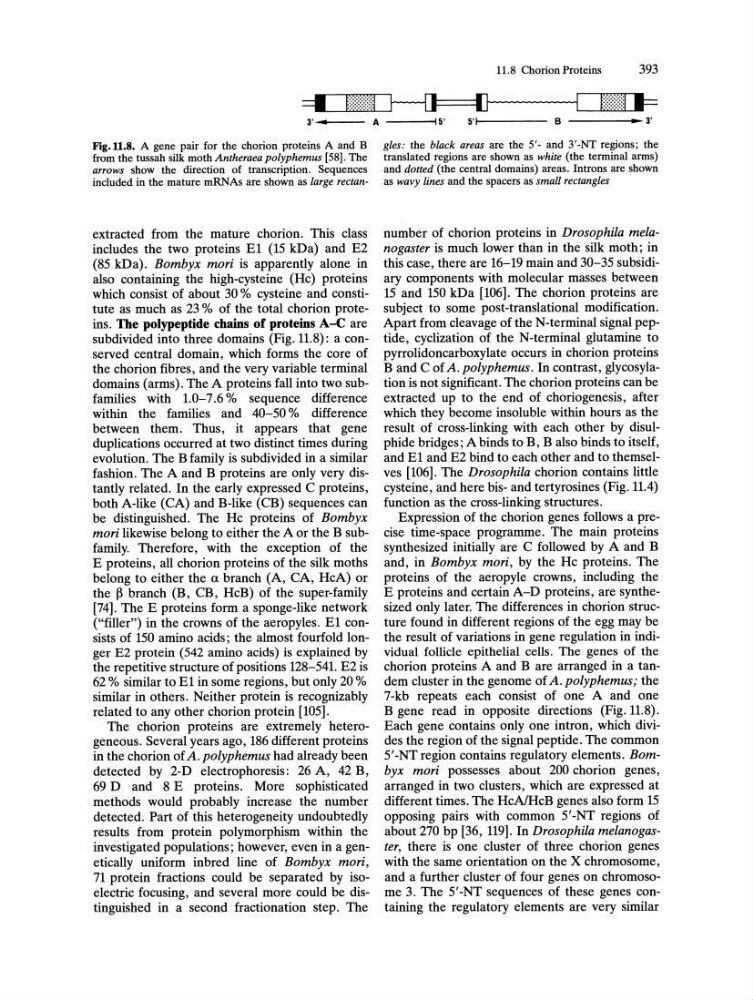
Fig.U.S. A gene pair for the chorion proteins A and B
from the tussah silk moth Antheraea polyphemus [58]. The
arrows show the direction of transcription. Sequences
included in the mature mRNAs are shown as large rectanextracted from the mature chorion. This class
includes the two proteins E1 (15 kDa) and E2
(85 kDa). Bombyx mori is apparently alone in
also containing the high-cysteine (Hc) proteins
which consist of about 30 % cysteine and constitute as much as 23 % of the total chorion proteins. The polypeptide chains of proteins A-C are
subdivided into three domains (Fig. 11.8): a conserved central domain, which forms the core of
the chorion fibres, and the very variable terminal
domains (arms). The A proteins fall into two subfamilies with 1.0-7.6 % sequence difference
within the families and 40-50 % difference
between them. Thus, it appears that gene
duplications occurred at two distinct times during
evolution. The B family is subdivided in a similar
fashion. The A and B proteins are only very distantly related. In the early expressed C proteins,
both A-like (CA) and B-like (CB) sequences can
be distinguished. The Hc proteins of Bombyx
mori likewise belong to either the A or the B subfamily. Therefore, with the exception of the
E proteins, all chorion proteins of the silk moths
belong to either the a branch (A, CA, HcA) or
the ~ branch (B, CB, HcB) of the super-family
[74]. The E proteins form a sponge-like network
("filler") in the crowns of the aeropyles. E1 consists of 150 amino acids; the almost fourfold longer E2 protein (542 amino acids) is explained by
the repetitive structure of positions 128-541. E2 is
62 % similar to E1 in some regions, but only 20 %
similar in others. Neither protein is recognizably
related to any other chorion protein [105].
The chorion proteins are extremely heterogeneous. Several years ago, 186 different proteins
in the chorion of A. polyphemus had already been
detected by 2-D electrophoresis: 26 A, 42 B,
69 D and 8 E proteins. More sophisticated
methods would probably increase the number
detected. Part of this heterogeneity undoubtedly
results from protein polymorphism within the
investigated popUlations; however, even in a genetically uniform inbred line of Bombyx mori,
n protein fractions could be separated by isoelectric focusing, and several more could be distinguished in a second fractionation step. The
A
11.8 Chorion Proteins
393
r----{)
I}
15'
5" ~----B
• 3'
gles: the black areas are the 5'- and 3'-NT regions; the
translated regions are shown as white (the terminal arms)
and dotted (the central domains) areas. Introns are shown
as wavy lines and the spacers as small rectangles
number of chorion proteins in Drosophila melanogaster is much lower than in the silk moth; in
this case, there are 16-19 main and 30-35 subsidiary components with molecular masses between
15 and 150 kDa [106]. The chorion proteins are
subject to some post-translational modification.
Apart from cleavage of the N-terminal signal peptide, cyclization of the N-terminal glutamine to
pyrrolidoncarboxylate occurs in chorion proteins
Band C of A. polyphemus. In contrast, glycosylation is not significant. The chorion proteins can be
extracted up to the end of choriogenesis, after
which they become insoluble within hours as the
result of cross-linking with each other by disulphide bridges; A binds to B, B also binds to itself,
and E1 and E2 bind to each other and to themselves [106]. The Drosophila chorion contains little
cysteine, and here bis- and tertyrosines (Fig. 11.4)
function as the cross-linking structures.
Expression of the chorion genes follows a precise time-space programme. The main proteins
synthesized initially are C followed by A and B
and, in Bombyx mori, by the Hc proteins. The
proteins of the aeropyle crowns, including the
E proteins and certain A-D proteins, are synthesized only later. The differences in chorion structure found in different regions of the egg may be
the result of variations in gene regulation in individual follicle epithelial cells. The genes of the
chorion proteins A and B are arranged in a tandem cluster in the genome of A. polyphemus; the
7-kb repeats each consist of one A and one
B gene read in opposite directions (Fig. 11.8).
Each gene contains only one intron, which divides the region of the signal peptide. The common
5'-NT region contains regulatory elements. Bombyx mori possesses about 200 chorion genes,
arranged in two clusters, which are expressed at
different times. The HcAlHcB genes also form 15
opposing pairs with common 5 I_NT regions of
about 270 bp [36, 119]. In Drosophila melanogaster, there is one cluster of three chorion genes
with the same orientation on the X chromosome,
and a further cluster of four genes on chromosome 3. The 5'-NT sequences of these genes containing the regulatory elements are very similar
3' •
Fig.U.S. A gene pair for the chorion proteins A and B
from the tussah silk moth Antheraea polyphemus [58]. The
arrows show the direction of transcription. Sequences
included in the mature mRNAs are shown as large rectanextracted from the mature chorion. This class
includes the two proteins E1 (15 kDa) and E2
(85 kDa). Bombyx mori is apparently alone in
also containing the high-cysteine (Hc) proteins
which consist of about 30 % cysteine and constitute as much as 23 % of the total chorion proteins. The polypeptide chains of proteins A-C are
subdivided into three domains (Fig. 11.8): a conserved central domain, which forms the core of
the chorion fibres, and the very variable terminal
domains (arms). The A proteins fall into two subfamilies with 1.0-7.6 % sequence difference
within the families and 40-50 % difference
between them. Thus, it appears that gene
duplications occurred at two distinct times during
evolution. The B family is subdivided in a similar
fashion. The A and B proteins are only very distantly related. In the early expressed C proteins,
both A-like (CA) and B-like (CB) sequences can
be distinguished. The Hc proteins of Bombyx
mori likewise belong to either the A or the B subfamily. Therefore, with the exception of the
E proteins, all chorion proteins of the silk moths
belong to either the a branch (A, CA, HcA) or
the ~ branch (B, CB, HcB) of the super-family
[74]. The E proteins form a sponge-like network
("filler") in the crowns of the aeropyles. E1 consists of 150 amino acids; the almost fourfold longer E2 protein (542 amino acids) is explained by
the repetitive structure of positions 128-541. E2 is
62 % similar to E1 in some regions, but only 20 %
similar in others. Neither protein is recognizably
related to any other chorion protein [105].
The chorion proteins are extremely heterogeneous. Several years ago, 186 different proteins
in the chorion of A. polyphemus had already been
detected by 2-D electrophoresis: 26 A, 42 B,
69 D and 8 E proteins. More sophisticated
methods would probably increase the number
detected. Part of this heterogeneity undoubtedly
results from protein polymorphism within the
investigated popUlations; however, even in a genetically uniform inbred line of Bombyx mori,
n protein fractions could be separated by isoelectric focusing, and several more could be distinguished in a second fractionation step. The
A
11.8 Chorion Proteins
393
r----{)
I}
15'
5" ~----B
• 3'
gles: the black areas are the 5'- and 3'-NT regions; the
translated regions are shown as white (the terminal arms)
and dotted (the central domains) areas. Introns are shown
as wavy lines and the spacers as small rectangles
number of chorion proteins in Drosophila melanogaster is much lower than in the silk moth; in
this case, there are 16-19 main and 30-35 subsidiary components with molecular masses between
15 and 150 kDa [106]. The chorion proteins are
subject to some post-translational modification.
Apart from cleavage of the N-terminal signal peptide, cyclization of the N-terminal glutamine to
pyrrolidoncarboxylate occurs in chorion proteins
Band C of A. polyphemus. In contrast, glycosylation is not significant. The chorion proteins can be
extracted up to the end of choriogenesis, after
which they become insoluble within hours as the
result of cross-linking with each other by disulphide bridges; A binds to B, B also binds to itself,
and E1 and E2 bind to each other and to themselves [106]. The Drosophila chorion contains little
cysteine, and here bis- and tertyrosines (Fig. 11.4)
function as the cross-linking structures.
Expression of the chorion genes follows a precise time-space programme. The main proteins
synthesized initially are C followed by A and B
and, in Bombyx mori, by the Hc proteins. The
proteins of the aeropyle crowns, including the
E proteins and certain A-D proteins, are synthesized only later. The differences in chorion structure found in different regions of the egg may be
the result of variations in gene regulation in individual follicle epithelial cells. The genes of the
chorion proteins A and B are arranged in a tandem cluster in the genome of A. polyphemus; the
7-kb repeats each consist of one A and one
B gene read in opposite directions (Fig. 11.8).
Each gene contains only one intron, which divides the region of the signal peptide. The common
5'-NT region contains regulatory elements. Bombyx mori possesses about 200 chorion genes,
arranged in two clusters, which are expressed at
different times. The HcAlHcB genes also form 15
opposing pairs with common 5 I_NT regions of
about 270 bp [36, 119]. In Drosophila melanogaster, there is one cluster of three chorion genes
with the same orientation on the X chromosome,
and a further cluster of four genes on chromosome 3. The 5'-NT sequences of these genes containing the regulatory elements are very similar