

362
10 Proteins of Muscle and the Cytoskeleton
The uptake of macromolecules like the epidermal growth factor (EGF), transferrin and asialoglycoproteins into the cell by receptor-mediated
endocytosis is an extraordinarily intensive process;
a membrane area equivalent to that of the whole
cell is taken up within 30 min. The resulting transport vesicles (coated vesicles) have a protein
envelope which is preformed in the coated pits of
the plasma membrane. This envelope is made up
of a characteristic, outer layer of dathrin, which is
polyhedric in structure, and an inner layer of
assembly proteins (17-100 kDa), which form complexes of 250-300 kDa. Quite surprisingly, one of
the assembly proteins, B-adaptin (100 kDa), is
identical throughout its whole 937-amino-acid
sequence in man, the rat and cattle [133,225]. The
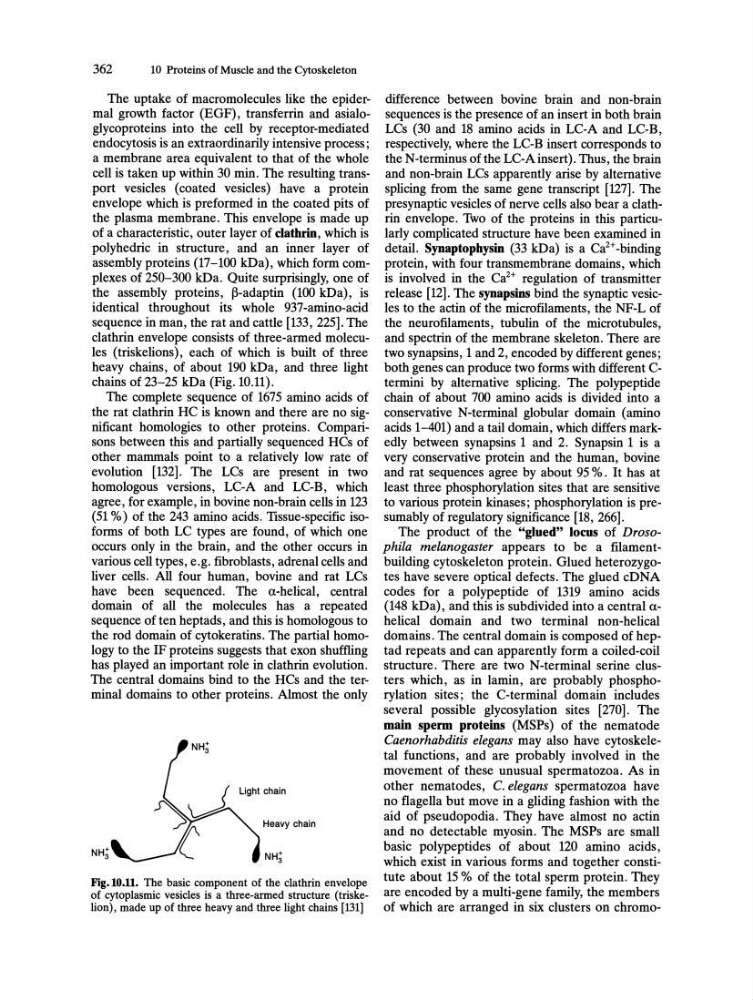
clathrin envelope consists of three-armed molecules (triskelions), each of which is built of three
heavy chains, of about 190 kDa, and three light
chains of 23-25 kDa (Fig. 10.11).
The complete sequence of 1675 amino acids of
the rat clathrin HC is known and there are no significant homologies to other proteins. Comparisons between this and partially sequenced HCs of
other mammals point to a relatively low rate of
evolution [132]. The LCs are present in two
homologous versions, LC-A and LC-B, which
agree, for example, in bovine non-brain cells in 123
(51 %) of the 243 amino acids. TIssue-specific isoforms of both LC types are found, of which one
occurs only in the brain, and the other occurs in
various cell types, e.g. fibroblasts, adrenal cells and
liver cells. All four human, bovine and rat LCs
have been sequenced. The a-helical, central
domain of all the molecules has a repeated
sequence often heptads, and this is homologous to
the rod domain of cytokeratins. The partial homology to the IF proteins suggests that exon shuffling
has played an important role in clathrin evolution.
The central domains bind to the HCs and the terminal domains to other proteins. Almost the only
Light chain
Heavy chain
Fig.lO.n. The basic component of the clathrin envelope
of cytoplasmic vesicles is a three-armed structure (triskelion), made up of three heavy and three light chains [131]
difference between bovine brain and non-brain
sequences is the presence of an insert in both brain
LCs (30 and 18 amino acids in LC-A and LC-B,
respectively, where the LC-B insert corresponds to
the N-terminus ofthe LC-Ainsert). Thus, the brain
and non-brain LCs apparently arise by alternative
splicing from the same gene transcript [127]. The
presynaptic vesicles of nerve cells also bear a clathrin envelope. Two of the proteins in this particularly complicated structure have been examined in
detail. Synaptophysin (33 kDa) is a Ca 2 + -binding
protein, with four transmembrane domains, which
is involved in the Ca2+ regulation of transmitter
release [12]. The synapsins bind the synaptic vesicles to the actin of the microfilaments, the NF-L of
the neurofilaments, tubulin of the microtubules,
and spectrin of the membrane skeleton. There are
two synapsins, 1 and 2, encoded by different genes;
both genes can produce two forms with different Ctermini by alternative splicing. The polypeptide
chain of about 700 amino acids is divided into a
conservative N-terminal globular domain (amino
acids 1-401) and a tail domain, which differs markedly between synapsins 1 and 2. Synapsin 1 is a
very conservative protein and the human, bovine
and rat sequences agree by about 95 %. It has at
least three phosphorylation sites that are sensitive
to various protein kinases; phosphorylation is presumably of regulatory significance [18, 266].
The product of the "glued" locus of Drosophila melanogaster appears to be a filamentbuilding cytoskeleton protein. Glued heterozygotes have severe optical defects. The glued cDNA
codes for a polypeptide of 1319 amino acids
(148 kDa), and this is subdivided into a central ahelical domain and two terminal non-helical
domains. The central domain is composed of heptad repeats and can apparently form a coiled-coil
structure. There are two N-terminal serine clusters which, as in lamin, are probably phosphorylation sites; the C-terminal domain includes
several possible glycosylation sites [270]. The
main sperm proteins (MSPs) of the nematode
Caenorhabditis elegans may also have cytoskeletal functions, and are probably involved in the
movement of these unusual spermatozoa. As in
other nematodes, C. elegans spermatozoa have
no flagella but move in a gliding fashion with the
aid of pseudopodia. They have almost no actin
and no detectable myosin. The MSPs are small
basic polypeptides of about 120 amino acids,
which exist in various forms and together constitute about 15 % of the total sperm protein. They
are encoded by a multi-gene family, the members
of which are arranged in six clusters on chromo-
10 Proteins of Muscle and the Cytoskeleton
The uptake of macromolecules like the epidermal growth factor (EGF), transferrin and asialoglycoproteins into the cell by receptor-mediated
endocytosis is an extraordinarily intensive process;
a membrane area equivalent to that of the whole
cell is taken up within 30 min. The resulting transport vesicles (coated vesicles) have a protein
envelope which is preformed in the coated pits of
the plasma membrane. This envelope is made up
of a characteristic, outer layer of dathrin, which is
polyhedric in structure, and an inner layer of
assembly proteins (17-100 kDa), which form complexes of 250-300 kDa. Quite surprisingly, one of
the assembly proteins, B-adaptin (100 kDa), is
identical throughout its whole 937-amino-acid
sequence in man, the rat and cattle [133,225]. The
clathrin envelope consists of three-armed molecules (triskelions), each of which is built of three
heavy chains, of about 190 kDa, and three light
chains of 23-25 kDa (Fig. 10.11).
The complete sequence of 1675 amino acids of
the rat clathrin HC is known and there are no significant homologies to other proteins. Comparisons between this and partially sequenced HCs of
other mammals point to a relatively low rate of
evolution [132]. The LCs are present in two
homologous versions, LC-A and LC-B, which
agree, for example, in bovine non-brain cells in 123
(51 %) of the 243 amino acids. TIssue-specific isoforms of both LC types are found, of which one
occurs only in the brain, and the other occurs in
various cell types, e.g. fibroblasts, adrenal cells and
liver cells. All four human, bovine and rat LCs
have been sequenced. The a-helical, central
domain of all the molecules has a repeated
sequence often heptads, and this is homologous to
the rod domain of cytokeratins. The partial homology to the IF proteins suggests that exon shuffling
has played an important role in clathrin evolution.
The central domains bind to the HCs and the terminal domains to other proteins. Almost the only
Light chain
Heavy chain
Fig.lO.n. The basic component of the clathrin envelope
of cytoplasmic vesicles is a three-armed structure (triskelion), made up of three heavy and three light chains [131]
difference between bovine brain and non-brain
sequences is the presence of an insert in both brain
LCs (30 and 18 amino acids in LC-A and LC-B,
respectively, where the LC-B insert corresponds to
the N-terminus ofthe LC-Ainsert). Thus, the brain
and non-brain LCs apparently arise by alternative
splicing from the same gene transcript [127]. The
presynaptic vesicles of nerve cells also bear a clathrin envelope. Two of the proteins in this particularly complicated structure have been examined in
detail. Synaptophysin (33 kDa) is a Ca 2 + -binding
protein, with four transmembrane domains, which
is involved in the Ca2+ regulation of transmitter
release [12]. The synapsins bind the synaptic vesicles to the actin of the microfilaments, the NF-L of
the neurofilaments, tubulin of the microtubules,
and spectrin of the membrane skeleton. There are
two synapsins, 1 and 2, encoded by different genes;
both genes can produce two forms with different Ctermini by alternative splicing. The polypeptide
chain of about 700 amino acids is divided into a
conservative N-terminal globular domain (amino
acids 1-401) and a tail domain, which differs markedly between synapsins 1 and 2. Synapsin 1 is a
very conservative protein and the human, bovine
and rat sequences agree by about 95 %. It has at
least three phosphorylation sites that are sensitive
to various protein kinases; phosphorylation is presumably of regulatory significance [18, 266].
The product of the "glued" locus of Drosophila melanogaster appears to be a filamentbuilding cytoskeleton protein. Glued heterozygotes have severe optical defects. The glued cDNA
codes for a polypeptide of 1319 amino acids
(148 kDa), and this is subdivided into a central ahelical domain and two terminal non-helical
domains. The central domain is composed of heptad repeats and can apparently form a coiled-coil
structure. There are two N-terminal serine clusters which, as in lamin, are probably phosphorylation sites; the C-terminal domain includes
several possible glycosylation sites [270]. The
main sperm proteins (MSPs) of the nematode
Caenorhabditis elegans may also have cytoskeletal functions, and are probably involved in the
movement of these unusual spermatozoa. As in
other nematodes, C. elegans spermatozoa have
no flagella but move in a gliding fashion with the
aid of pseudopodia. They have almost no actin
and no detectable myosin. The MSPs are small
basic polypeptides of about 120 amino acids,
which exist in various forms and together constitute about 15 % of the total sperm protein. They
are encoded by a multi-gene family, the members
of which are arranged in six clusters on chromo-