

somes II and IV, but are coordinately expressed.
There are several pseudo genes in the family but
at least 37 genes are transcribed. The proteins are
synthesized in the primary spermatocytes and
aggregate to form a fibrillar cell organelle; they
break up again into monomers in the spermatids
and reaggregate to form the fibrils of the pseudopodium in the mature spermatozoon [297].
10.12 Lens Proteins (Crystallins)
The lens of the vertebrate eye is the most proteinrich organ of the body; the dry weight is almost
exclusively that of the constituent proteins and
the protein content may reach 50 % of the fresh
weight. The refractive index of the lens increases
with increasing protein content, but the deformability is reduced. Avian eye lenses with their particularly wide accommodation spectrum have the
lowest protein concentration of about 20 % .
Because of the optical characteristics of water,
fish eyes require lenses of extremely high refractive index and therefore have protein concentrations of about 50 %; this means, however, that
adjustments to distance cannot be achieved by
deformation but only by moving the lens. The
lenses of mammalian eyes have medium protein
concentrations of 30-40 %. More than 90 % of
lens protein is accounted for by crystallins. In the
vertebrates these are restricted to the eye, where
they also occur in small amounts in tissues other
than the lens.
Lenses are built up from cellular lens fibres,
derived from a layer of epithelial cells on the
anterior surface of the lens. Newly synthesized
fibres are laid down on the preceding fibres so
that a concentric layering occurs with the oldest
fibres in the centre. As there is no turnover of
cells and proteins in the lens, the proteins in the
oldest fibres are already synthesized in the
embryo. Crystallins are thus the vertebrate proteins with the longest life and are, therefore, excellent objects for the study of ageing processes. The
solubility of the lens proteins declines with age;
the lens of a child of 10 years contains only 3 %
insoluble protein compared with 40 % in the lens
of an 80-year-old person. The insoluble proportion may increase pathologically (cataract) to
70 %, the main cause being increased crosslinking due to the formation of disulphide bridges
and other, as yet unknown, cross-linking structures; contrary to previous hypotheses, bistyrosine
is not involved. Further age-dependent changes
10.12 Lens Proteins (Crystallins)
363
in crystallins are the deamidation of specific asparagines and glutamines [295], and chain cleavage
close to the C-terminus. Racemization of aspartate residues to the D-isomer also occurs in crystallins; the rate of this change is 0.14 % per year and
cannot therefore be detected in proteins with a
higher turnover rate. The main cause of all these
alterations is probably light-induced oxidation.
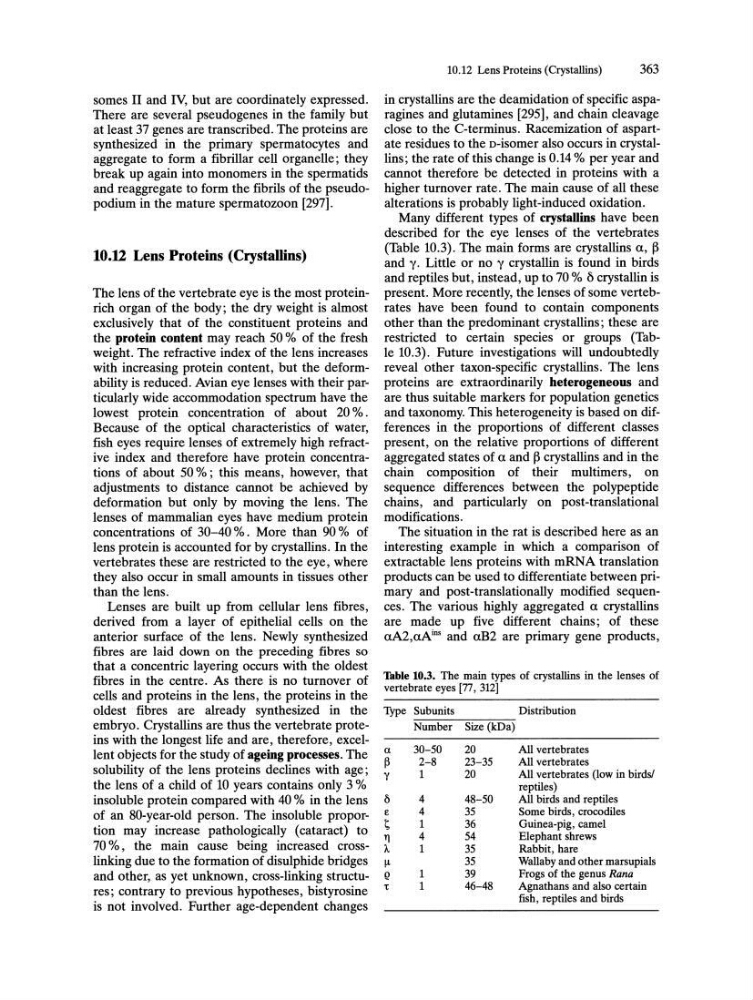
Many different types of crystaUins have been
described for the eye lenses of the vertebrates
(Table 10.3). The main forms are crystallins a, ~
and y. Little or no y crystallin is found in birds
and reptiles but, instead, up to 70 % 6 crystallin is
present. More recently, the lenses of some vertebrates have been found to contain components
other than the predominant crystallins; these are
restricted to certain species or groups (Table 10.3). Future investigations will undoubtedly
reveal other taxon-specific crystallins. The lens
proteins are extraordinarily heterogeneous and
are thus suitable markers for population genetics
and taxonomy. This heterogeneity is based on differences in the proportions of different classes
present, on the relative proportions of different
aggregated states of a and ~ crystallins and in the
chain composition of their multimers, on
sequence differences between the polypeptide
chains, and particularly on post-translational
modifications.
The situation in the rat is described here as an
interesting example in which a comparison of
extractable lens proteins with mRNA translation
products can be used to differentiate between primary and post-translationally modified sequences. The various highly aggregated a crystallins
are made up five different chains; of these
aA2,aA ins and aB2 are primary gene products,
Table 10.3. The main types of crystallins in the lenses of
vertebrate eyes [77, 312]
Type Subunits
Distribution
Number Size (kDa)
a
30-50
20
All vertebrates
~
2-8
23-35
All vertebrates
y
1
20
All vertebrates (low in birds!
reptiles)
{)
4
48-50
All birds and reptiles
E
4
35
Some birds, crocodiles
~
1
36
Guinea-pig, camel
'I']
4
54
Elephant shrews
A.
1
35
Rabbit, hare
11
35
Wallaby and other marsupials
Q
1
39
Frogs of the genus Rana
t
1
46-48
Agnathans and also certain
fish, reptiles and birds
There are several pseudo genes in the family but
at least 37 genes are transcribed. The proteins are
synthesized in the primary spermatocytes and
aggregate to form a fibrillar cell organelle; they
break up again into monomers in the spermatids
and reaggregate to form the fibrils of the pseudopodium in the mature spermatozoon [297].
10.12 Lens Proteins (Crystallins)
The lens of the vertebrate eye is the most proteinrich organ of the body; the dry weight is almost
exclusively that of the constituent proteins and
the protein content may reach 50 % of the fresh
weight. The refractive index of the lens increases
with increasing protein content, but the deformability is reduced. Avian eye lenses with their particularly wide accommodation spectrum have the
lowest protein concentration of about 20 % .
Because of the optical characteristics of water,
fish eyes require lenses of extremely high refractive index and therefore have protein concentrations of about 50 %; this means, however, that
adjustments to distance cannot be achieved by
deformation but only by moving the lens. The
lenses of mammalian eyes have medium protein
concentrations of 30-40 %. More than 90 % of
lens protein is accounted for by crystallins. In the
vertebrates these are restricted to the eye, where
they also occur in small amounts in tissues other
than the lens.
Lenses are built up from cellular lens fibres,
derived from a layer of epithelial cells on the
anterior surface of the lens. Newly synthesized
fibres are laid down on the preceding fibres so
that a concentric layering occurs with the oldest
fibres in the centre. As there is no turnover of
cells and proteins in the lens, the proteins in the
oldest fibres are already synthesized in the
embryo. Crystallins are thus the vertebrate proteins with the longest life and are, therefore, excellent objects for the study of ageing processes. The
solubility of the lens proteins declines with age;
the lens of a child of 10 years contains only 3 %
insoluble protein compared with 40 % in the lens
of an 80-year-old person. The insoluble proportion may increase pathologically (cataract) to
70 %, the main cause being increased crosslinking due to the formation of disulphide bridges
and other, as yet unknown, cross-linking structures; contrary to previous hypotheses, bistyrosine
is not involved. Further age-dependent changes
10.12 Lens Proteins (Crystallins)
363
in crystallins are the deamidation of specific asparagines and glutamines [295], and chain cleavage
close to the C-terminus. Racemization of aspartate residues to the D-isomer also occurs in crystallins; the rate of this change is 0.14 % per year and
cannot therefore be detected in proteins with a
higher turnover rate. The main cause of all these
alterations is probably light-induced oxidation.
Many different types of crystaUins have been
described for the eye lenses of the vertebrates
(Table 10.3). The main forms are crystallins a, ~
and y. Little or no y crystallin is found in birds
and reptiles but, instead, up to 70 % 6 crystallin is
present. More recently, the lenses of some vertebrates have been found to contain components
other than the predominant crystallins; these are
restricted to certain species or groups (Table 10.3). Future investigations will undoubtedly
reveal other taxon-specific crystallins. The lens
proteins are extraordinarily heterogeneous and
are thus suitable markers for population genetics
and taxonomy. This heterogeneity is based on differences in the proportions of different classes
present, on the relative proportions of different
aggregated states of a and ~ crystallins and in the
chain composition of their multimers, on
sequence differences between the polypeptide
chains, and particularly on post-translational
modifications.
The situation in the rat is described here as an
interesting example in which a comparison of
extractable lens proteins with mRNA translation
products can be used to differentiate between primary and post-translationally modified sequences. The various highly aggregated a crystallins
are made up five different chains; of these
aA2,aA ins and aB2 are primary gene products,
Table 10.3. The main types of crystallins in the lenses of
vertebrate eyes [77, 312]
Type Subunits
Distribution
Number Size (kDa)
a
30-50
20
All vertebrates
~
2-8
23-35
All vertebrates
y
1
20
All vertebrates (low in birds!
reptiles)
{)
4
48-50
All birds and reptiles
E
4
35
Some birds, crocodiles
~
1
36
Guinea-pig, camel
'I']
4
54
Elephant shrews
A.
1
35
Rabbit, hare
11
35
Wallaby and other marsupials
Q
1
39
Frogs of the genus Rana
t
1
46-48
Agnathans and also certain
fish, reptiles and birds