

252
7 Respiratory Pigments
a)
v
o
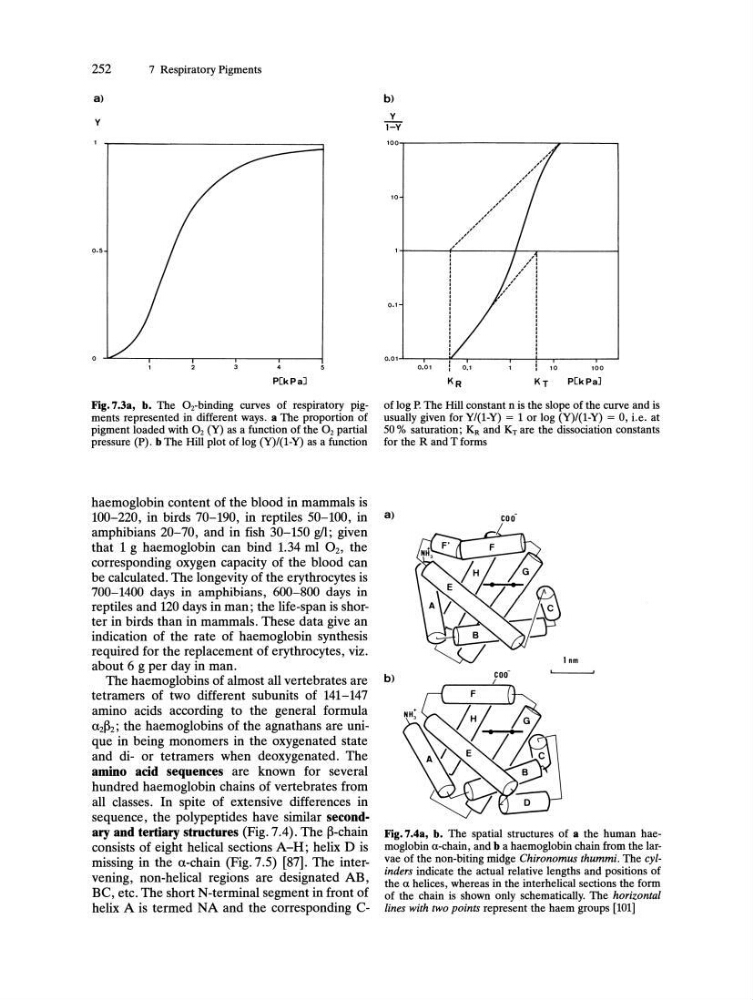
Fig.7.3a, b. The 02-binding curves of respiratory pigments represented in different ways. a The proportion of
pigment loaded with O2 (Y) as a function of the O2 partial
pressure (P). b The Hill plot of log (Y)/(l-Y) as a function
b)
v
I-V
1 0 0 , - - - - - - - - - - - - - r - - - - - - - ,
10
0.1
0.01..L---r----t"---,---r---t-.----~.....J
0.01
0.1
10
100
KT
P[kPa]
of log P. The Hill constant n is the slope of the curve and is
usually given for Y/(l-Y) = 1 or log (Y)/(l-Y) = 0, i.e. at
50 % saturation; KR and KT are the dissociation constants
for the Rand T forms
haemoglobin content of the blood in mammals is
100-220, in birds 70-190, in reptiles 50-100, in a)
amphibians 20-70, and in fish 30-150 gil; given
that 1 g haemoglobin can bind 1.34 ml Oz, the
corresponding oxygen capacity of the blood can
be calculated. The longevity of the erythrocytes is
700-1400 days in amphibians, 600-800 days in
reptiles and 120 days in man; the life-span is shorter in birds than in mammals. These data give an
indication of the rate of haemoglobin synthesis
required for the replacement of erythrocytes, viz.
about 6 g per day in man.
lnm
The haemoglobins of almost all vertebrates are b)
tetramers of two different subunits of 141-147
amino acids according to the general formula
az~z; the haemoglobins of the agnathans are unique in being monomers in the oxygenated state
and di- or tetramers when deoxygenated. The
amino acid sequences are known for several
hundred haemoglobin chains of vertebrates from
all classes. In spite of extensive differences in
sequence, the polypeptides have similar secondary and tertiary structures (Fig. 7.4). The ~-chain
consists of eight helical sections A-H; helix D is
missing in the a-chain (Fig.7.5) [87]. The intervening, non-helical regions are designated AB,
BC, etc. The short N-terminal segment in front of
helix A is termed NA and the corresponding CFig.7.4a, b. The spatial structures of a the human haemoglobin a-chain, and b a haemoglobin chain from the larvae of the non-biting midge Chironomus thummi. The cylinders indicate the actual relative lengths and positions of
the a helices, whereas in the interhelical sections the form
of the chain is shown only schematically. The horizontal
lines with two points represent the haem groups [101]
7 Respiratory Pigments
a)
v
o
Fig.7.3a, b. The 02-binding curves of respiratory pigments represented in different ways. a The proportion of
pigment loaded with O2 (Y) as a function of the O2 partial
pressure (P). b The Hill plot of log (Y)/(l-Y) as a function
b)
v
I-V
1 0 0 , - - - - - - - - - - - - - r - - - - - - - ,
10
0.1
0.01..L---r----t"---,---r---t-.----~.....J
0.01
0.1
10
100
KT
P[kPa]
of log P. The Hill constant n is the slope of the curve and is
usually given for Y/(l-Y) = 1 or log (Y)/(l-Y) = 0, i.e. at
50 % saturation; KR and KT are the dissociation constants
for the Rand T forms
haemoglobin content of the blood in mammals is
100-220, in birds 70-190, in reptiles 50-100, in a)
amphibians 20-70, and in fish 30-150 gil; given
that 1 g haemoglobin can bind 1.34 ml Oz, the
corresponding oxygen capacity of the blood can
be calculated. The longevity of the erythrocytes is
700-1400 days in amphibians, 600-800 days in
reptiles and 120 days in man; the life-span is shorter in birds than in mammals. These data give an
indication of the rate of haemoglobin synthesis
required for the replacement of erythrocytes, viz.
about 6 g per day in man.
lnm
The haemoglobins of almost all vertebrates are b)
tetramers of two different subunits of 141-147
amino acids according to the general formula
az~z; the haemoglobins of the agnathans are unique in being monomers in the oxygenated state
and di- or tetramers when deoxygenated. The
amino acid sequences are known for several
hundred haemoglobin chains of vertebrates from
all classes. In spite of extensive differences in
sequence, the polypeptides have similar secondary and tertiary structures (Fig. 7.4). The ~-chain
consists of eight helical sections A-H; helix D is
missing in the a-chain (Fig.7.5) [87]. The intervening, non-helical regions are designated AB,
BC, etc. The short N-terminal segment in front of
helix A is termed NA and the corresponding CFig.7.4a, b. The spatial structures of a the human haemoglobin a-chain, and b a haemoglobin chain from the larvae of the non-biting midge Chironomus thummi. The cylinders indicate the actual relative lengths and positions of
the a helices, whereas in the interhelical sections the form
of the chain is shown only schematically. The horizontal
lines with two points represent the haem groups [101]