

250
7 Respiratory Pigments
/0
o
Pyrrol
I
Pyrrol
)Feii(
His-194 " /0-0\ / Hls-344
His-198 -Cuii
Cuii-His-348
Pyrrol
I
Pyrrol
/
(A)
(8) "His-224
Hls-384
H"lsF8
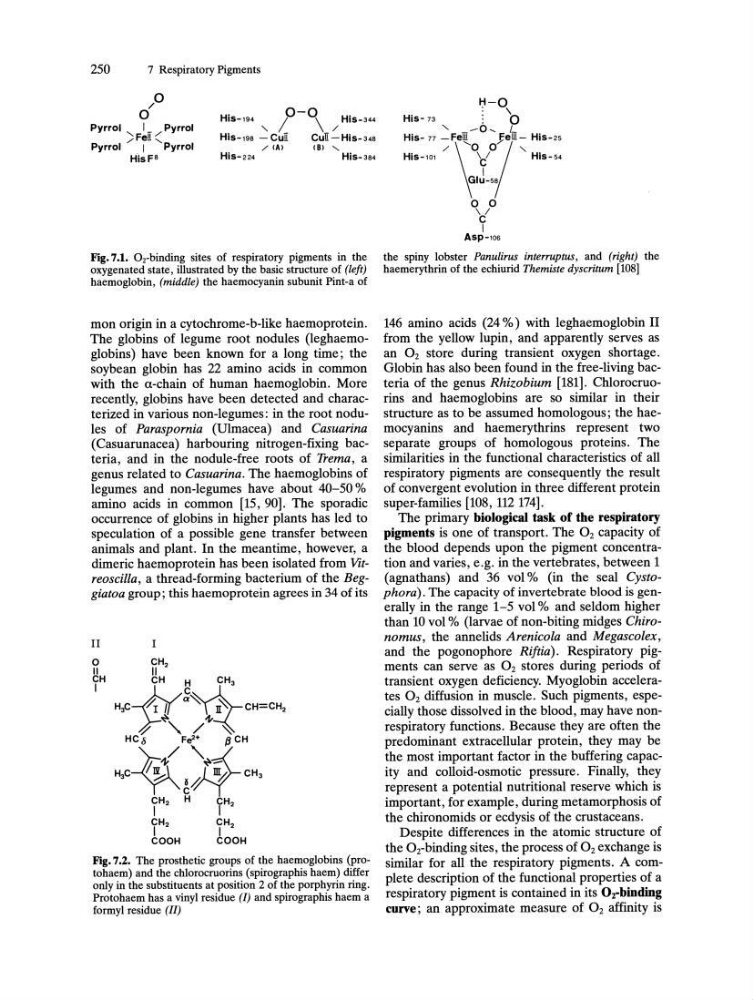
Fig.7.1. 02-binding sites of respiratory pigments in the
oxygenated state, illustrated by the basic structure of (left)
haemoglobin, (middle) the haemocyanin subunit Pint-a of
mon origin in a cytochrome-b-like haemoprotein.
The globins of legume root nodules (leghaemoglobins) have been known for a long time; the
soybean globin has 22 amino acids in common
with the a-chain of human haemoglobin. More
recently, globins have been detected and characterized in various non-legumes: in the root nodules of Paraspornia (Ulmacea) and Casuarina
(Casuarunacea) harbouring nitrogen-fixing bacteria, and in the nodule-free roots of Trema, a
genus related to Casuarina. The haemoglobins of
legumes and non-legumes have about 40-50 %
amino acids in common [15, 90]. The sporadic
occurrence of globins in higher plants has led to
speculation of a possible gene transfer between
animals and plant. In the meantime, however, a
dimeric haemoprotein has been isolated from Vitreoscilla, a thread-forming bacterium of the Beggiatoa group; this haemoprotein agrees in 34 of its
II
o
II
CH
I
I
CH2
"
CH
H
CH3
H3Ckg~CH=CH2
}-~" /~~
HC);{Fe\~CH
H3C~~kCH3
CH2 H
CH 2
I
I
CH2
CH 2
I
I
COOH
COOH
Fig.7.2. The prosthetic groups of the haemoglobins (protohaem) and the chlorocruorins (spirographis haem) differ
only in the substituents at position 2 of the porphyrin ring.
Protohaem has a vinyl residue (I) and spirographis haem a
formyl residue (II)
1;1-0
H ·
:
\
IS-73
:
0
" _--0..... l
::::, :: -:;F\"oy1'~ :::::
~'u-5i
o 0
V I
ASP-106
the spiny lobster Panulirus interruptus, and (right) the
haemerythrin of the echiurid Themiste dyscritum [108]
146 amino acids (24 %) with leghaemoglobin II
from the yellow lupin, and apparently serves as
an O2 store during transient oxygen shortage.
Globin has also been found in the free-living bacteria of the genus Rhizobium [181]. Chlorocruorins and haemoglobins are so similar in their
structure as to be assumed homologous; the haemocyanins and haemerythrins represent two
separate groups of homologous proteins. The
similarities in the functional characteristics of all
respiratory pigments are consequently the result
of convergent evolution in three different protein
super-families [108, 112 174].
The primary biological task of the respiratory
pigments is one of transport. The O2 capacity of
the blood depends upon the pigment concentration and varies, e.g. in the vertebrates, between 1
(agnathans) and 36 vol % (in the seal Cystophora). The capacity of invertebrate blood is generally in the range 1-5 vol % and seldom higher
than 10 vol % (larvae of non-biting midges Chironom us , the annelids Arenicola and Megascolex,
and the pogonophore Riftia). Respiratory pigments can serve as O2 stores during periods of
transient oxygen deficiency. Myoglobin accelerates O2 diffusion in muscle. Such pigments, especially those dissolved in the blood, may have nonrespiratory functions. Because they are often the
predominant extracellular protein, they may be
the most important factor in the buffering capacity and colloid-osmotic pressure. Finally, they
represent a potential nutritional reserve which is
important, for example, during metamorphosis of
the chironomids or ecdysis of the crustaceans.
Despite differences in the atomic structure of
the 02-binding sites, the process of O2 exchange is
similar for all the respiratory pigments. A complete description of the functional properties of a
respiratory pigment is contained in its Ol-binding
curve; an approximate measure of O2 affinity is
7 Respiratory Pigments
/0
o
Pyrrol
I
Pyrrol
)Feii(
His-194 " /0-0\ / Hls-344
His-198 -Cuii
Cuii-His-348
Pyrrol
I
Pyrrol
/
(A)
(8) "His-224
Hls-384
H"lsF8
Fig.7.1. 02-binding sites of respiratory pigments in the
oxygenated state, illustrated by the basic structure of (left)
haemoglobin, (middle) the haemocyanin subunit Pint-a of
mon origin in a cytochrome-b-like haemoprotein.
The globins of legume root nodules (leghaemoglobins) have been known for a long time; the
soybean globin has 22 amino acids in common
with the a-chain of human haemoglobin. More
recently, globins have been detected and characterized in various non-legumes: in the root nodules of Paraspornia (Ulmacea) and Casuarina
(Casuarunacea) harbouring nitrogen-fixing bacteria, and in the nodule-free roots of Trema, a
genus related to Casuarina. The haemoglobins of
legumes and non-legumes have about 40-50 %
amino acids in common [15, 90]. The sporadic
occurrence of globins in higher plants has led to
speculation of a possible gene transfer between
animals and plant. In the meantime, however, a
dimeric haemoprotein has been isolated from Vitreoscilla, a thread-forming bacterium of the Beggiatoa group; this haemoprotein agrees in 34 of its
II
o
II
CH
I
I
CH2
"
CH
H
CH3
H3Ckg~CH=CH2
}-~" /~~
HC);{Fe\~CH
H3C~~kCH3
CH2 H
CH 2
I
I
CH2
CH 2
I
I
COOH
COOH
Fig.7.2. The prosthetic groups of the haemoglobins (protohaem) and the chlorocruorins (spirographis haem) differ
only in the substituents at position 2 of the porphyrin ring.
Protohaem has a vinyl residue (I) and spirographis haem a
formyl residue (II)
1;1-0
H ·
:
\
IS-73
:
0
" _--0..... l
::::, :: -:;F\"oy1'~ :::::
~'u-5i
o 0
V I
ASP-106
the spiny lobster Panulirus interruptus, and (right) the
haemerythrin of the echiurid Themiste dyscritum [108]
146 amino acids (24 %) with leghaemoglobin II
from the yellow lupin, and apparently serves as
an O2 store during transient oxygen shortage.
Globin has also been found in the free-living bacteria of the genus Rhizobium [181]. Chlorocruorins and haemoglobins are so similar in their
structure as to be assumed homologous; the haemocyanins and haemerythrins represent two
separate groups of homologous proteins. The
similarities in the functional characteristics of all
respiratory pigments are consequently the result
of convergent evolution in three different protein
super-families [108, 112 174].
The primary biological task of the respiratory
pigments is one of transport. The O2 capacity of
the blood depends upon the pigment concentration and varies, e.g. in the vertebrates, between 1
(agnathans) and 36 vol % (in the seal Cystophora). The capacity of invertebrate blood is generally in the range 1-5 vol % and seldom higher
than 10 vol % (larvae of non-biting midges Chironom us , the annelids Arenicola and Megascolex,
and the pogonophore Riftia). Respiratory pigments can serve as O2 stores during periods of
transient oxygen deficiency. Myoglobin accelerates O2 diffusion in muscle. Such pigments, especially those dissolved in the blood, may have nonrespiratory functions. Because they are often the
predominant extracellular protein, they may be
the most important factor in the buffering capacity and colloid-osmotic pressure. Finally, they
represent a potential nutritional reserve which is
important, for example, during metamorphosis of
the chironomids or ecdysis of the crustaceans.
Despite differences in the atomic structure of
the 02-binding sites, the process of O2 exchange is
similar for all the respiratory pigments. A complete description of the functional properties of a
respiratory pigment is contained in its Ol-binding
curve; an approximate measure of O2 affinity is