

158
4 Molecular Evolution
a)
b)
-KA
AAT
AKA
AAA
A
AAT
-KA
K
AKA
AAA
K
-KA
AKA
A
AAT
AAA
A
development of these mathematical procedures
has been aimed at deriving as much phylogenetic
information as possible from the molecular data
in the shortest possible time [29, 222, 357]. The
problem of finding the shortest possible network
from a given set of data can only really be solved
empirically. There is a whole series of calculation
methods (algorithms) which include this search
B
C
A
A~
B I. 32
a
>-__ ;:;.C _ _ _ C
b
B
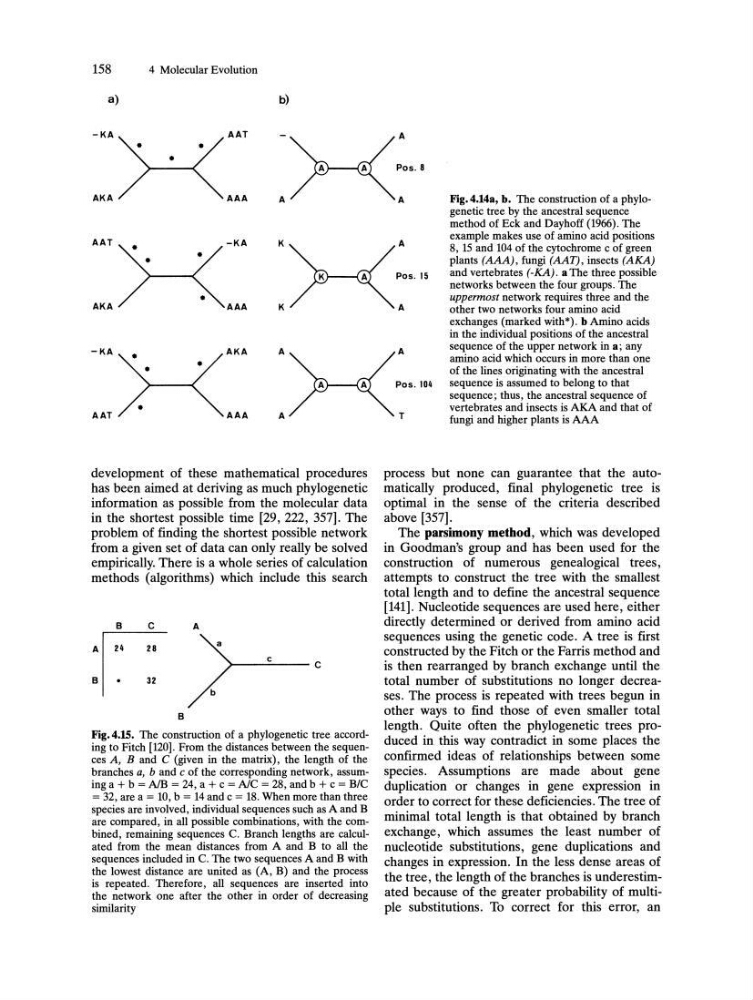
Fig. 4.15. The construction of a phylogenetic tree according to Fitch [120]. From the distances between the sequences A, Band C (given in the matrix), the length of the
branches a, band c of the corresponding network, assuming a + b = AlB = 24, a + c = AlC = 28, and b + c = B/C
= 32, are a = 10, b = 14 and c = 18. When more than three
species are involved, individual sequences such as A and B
are compared, in all possible combinations, with the combined, remaining sequences C. Branch lengths are calculated from the mean distances from A and B to all the
sequences included in C. The two sequences A and B with
the lowest distance are united as (A, B) and the process
is repeated. Therefore, all sequences are inserted into
the network one after the other in order of decreasing
similarity
A
Pos. 8
A
Fig. 4.148, b. The construction of a phylogenetic tree by the ancestral sequence
method of Eck and Dayhoff (1966). The
A
example makes use of amino acid positions
8,15 and 104 of the cytochrome c of green
plants (AAA), fungi (AAT) , insects (AKA)
Pos.15
and vertebrates (-KA). 8 The three possible
networks between the four groups. The
uppermost network requires three and the
A
other two networks four amino acid
exchanges (marked with*). b Amino acids
in the individual positions of the ancestral
A
sequence of the upper network in 8; any
amino acid which occurs in more than one
of the lines originating with the ancestral
Pos. 104
sequence is assumed to belong to that
sequence; thus, the ancestral sequence of
vertebrates and insects is AKA and that of
T
fungi and higher plants is AAA
process but none can guarantee that the automatically produced, final phylogenetic tree is
optimal in the sense of the criteria described
above [357].
The parsimony method, which was developed
in Goodman's group and has been used for the
construction of numerous genealogical trees,
attempts to construct the tree with the smallest
total length and to define the ancestral sequence
[141]. Nucleotide sequences are used here, either
directly determined or derived from amino acid
sequences using the genetic code. A tree is first
constructed by the Fitch or the Farris method and
is then rearranged by branch exchange until the
total number of substitutions no longer decreases. The process is repeated with trees begun in
other ways to find those of even smaller total
length. Quite often the phylogenetic trees produced in this way contradict in some places the
confirmed ideas of relationships between some
species. Assumptions are made about gene
duplication or changes in gene expression in
order to correct for these deficiencies. The tree of
minimal total length is that obtained by branch
exchange, which assumes the least number of
nucleotide substitutions, gene duplications and
changes in expression. In the less dense areas of
the tree, the length of the branches is underestimated because of the greater probability of multiple substitutions. To correct for this error, an
4 Molecular Evolution
a)
b)
-KA
AAT
AKA
AAA
A
AAT
-KA
K
AKA
AAA
K
-KA
AKA
A
AAT
AAA
A
development of these mathematical procedures
has been aimed at deriving as much phylogenetic
information as possible from the molecular data
in the shortest possible time [29, 222, 357]. The
problem of finding the shortest possible network
from a given set of data can only really be solved
empirically. There is a whole series of calculation
methods (algorithms) which include this search
B
C
A
A~
B I. 32
a
>-__ ;:;.C _ _ _ C
b
B
Fig. 4.15. The construction of a phylogenetic tree according to Fitch [120]. From the distances between the sequences A, Band C (given in the matrix), the length of the
branches a, band c of the corresponding network, assuming a + b = AlB = 24, a + c = AlC = 28, and b + c = B/C
= 32, are a = 10, b = 14 and c = 18. When more than three
species are involved, individual sequences such as A and B
are compared, in all possible combinations, with the combined, remaining sequences C. Branch lengths are calculated from the mean distances from A and B to all the
sequences included in C. The two sequences A and B with
the lowest distance are united as (A, B) and the process
is repeated. Therefore, all sequences are inserted into
the network one after the other in order of decreasing
similarity
A
Pos. 8
A
Fig. 4.148, b. The construction of a phylogenetic tree by the ancestral sequence
method of Eck and Dayhoff (1966). The
A
example makes use of amino acid positions
8,15 and 104 of the cytochrome c of green
plants (AAA), fungi (AAT) , insects (AKA)
Pos.15
and vertebrates (-KA). 8 The three possible
networks between the four groups. The
uppermost network requires three and the
A
other two networks four amino acid
exchanges (marked with*). b Amino acids
in the individual positions of the ancestral
A
sequence of the upper network in 8; any
amino acid which occurs in more than one
of the lines originating with the ancestral
Pos. 104
sequence is assumed to belong to that
sequence; thus, the ancestral sequence of
vertebrates and insects is AKA and that of
T
fungi and higher plants is AAA
process but none can guarantee that the automatically produced, final phylogenetic tree is
optimal in the sense of the criteria described
above [357].
The parsimony method, which was developed
in Goodman's group and has been used for the
construction of numerous genealogical trees,
attempts to construct the tree with the smallest
total length and to define the ancestral sequence
[141]. Nucleotide sequences are used here, either
directly determined or derived from amino acid
sequences using the genetic code. A tree is first
constructed by the Fitch or the Farris method and
is then rearranged by branch exchange until the
total number of substitutions no longer decreases. The process is repeated with trees begun in
other ways to find those of even smaller total
length. Quite often the phylogenetic trees produced in this way contradict in some places the
confirmed ideas of relationships between some
species. Assumptions are made about gene
duplication or changes in gene expression in
order to correct for these deficiencies. The tree of
minimal total length is that obtained by branch
exchange, which assumes the least number of
nucleotide substitutions, gene duplications and
changes in expression. In the less dense areas of
the tree, the length of the branches is underestimated because of the greater probability of multiple substitutions. To correct for this error, an