

4.5.7 Construction of Phylogenetic Trees from Molecular Data
157
a)
A
B
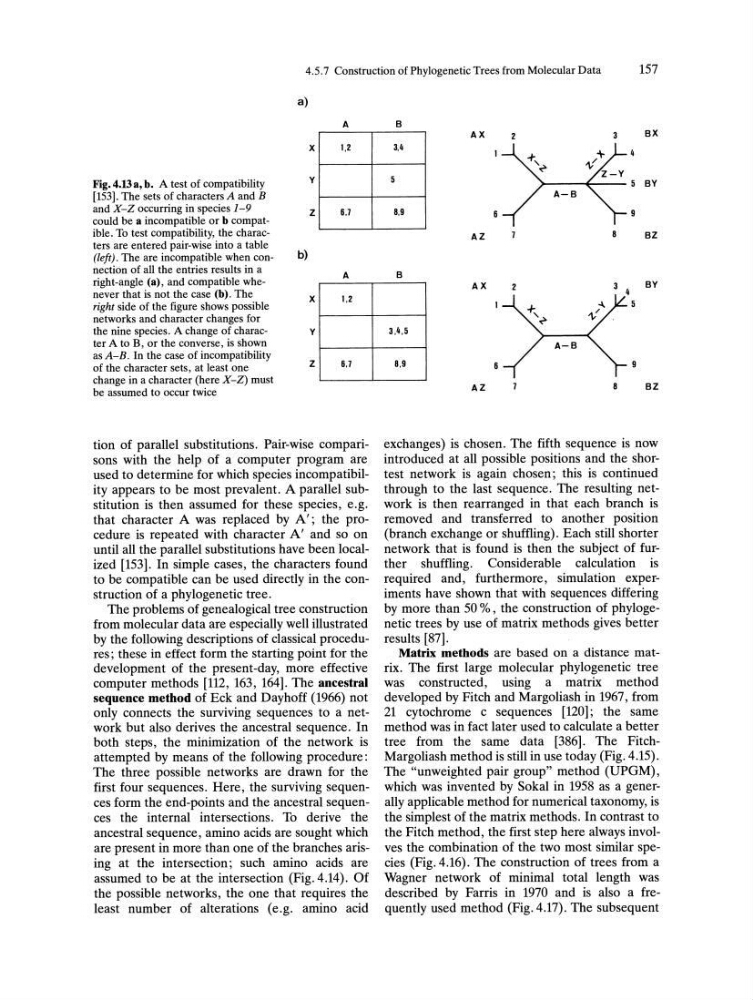
Fig. 4.13 a, b. A test of compatibility
[153]. The sets of characters A and B
and X-Z occurring in species 1-9
could be a incompatible or b compatible. To test compatibility, the characters are entered pair-wise into a table
(left). The are incompatible when connection of all the entries results in a
right-angle (a), and compatible whenever that is not the case (b). The
right side of the figure shows possible
networks and character changes for
the nine species. A change of character A to B, or the converse, is shown
as A-B. In the case of incompatibility
of the character sets, at least one
change in a character (here X-Z) must
be assumed to occur twice
b)
X
Y
Z
X
Y
Z
1.2
6.7
A
1,2
6,7
tion of parallel substitutions. Pair-wise comparisons with the help of a computer program are
used to determine for which species incompatibility appears to be most prevalent. A parallel substitution is then assumed for these species, e.g.
that character A was replaced by A'; the procedure is repeated with character A' and so on
until all the parallel substitutions have been localized [153]. In simple cases, the characters found
to be compatible can be used directly in the construction of a phylogenetic tree.
The problems of genealogical tree construction
from molecular data are especially well illustrated
by the following descriptions of classical procedures; these in effect form the starting point for the
development of the present-day, more effective
computer methods [112, 163, 164]. The ancestral
sequence method of Eck and Dayhoff (1966) not
only connects the surviving sequences to a network but also derives the ancestral sequence. In
both steps, the minimization of the network is
attempted by means of the following procedure:
The three possible networks are drawn for the
first four sequences. Here, the surviving sequences form the end-points and the ancestral sequences the internal intersections. To derive the
ancestral sequence, amino acids are sought which
are present in more than one of the branches arising at the intersection; such amino acids are
assumed to be at the intersection (Fig. 4.14). Of
the possible networks, the one that requires the
least number of alterations (e.g. amino acid
AX
BX
3.4
5
> - - - " + - - - 5 BY
8,9
AZ
BZ
B
AX
3
BY
3,4,5
8,9
AZ
8
BZ
exchanges) is chosen. The fifth sequence is now
introduced at all possible positions and the shortest network is again chosen; this is continued
through to the last sequence. The resulting network is then rearranged in that each branch is
removed and transferred to another position
(branch exchange or shuffling). Each still shorter
network that is found is then the subject of further shuffling. Considerable calculation is
required and, furthermore, simulation experiments have shown that with sequences differing
by more than 50 %, the construction of phylogenetic trees by use of matrix methods gives better
results [87].
Matrix methods are based on a distance matrix. The first large molecular phylogenetic tree
was constructed, using a matrix method
developed by Fitch and Margoliash in 1967, from
21 cytochrome c sequences [120]; the same
method was in fact later used to calculate a better
tree from the same data [386]. The FitchMargoliash method is still in use today (Fig. 4.15).
The "unweighted pair group" method (UPGM),
which was invented by Sokal in 1958 as a generally applicable method for numerical taxonomy, is
the simplest of the matrix methods. In contrast to
the Fitch method, the first step here always involves the combination of the two most similar species (Fig. 4.16). The construction of trees from a
Wagner network of minimal total length was
described by Farris in 1970 and is also a frequently used method (Fig. 4.17). The subsequent
157
a)
A
B
Fig. 4.13 a, b. A test of compatibility
[153]. The sets of characters A and B
and X-Z occurring in species 1-9
could be a incompatible or b compatible. To test compatibility, the characters are entered pair-wise into a table
(left). The are incompatible when connection of all the entries results in a
right-angle (a), and compatible whenever that is not the case (b). The
right side of the figure shows possible
networks and character changes for
the nine species. A change of character A to B, or the converse, is shown
as A-B. In the case of incompatibility
of the character sets, at least one
change in a character (here X-Z) must
be assumed to occur twice
b)
X
Y
Z
X
Y
Z
1.2
6.7
A
1,2
6,7
tion of parallel substitutions. Pair-wise comparisons with the help of a computer program are
used to determine for which species incompatibility appears to be most prevalent. A parallel substitution is then assumed for these species, e.g.
that character A was replaced by A'; the procedure is repeated with character A' and so on
until all the parallel substitutions have been localized [153]. In simple cases, the characters found
to be compatible can be used directly in the construction of a phylogenetic tree.
The problems of genealogical tree construction
from molecular data are especially well illustrated
by the following descriptions of classical procedures; these in effect form the starting point for the
development of the present-day, more effective
computer methods [112, 163, 164]. The ancestral
sequence method of Eck and Dayhoff (1966) not
only connects the surviving sequences to a network but also derives the ancestral sequence. In
both steps, the minimization of the network is
attempted by means of the following procedure:
The three possible networks are drawn for the
first four sequences. Here, the surviving sequences form the end-points and the ancestral sequences the internal intersections. To derive the
ancestral sequence, amino acids are sought which
are present in more than one of the branches arising at the intersection; such amino acids are
assumed to be at the intersection (Fig. 4.14). Of
the possible networks, the one that requires the
least number of alterations (e.g. amino acid
AX
BX
3.4
5
> - - - " + - - - 5 BY
8,9
AZ
BZ
B
AX
3
BY
3,4,5
8,9
AZ
8
BZ
exchanges) is chosen. The fifth sequence is now
introduced at all possible positions and the shortest network is again chosen; this is continued
through to the last sequence. The resulting network is then rearranged in that each branch is
removed and transferred to another position
(branch exchange or shuffling). Each still shorter
network that is found is then the subject of further shuffling. Considerable calculation is
required and, furthermore, simulation experiments have shown that with sequences differing
by more than 50 %, the construction of phylogenetic trees by use of matrix methods gives better
results [87].
Matrix methods are based on a distance matrix. The first large molecular phylogenetic tree
was constructed, using a matrix method
developed by Fitch and Margoliash in 1967, from
21 cytochrome c sequences [120]; the same
method was in fact later used to calculate a better
tree from the same data [386]. The FitchMargoliash method is still in use today (Fig. 4.15).
The "unweighted pair group" method (UPGM),
which was invented by Sokal in 1958 as a generally applicable method for numerical taxonomy, is
the simplest of the matrix methods. In contrast to
the Fitch method, the first step here always involves the combination of the two most similar species (Fig. 4.16). The construction of trees from a
Wagner network of minimal total length was
described by Farris in 1970 and is also a frequently used method (Fig. 4.17). The subsequent