

156
4 Molecular Evolution
distance, information tends to be lost and events
such as parallel or back mutations are difficult
both to recognize and to include in the calculations.
The very successful method of Willi Hennig,
which is based on morphological characters and
results in dichotomously branched phylogenetic
trees, involves the search for the sibling species or
groups sharing the most recent, common ancestor. This requires evidence of the joint possession
of derived (apomorphous) characters (synapomorphy). The occurrence of an apomorphous
character in only one taxon (autapomorphy) or
the joint possession of plesiomorphous characters, i.e. those also found in other taxa
(symplesiomorphy), are not relevant to the analysis of relationships. Hennig's method has, up to
now, only rarely been applied using molecular
characters and then with only modest success,
e.g. with electrophoretic data [322] and data on
the disulphide bridges of transferrins [437]; it
would be interesting to apply the method to
sequence data.
With the aid of numerical methods, surviving
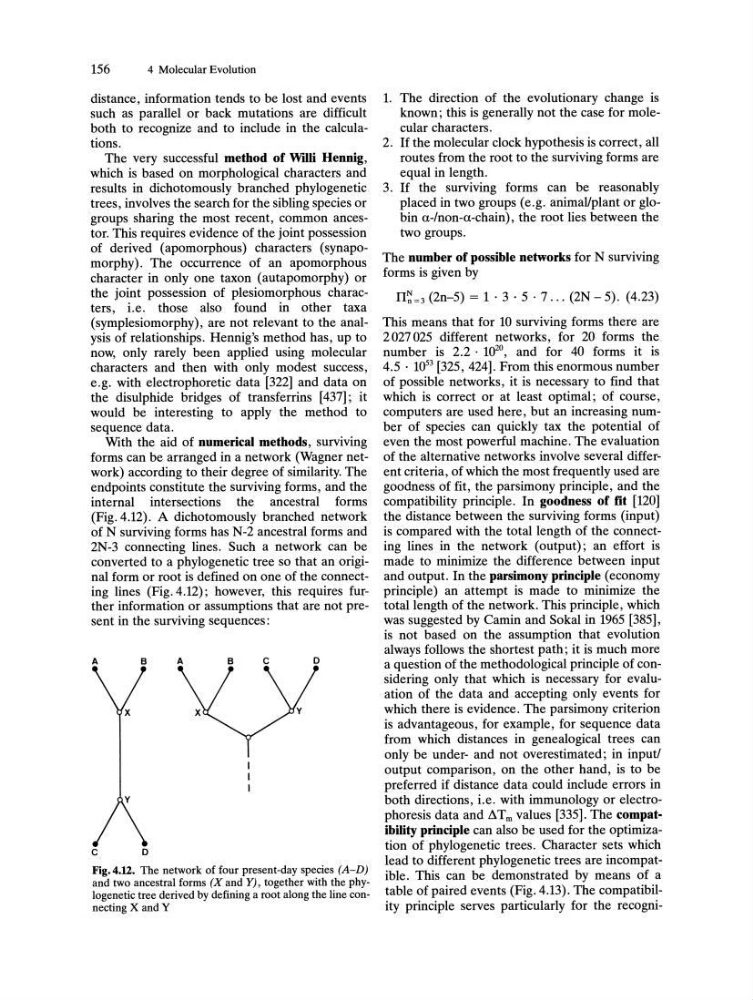
forms can be arranged in a network (Wagner network) according to their degree of similarity. The
endpoints constitute the surviving forms, and the
internal intersections the ancestral forms
(Fig.4.12). A dichotomously branched network
of N surviving forms has N-2 ancestral forms and
2N-3 connecting lines. Such a network can be
converted to a phylogenetic tree so that an original form or root is defined on one of the connecting lines (Fig. 4.12); however, this requires further information or assumptions that are not present in the surviving sequences:
A
B
A
B
c
o
y
C
0
Fig.4.12. The network of four present-day species (A-D)
and two ancestral forms (X and Y), together with the phylogenetic tree derived by defining a root along the line connecting X and Y
1. The direction of the evolutionary change is
known; this is generally not the case for molecular characters.
2. If the molecular clock hypothesis is correct, all
routes from the root to the surviving forms are
equal in length.
3. If the surviving forms can be reasonably
placed in two groups (e.g. animal/plant or globin a-/non-a-chain), the root lies between the
two groups.
The number of possible networks for N surviving
forms is given by
rr~=3 (2n-5) = 1 ·3 . 5 ·7 ... (2N - 5). (4.23)
This means that for 10 surviving forms there are
2027025 different networks, for 20 forms the
number is 2.2· 10 20 , and for 40 forms it is
4.5 . 10 53 [325,424]. From this enormous number
of possible networks, it is necessary to find that
which is correct or at least optimal; of course,
computers are used here, but an increasing number of species can quickly tax the potential of
even the most powerful machine. The evaluation
of the alternative networks involve several different criteria, of which the most frequently used are
goodness of fit, the parsimony principle, and the
compatibility principle. In goodness of fit [120]
the distance between the surviving forms (input)
is compared with the total length of the connecting lines in the network (output); an effort is
made to minimize the difference between input
and output. In the parsimony principle (economy
principle) an attempt is made to minimize the
total length of the network. This principle, which
was suggested by Camin and Sokal in 1965 [385],
is not based on the assumption that evolution
always follows the shortest path; it is much more
a question of the methodological principle of considering only that which is necessary for evaluation of the data and accepting only events for
which there is evidence. The parsimony criterion
is advantageous, for example, for sequence data
from which distances in genealogical trees can
only be under- and not overestimated; in input!
output comparison, on the other hand, is to be
preferred if distance data could include errors in
both directions, i.e. with immunology or electrophoresis data and ~Tm values [335]. The compatibility principle can also be used for the optimization of phylogenetic trees. Character sets which
lead to different phylogenetic trees are incompatible. This can be demonstrated by means of a
table of paired events (Fig. 4.13). The compatibility principle serves particularly for the recogni-
4 Molecular Evolution
distance, information tends to be lost and events
such as parallel or back mutations are difficult
both to recognize and to include in the calculations.
The very successful method of Willi Hennig,
which is based on morphological characters and
results in dichotomously branched phylogenetic
trees, involves the search for the sibling species or
groups sharing the most recent, common ancestor. This requires evidence of the joint possession
of derived (apomorphous) characters (synapomorphy). The occurrence of an apomorphous
character in only one taxon (autapomorphy) or
the joint possession of plesiomorphous characters, i.e. those also found in other taxa
(symplesiomorphy), are not relevant to the analysis of relationships. Hennig's method has, up to
now, only rarely been applied using molecular
characters and then with only modest success,
e.g. with electrophoretic data [322] and data on
the disulphide bridges of transferrins [437]; it
would be interesting to apply the method to
sequence data.
With the aid of numerical methods, surviving
forms can be arranged in a network (Wagner network) according to their degree of similarity. The
endpoints constitute the surviving forms, and the
internal intersections the ancestral forms
(Fig.4.12). A dichotomously branched network
of N surviving forms has N-2 ancestral forms and
2N-3 connecting lines. Such a network can be
converted to a phylogenetic tree so that an original form or root is defined on one of the connecting lines (Fig. 4.12); however, this requires further information or assumptions that are not present in the surviving sequences:
A
B
A
B
c
o
y
C
0
Fig.4.12. The network of four present-day species (A-D)
and two ancestral forms (X and Y), together with the phylogenetic tree derived by defining a root along the line connecting X and Y
1. The direction of the evolutionary change is
known; this is generally not the case for molecular characters.
2. If the molecular clock hypothesis is correct, all
routes from the root to the surviving forms are
equal in length.
3. If the surviving forms can be reasonably
placed in two groups (e.g. animal/plant or globin a-/non-a-chain), the root lies between the
two groups.
The number of possible networks for N surviving
forms is given by
rr~=3 (2n-5) = 1 ·3 . 5 ·7 ... (2N - 5). (4.23)
This means that for 10 surviving forms there are
2027025 different networks, for 20 forms the
number is 2.2· 10 20 , and for 40 forms it is
4.5 . 10 53 [325,424]. From this enormous number
of possible networks, it is necessary to find that
which is correct or at least optimal; of course,
computers are used here, but an increasing number of species can quickly tax the potential of
even the most powerful machine. The evaluation
of the alternative networks involve several different criteria, of which the most frequently used are
goodness of fit, the parsimony principle, and the
compatibility principle. In goodness of fit [120]
the distance between the surviving forms (input)
is compared with the total length of the connecting lines in the network (output); an effort is
made to minimize the difference between input
and output. In the parsimony principle (economy
principle) an attempt is made to minimize the
total length of the network. This principle, which
was suggested by Camin and Sokal in 1965 [385],
is not based on the assumption that evolution
always follows the shortest path; it is much more
a question of the methodological principle of considering only that which is necessary for evaluation of the data and accepting only events for
which there is evidence. The parsimony criterion
is advantageous, for example, for sequence data
from which distances in genealogical trees can
only be under- and not overestimated; in input!
output comparison, on the other hand, is to be
preferred if distance data could include errors in
both directions, i.e. with immunology or electrophoresis data and ~Tm values [335]. The compatibility principle can also be used for the optimization of phylogenetic trees. Character sets which
lead to different phylogenetic trees are incompatible. This can be demonstrated by means of a
table of paired events (Fig. 4.13). The compatibility principle serves particularly for the recogni-