

4.5.7 Construction of Phylogenetic Trees from Molecular Data
159
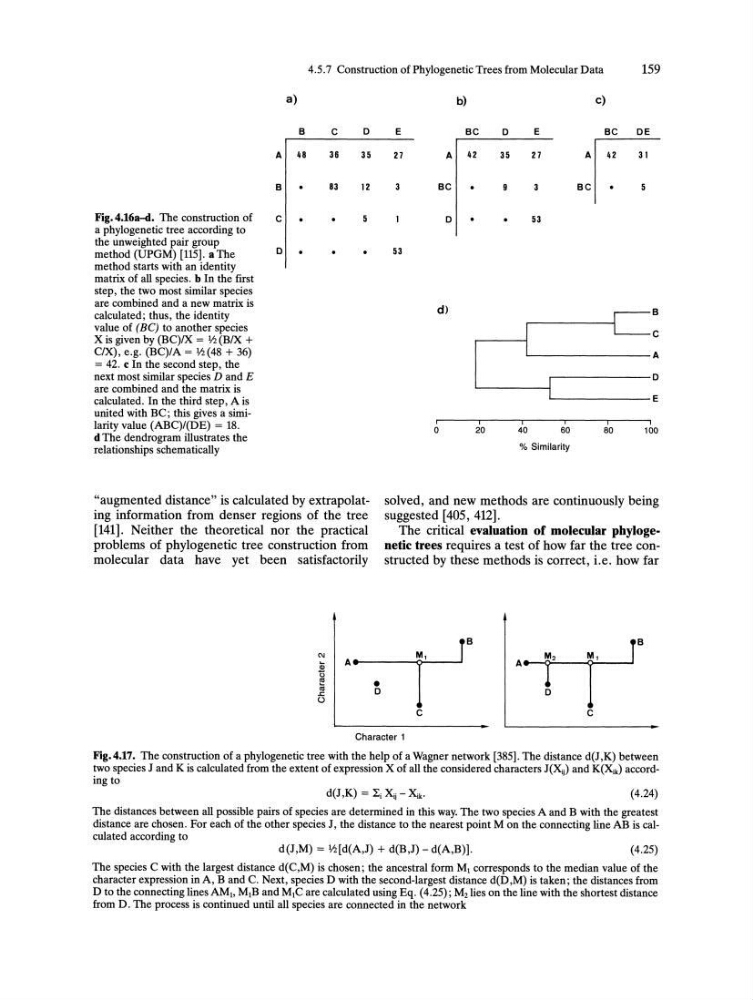
Fig. 4.16a-d. The construction of
a phylogenetic tree according to
the unweighted pair group
method (UPGM) [115]. a The
method starts with an identity
matrix of all species. b In the first
step, the two most similar species
are combined and a new matrix is
calculated; thus, the identity
value of (Be) to another species
X is given by (BC)/x = 1;2 (B/x +
C/X), e.g. (BC)/A = 1;2(48 + 36)
= 42. c In the second step, the
next most similar species D and E
are combined and the matrix is
calculated. In the third step, A is
united with BC; this gives a similarity value (ABC)/(DE) = 18.
d The dendrogram illustrates the
relationships schematically
a)
B
A
48
B
C
o
C
o
36
35
83
12
"augmented distance" is calculated by extrapolating information from denser regions of the tree
[141]. Neither the theoretical nor the practical
problems of phylogenetic tree construction from
molecular data have yet been satisfactorily
C\I
2
A
u
~
' "
J::
(,)
• 0
E
27
53
A
BC
0
d)
i
o
b)
BC
42
I
20
0
35
c)
E
BC
DE
27
Ar
B C .
5
53
B
C
~-----------------A
, . . - - - - - - - - - 0
l . . . - - - - - - - - E
I
I
40
60
% Similarity
I
80
I
100
solved, and new methods are continuously being
suggested [405, 412].
The critical evaluation of molecular phylogenetic trees requires a test of how far the tree constructed by these methods is correct, i.e. how far
B
B
M,
A
Mo
M,
0
C
C
Character 1
Fig. 4.17. The construction of a phylogenetic tree with the help of a Wagner network [385]. The distance d( J ,K) between
two species J and K is calculated from the extent of expression X of all the considered characters J(Xij) and K(Xik) according to
d(J ,K) = Li Xij - Xik•
(4.24)
The distances between all possible pairs of species are determined in this way. The two species A and B with the greatest
distance are chosen. For each of the other species J, the distance to the nearest point M on the connecting line AB is calculated according to
d(J,M) = 1;2[d(A,J) + d(B,J) - d(A,B)].
(4.25)
The species C with the largest distance d(C,M) is chosen; the ancestral form Ml corresponds to the median value of the
character expression in A, Band C. Next, species D with the second-largest distance d(D ,M) is taken; the distances from
D to the connecting lines AM), MIB and M1C are calculated using Eq. (4.25); Mzlies on the line with the shortest distance
from D. The process is continued until all species are connected in the network
159
Fig. 4.16a-d. The construction of
a phylogenetic tree according to
the unweighted pair group
method (UPGM) [115]. a The
method starts with an identity
matrix of all species. b In the first
step, the two most similar species
are combined and a new matrix is
calculated; thus, the identity
value of (Be) to another species
X is given by (BC)/x = 1;2 (B/x +
C/X), e.g. (BC)/A = 1;2(48 + 36)
= 42. c In the second step, the
next most similar species D and E
are combined and the matrix is
calculated. In the third step, A is
united with BC; this gives a similarity value (ABC)/(DE) = 18.
d The dendrogram illustrates the
relationships schematically
a)
B
A
48
B
C
o
C
o
36
35
83
12
"augmented distance" is calculated by extrapolating information from denser regions of the tree
[141]. Neither the theoretical nor the practical
problems of phylogenetic tree construction from
molecular data have yet been satisfactorily
C\I
2
A
u
~
' "
J::
(,)
• 0
E
27
53
A
BC
0
d)
i
o
b)
BC
42
I
20
0
35
c)
E
BC
DE
27
Ar
B C .
5
53
B
C
~-----------------A
, . . - - - - - - - - - 0
l . . . - - - - - - - - E
I
I
40
60
% Similarity
I
80
I
100
solved, and new methods are continuously being
suggested [405, 412].
The critical evaluation of molecular phylogenetic trees requires a test of how far the tree constructed by these methods is correct, i.e. how far
B
B
M,
A
Mo
M,
0
C
C
Character 1
Fig. 4.17. The construction of a phylogenetic tree with the help of a Wagner network [385]. The distance d( J ,K) between
two species J and K is calculated from the extent of expression X of all the considered characters J(Xij) and K(Xik) according to
d(J ,K) = Li Xij - Xik•
(4.24)
The distances between all possible pairs of species are determined in this way. The two species A and B with the greatest
distance are chosen. For each of the other species J, the distance to the nearest point M on the connecting line AB is calculated according to
d(J,M) = 1;2[d(A,J) + d(B,J) - d(A,B)].
(4.25)
The species C with the largest distance d(C,M) is chosen; the ancestral form Ml corresponds to the median value of the
character expression in A, Band C. Next, species D with the second-largest distance d(D ,M) is taken; the distances from
D to the connecting lines AM), MIB and M1C are calculated using Eq. (4.25); Mzlies on the line with the shortest distance
from D. The process is continued until all species are connected in the network