

where njA and niB indicate the number of amino
acids of type i in two proteins A and B with the
same length N. For technical reasons, Asp/Asn
and GlulGln are not distinguished and therefore
only 18 amino acids are considered. S~n is an
estimate of the number of positions at which the
compared sequences disagree. Values for S~n/N
of up to 0.42, i.e. an estimated sequence difference of up to 42 % , can be taken as clear evidence
of homology; in several thousand comparisons of
proteins with known sequences, only one exception was found [79]. The S~n value for protein
pairs of differing length can also be calculated
using quite a complicated equation [344]. According to Ghiretti-Magaldi, the variable probabilities
for the origin of an amino acid i, dependent upon
the number of synonymous codons, should be
taken into account thus:
(4.17)
In this equation, XjA and XiB indicate the proportions of the amino acids i in A and B; nj is the
number of triplets coding for i. The values
obtained in this way for 15 homologous proteins
were found to be strongly correlated with the
sequence differences [133].
4.5.3 Immunological Distance Between Proteins
151
4.5.3 Immunological Distance
Between Proteins
The most widely used immunological method for
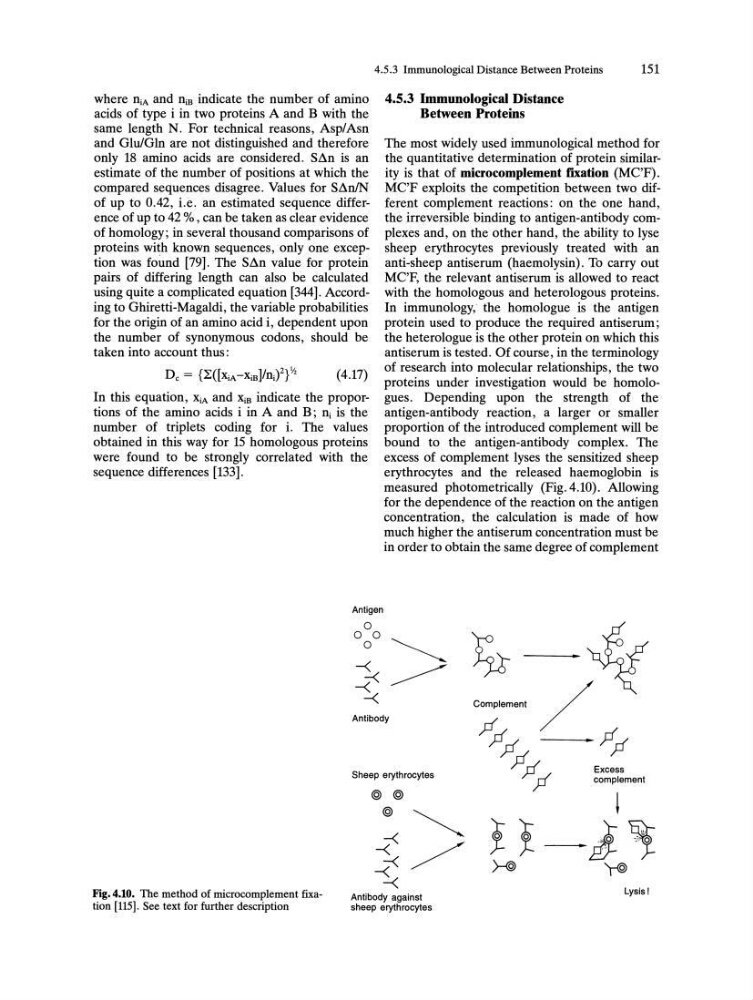
the quantitative determination of protein similarity is that of microcomplement rlXation (MC'F).
MC'F exploits the competition between two different complement reactions: on the one hand,
the irreversible binding to antigen-antibody complexes and, on the other hand, the ability to lyse
sheep erythrocytes previously treated with an
anti-sheep antiserum (haemolysin). To carry out
MC'F, the relevant antiserum is allowed to react
with the homologous and heterologous proteins.
In immunology, the homologue is the antigen
protein used to produce the required antiserum;
the heterologue is the other protein on which this
antiserum is tested. Of course, in the terminology
of research into molecular relationships, the two
proteins under investigation would be homologues. Depending upon the strength of the
antigen-antibody reaction, a larger or smaller
proportion of the introduced complement will be
bound to the antigen-antibody complex. The
excess of complement lyses the sensitized sheep
erythrocytes and the released haemoglobin is
measured photometrically (Fig. 4.10). Allowing
for the dependence of the reaction on the antigen
concentration, the calculation is made of how
much higher the antiserum concentration must be
in order to obtain the same degree of complement
Antigen
Fig.4.10. The method of microcomplement fixation [115]. See text for further description
o
o 0
o
Antibody
Sheep erythrocytes
@ @
@
-<-<
-<-<
-<
Antibody against
sheep erythrocytes
Lysis!
acids of type i in two proteins A and B with the
same length N. For technical reasons, Asp/Asn
and GlulGln are not distinguished and therefore
only 18 amino acids are considered. S~n is an
estimate of the number of positions at which the
compared sequences disagree. Values for S~n/N
of up to 0.42, i.e. an estimated sequence difference of up to 42 % , can be taken as clear evidence
of homology; in several thousand comparisons of
proteins with known sequences, only one exception was found [79]. The S~n value for protein
pairs of differing length can also be calculated
using quite a complicated equation [344]. According to Ghiretti-Magaldi, the variable probabilities
for the origin of an amino acid i, dependent upon
the number of synonymous codons, should be
taken into account thus:
(4.17)
In this equation, XjA and XiB indicate the proportions of the amino acids i in A and B; nj is the
number of triplets coding for i. The values
obtained in this way for 15 homologous proteins
were found to be strongly correlated with the
sequence differences [133].
4.5.3 Immunological Distance Between Proteins
151
4.5.3 Immunological Distance
Between Proteins
The most widely used immunological method for
the quantitative determination of protein similarity is that of microcomplement rlXation (MC'F).
MC'F exploits the competition between two different complement reactions: on the one hand,
the irreversible binding to antigen-antibody complexes and, on the other hand, the ability to lyse
sheep erythrocytes previously treated with an
anti-sheep antiserum (haemolysin). To carry out
MC'F, the relevant antiserum is allowed to react
with the homologous and heterologous proteins.
In immunology, the homologue is the antigen
protein used to produce the required antiserum;
the heterologue is the other protein on which this
antiserum is tested. Of course, in the terminology
of research into molecular relationships, the two
proteins under investigation would be homologues. Depending upon the strength of the
antigen-antibody reaction, a larger or smaller
proportion of the introduced complement will be
bound to the antigen-antibody complex. The
excess of complement lyses the sensitized sheep
erythrocytes and the released haemoglobin is
measured photometrically (Fig. 4.10). Allowing
for the dependence of the reaction on the antigen
concentration, the calculation is made of how
much higher the antiserum concentration must be
in order to obtain the same degree of complement
Antigen
Fig.4.10. The method of microcomplement fixation [115]. See text for further description
o
o 0
o
Antibody
Sheep erythrocytes
@ @
@
-<-<
-<-<
-<
Antibody against
sheep erythrocytes
Lysis!