

152
4 Molecular Evolution
binding with the "heterologous" as with the
"homologous" protein. The resulting factor is termed the "index of dissimilarity" (ID), and the
value 100 . log ID represents the immunological
distance [115]. The distances determined in this
way are independent of the antiserum used. A
radio-immunological method has recently been
developed which gives results similar to those
from the MC'F, but is about 1000-times more sensitive and requires only a few nanograms of protein [251].
Theoretically, the immunological distance is
proportional to the percentage difference in the
sequences [267] and this has been confirmed for
many proteins. Thus, an immunological distance
of 100 corresponds to a sequence difference of
20 % in bacterial azurines, tryptophan synthetases, and avian egg lysozymes, and of about 14 %
in pancreas RNases [334]. However, the error
may be as large as 60 % with small distances and
the accuracy of immunologically determined
evolutionary distances should not be overestimated [289]. On the other hand, MC'F is particularly suitable for phylogenetic studies in which as
many species as possible must be compared. The
method has been used in investigations of several
hundred vertebrate species, in particular for comparisons of serum albumin, which is easy to
obtain, contains a lot of information in its 580
amino acids, and shows a relatively high rate of
evolution. Despite the problems referred to
above, these data are still of great importance
today to the discussion of central questions in
molecular evolution research: the concept of the
molecular clock, which is sometimes even termed
the albumin clock; the problem of the missing
correlation between molecular evolution and the
evolution of complex phenotypic characters; and
finally, in the solution of individual phylogenetic
problems and the construction of phylogenetic
trees. Other immunological methods, e.g. immunoprecipitation, immunodiffusion and immunoelectrophoresis, as well as radio- and enzymeimmunological procedures, have mainly been
used qualitatively, e.g. as evidence for the homology of proteins, and only rarely for quantitative
determination of evolutionary distance. The
enzyme-linked-immunosorption-assay (ELISA)
should give accurate results for sequence differences of up to 60 %, whereas MC'F is only useful
for differences of up to 40 % [177].
4.5.4 Genetic Distance Given
by Electrophoretic Data
Comparisons of amino acid or nucleotide sequences, amino acid composition and immunological
properties give information of the evolutionary
distance of only single genes. In contrast, electrophoretic data on a large number of loci can be
used, with a few reservations, to derive the average evolutionary distance of whole genomes. The
valid objections here are the same as those for the
determination of genetic variability from electrophoregrams:
1. Standard electrophoresis detects only amino
acid-exchanging substitutions, and only those
which result in a change in charge; equal electrophoretic mobility cannot be taken unconditionally as evidence for sequence identity. In
addition, in the determination of evolutionary
distance between distantly related organisms,
the probability of opposite charge change,
which cannot be recognized, increases with
increasing distance. Thus, electrophoretically
determined distances become more unreliable
the further apart the compared taxa. It is
therefore recommended that the more efficient method of 2-D electrophoresis be used
for the determination of genetic similarity
between different groups of animals
[278,457].
2. The commonly investigated proteins (Table 4.9) should not be looked upon as representative of the whole genome.
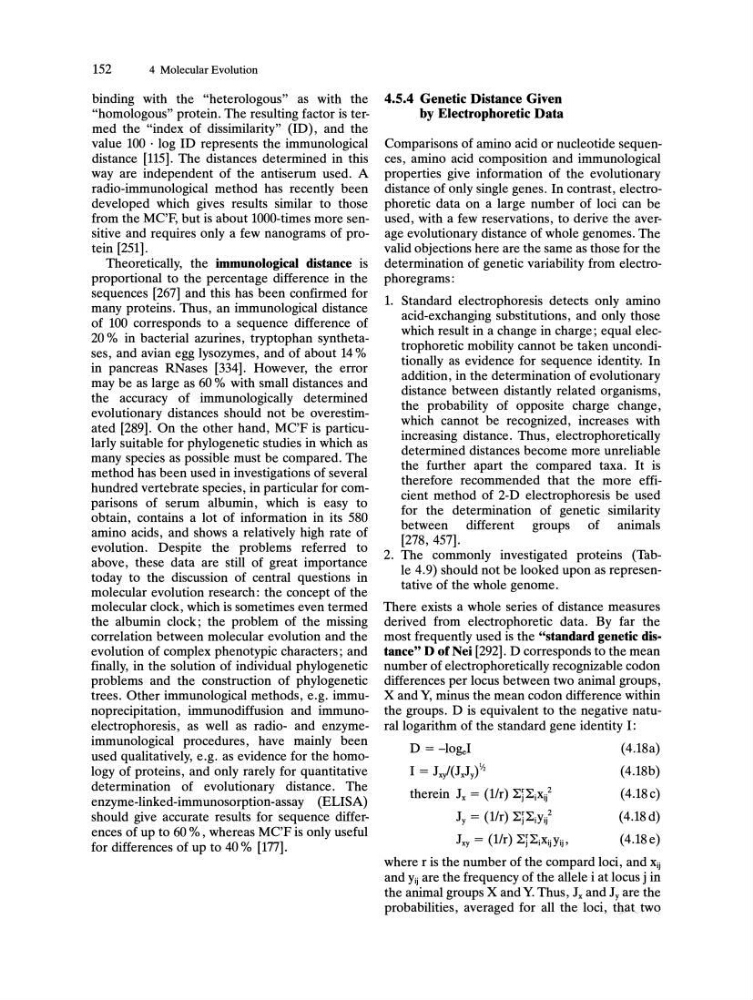
There exists a whole series of distance measures
derived from electrophoretic data. By far the
most frequently used is the "standard genetic distance" D ofNei [292]. D corresponds to the mean
number of electrophoretically recognizable codon
differences per locus between two animal groups,
X and Y, minus the mean codon difference within
the groups. D is equivalent to the negative naturallogarithm of the standard gene identity I:
D = -logeI
I = Jx/(JXJy)Y2
therein Jx = (l/r) LP:iXi/
Jy = (l/r) LjL;yl
Jxy = (l/r) LjLiXijYij,
(4.18a)
(4.18b)
(4.18 c)
(4.18 d)
(4.18 e)
where r is the number of the compard loci, and Xij
and Yij are the frequency of the allele i at locus j in
the animal groups X and Y. Thus, Jx and Jy are the
probabilities, averaged for all the loci, that two
4 Molecular Evolution
binding with the "heterologous" as with the
"homologous" protein. The resulting factor is termed the "index of dissimilarity" (ID), and the
value 100 . log ID represents the immunological
distance [115]. The distances determined in this
way are independent of the antiserum used. A
radio-immunological method has recently been
developed which gives results similar to those
from the MC'F, but is about 1000-times more sensitive and requires only a few nanograms of protein [251].
Theoretically, the immunological distance is
proportional to the percentage difference in the
sequences [267] and this has been confirmed for
many proteins. Thus, an immunological distance
of 100 corresponds to a sequence difference of
20 % in bacterial azurines, tryptophan synthetases, and avian egg lysozymes, and of about 14 %
in pancreas RNases [334]. However, the error
may be as large as 60 % with small distances and
the accuracy of immunologically determined
evolutionary distances should not be overestimated [289]. On the other hand, MC'F is particularly suitable for phylogenetic studies in which as
many species as possible must be compared. The
method has been used in investigations of several
hundred vertebrate species, in particular for comparisons of serum albumin, which is easy to
obtain, contains a lot of information in its 580
amino acids, and shows a relatively high rate of
evolution. Despite the problems referred to
above, these data are still of great importance
today to the discussion of central questions in
molecular evolution research: the concept of the
molecular clock, which is sometimes even termed
the albumin clock; the problem of the missing
correlation between molecular evolution and the
evolution of complex phenotypic characters; and
finally, in the solution of individual phylogenetic
problems and the construction of phylogenetic
trees. Other immunological methods, e.g. immunoprecipitation, immunodiffusion and immunoelectrophoresis, as well as radio- and enzymeimmunological procedures, have mainly been
used qualitatively, e.g. as evidence for the homology of proteins, and only rarely for quantitative
determination of evolutionary distance. The
enzyme-linked-immunosorption-assay (ELISA)
should give accurate results for sequence differences of up to 60 %, whereas MC'F is only useful
for differences of up to 40 % [177].
4.5.4 Genetic Distance Given
by Electrophoretic Data
Comparisons of amino acid or nucleotide sequences, amino acid composition and immunological
properties give information of the evolutionary
distance of only single genes. In contrast, electrophoretic data on a large number of loci can be
used, with a few reservations, to derive the average evolutionary distance of whole genomes. The
valid objections here are the same as those for the
determination of genetic variability from electrophoregrams:
1. Standard electrophoresis detects only amino
acid-exchanging substitutions, and only those
which result in a change in charge; equal electrophoretic mobility cannot be taken unconditionally as evidence for sequence identity. In
addition, in the determination of evolutionary
distance between distantly related organisms,
the probability of opposite charge change,
which cannot be recognized, increases with
increasing distance. Thus, electrophoretically
determined distances become more unreliable
the further apart the compared taxa. It is
therefore recommended that the more efficient method of 2-D electrophoresis be used
for the determination of genetic similarity
between different groups of animals
[278,457].
2. The commonly investigated proteins (Table 4.9) should not be looked upon as representative of the whole genome.
There exists a whole series of distance measures
derived from electrophoretic data. By far the
most frequently used is the "standard genetic distance" D ofNei [292]. D corresponds to the mean
number of electrophoretically recognizable codon
differences per locus between two animal groups,
X and Y, minus the mean codon difference within
the groups. D is equivalent to the negative naturallogarithm of the standard gene identity I:
D = -logeI
I = Jx/(JXJy)Y2
therein Jx = (l/r) LP:iXi/
Jy = (l/r) LjL;yl
Jxy = (l/r) LjLiXijYij,
(4.18a)
(4.18b)
(4.18 c)
(4.18 d)
(4.18 e)
where r is the number of the compard loci, and Xij
and Yij are the frequency of the allele i at locus j in
the animal groups X and Y. Thus, Jx and Jy are the
probabilities, averaged for all the loci, that two