

150
4 Molecular Evolution
and back mutations, the comparison of DNA
sequences presents further problems due to: (1)
differences in base composition; (2) variable frequencies of the 12 possible substitutions; (3)
unequal distribution of the substitutions between
the codons of a gene; and (4) unequal distribution between the three codon positions.
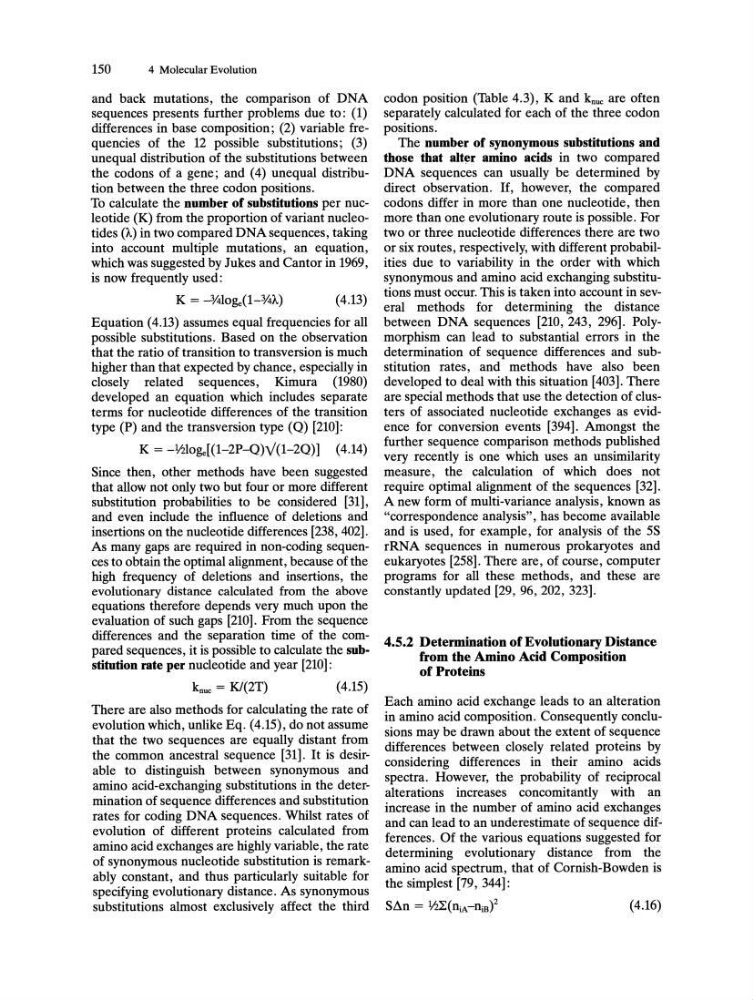
To calculate the number of substitutions per nucleotide (K) from the proportion of variant nucleotides (A) in two compared DNA sequences, taking
into account multiple mutations, an equation,
which was suggested by Jukes and Cantor in 1969,
is now frequently used:
(4.13)
Equation (4.13) assumes equal frequencies for all
possible substitutions. Based on the observation
that the ratio of transition to transversion is much
higher than that expected by chance, especially in
closely related sequences, Kimura (1980)
developed an equation which includes separate
terms for nucleotide differences of the transition
type (P) and the transversion type (Q) [210]:
K = -lhloge[(1-2P-Q)y(I-2Q)] (4.14)
Since then, other methods have been suggested
that allow not only two but four or more different
substitution probabilities to be considered [31],
and even include the influence of deletions and
insertions on the nucleotide differences [238, 402].
As many gaps are required in non-coding sequences to obtain the optimal alignment, because of the
high frequency of deletions and insertions, the
evolutionary distance calculated from the above
equations therefore depends very much upon the
evaluation of such gaps [210]. From the sequence
differences and the separation time of the compared sequences, it is possible to calculate the substitution rate per nucleotide and year [210]:
knuc = K/(2T)
(4.15)
There are also methods for calculating the rate of
evolution which, unlike Eq. (4.15), do not assume
that the two sequences are equally distant from
the common ancestral sequence [31]. It is desirable to distinguish between synonymous and
amino acid-exchanging substitutions in the determination of sequence differences and substitution
rates for coding DNA sequences. Whilst rates of
evolution of different proteins calculated from
amino acid exchanges are highly variable, the rate
of synonymous nucleotide substitution is remarkably constant, and thus particularly suitable for
specifying evolutionary distance. As synonymous
substitutions almost exclusively affect the third
codon position (Table 4.3), K and knuc are often
separately calculated for each of the three codon
positions.
The number of synonymous substitutions and
those that alter amino acids in two compared
DNA sequences can usually be determined by
direct observation. If, however, the compared
codons differ in more than one nucleotide, then
more than one evolutionary route is possible. For
two or three nucleotide differences there are two
or six routes, respectively, with different probabilities due to variability in the order with which
synonymous and amino acid exchanging substitutions must occur. This is taken into account in several methods for determining the distance
between DNA sequences [210,243, 296]. Polymorphism can lead to substantial errors in the
determination of sequence differences and substitution rates, and methods have also been
developed to deal with this situation [403]. There
are special methods that use the detection of clusters of associated nucleotide exchanges as evidence for conversion events [394]. Amongst the
further sequence comparison methods published
very recently is one which uses an unsimilarity
measure, the calculation of which does not
require optimal alignment of the sequences [32].
A new form of multi-variance analysis, known as
"correspondence analysis", has become available
and is used, for example, for analysis of the 5S
rRNA sequences in numerous prokaryotes and
eukaryotes [258]. There are, of course, computer
programs for all these methods, and these are
constantly updated [29, 96,202, 323].
4.5.2 Determination of Evolutionary Distance
from the Amino Acid Composition
of Proteins
Each amino acid exchange leads to an alteration
in amino acid composition. Consequently conclusions may be drawn about the extent of sequence
differences between closely related proteins by
considering differences in their amino acids
spectra. However, the probability of reciprocal
alterations increases concomitantly with an
increase in the number of amino acid exchanges
and can lead to an underestimate of sequence differences. Of the various equations suggested for
determining evolutionary distance from the
amino acid spectrum, that of Cornish-Bowden is
the simplest [79, 344]:
(4.16)
4 Molecular Evolution
and back mutations, the comparison of DNA
sequences presents further problems due to: (1)
differences in base composition; (2) variable frequencies of the 12 possible substitutions; (3)
unequal distribution of the substitutions between
the codons of a gene; and (4) unequal distribution between the three codon positions.
To calculate the number of substitutions per nucleotide (K) from the proportion of variant nucleotides (A) in two compared DNA sequences, taking
into account multiple mutations, an equation,
which was suggested by Jukes and Cantor in 1969,
is now frequently used:
(4.13)
Equation (4.13) assumes equal frequencies for all
possible substitutions. Based on the observation
that the ratio of transition to transversion is much
higher than that expected by chance, especially in
closely related sequences, Kimura (1980)
developed an equation which includes separate
terms for nucleotide differences of the transition
type (P) and the transversion type (Q) [210]:
K = -lhloge[(1-2P-Q)y(I-2Q)] (4.14)
Since then, other methods have been suggested
that allow not only two but four or more different
substitution probabilities to be considered [31],
and even include the influence of deletions and
insertions on the nucleotide differences [238, 402].
As many gaps are required in non-coding sequences to obtain the optimal alignment, because of the
high frequency of deletions and insertions, the
evolutionary distance calculated from the above
equations therefore depends very much upon the
evaluation of such gaps [210]. From the sequence
differences and the separation time of the compared sequences, it is possible to calculate the substitution rate per nucleotide and year [210]:
knuc = K/(2T)
(4.15)
There are also methods for calculating the rate of
evolution which, unlike Eq. (4.15), do not assume
that the two sequences are equally distant from
the common ancestral sequence [31]. It is desirable to distinguish between synonymous and
amino acid-exchanging substitutions in the determination of sequence differences and substitution
rates for coding DNA sequences. Whilst rates of
evolution of different proteins calculated from
amino acid exchanges are highly variable, the rate
of synonymous nucleotide substitution is remarkably constant, and thus particularly suitable for
specifying evolutionary distance. As synonymous
substitutions almost exclusively affect the third
codon position (Table 4.3), K and knuc are often
separately calculated for each of the three codon
positions.
The number of synonymous substitutions and
those that alter amino acids in two compared
DNA sequences can usually be determined by
direct observation. If, however, the compared
codons differ in more than one nucleotide, then
more than one evolutionary route is possible. For
two or three nucleotide differences there are two
or six routes, respectively, with different probabilities due to variability in the order with which
synonymous and amino acid exchanging substitutions must occur. This is taken into account in several methods for determining the distance
between DNA sequences [210,243, 296]. Polymorphism can lead to substantial errors in the
determination of sequence differences and substitution rates, and methods have also been
developed to deal with this situation [403]. There
are special methods that use the detection of clusters of associated nucleotide exchanges as evidence for conversion events [394]. Amongst the
further sequence comparison methods published
very recently is one which uses an unsimilarity
measure, the calculation of which does not
require optimal alignment of the sequences [32].
A new form of multi-variance analysis, known as
"correspondence analysis", has become available
and is used, for example, for analysis of the 5S
rRNA sequences in numerous prokaryotes and
eukaryotes [258]. There are, of course, computer
programs for all these methods, and these are
constantly updated [29, 96,202, 323].
4.5.2 Determination of Evolutionary Distance
from the Amino Acid Composition
of Proteins
Each amino acid exchange leads to an alteration
in amino acid composition. Consequently conclusions may be drawn about the extent of sequence
differences between closely related proteins by
considering differences in their amino acids
spectra. However, the probability of reciprocal
alterations increases concomitantly with an
increase in the number of amino acid exchanges
and can lead to an underestimate of sequence differences. Of the various equations suggested for
determining evolutionary distance from the
amino acid spectrum, that of Cornish-Bowden is
the simplest [79, 344]:
(4.16)