

4.3.2 Methodological Problems in the Determination of Protein Polymorphism
133
4.3.2 Methodological Problems
in the Determination
of Protein Polymorphism
Enzyme electrophoresis is carried out in the following way: the soluble protein of the whole animal or a single organ is fractionated using starchgel or polyacrylamide-gel electrophoresis; enzyme bands with a certain substrate specificity are
visualized on the electrophoregram by use of a
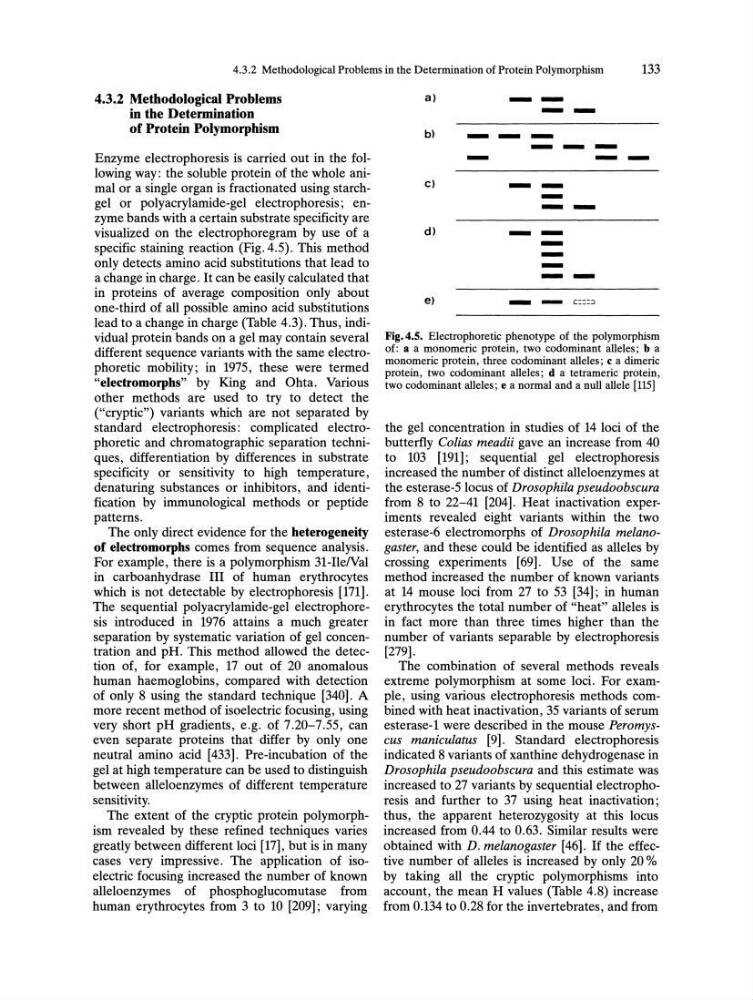
specific staining reaction (Fig. 4.5). This method
only detects amino acid substitutions that lead to
a change in charge. It can be easily calculated that
in proteins of average composition only about
one-third of all possible amino acid substitutions
lead to a change in charge (Table 4.3). Thus, individual protein bands on a gel may contain several
different sequence variants with the same electrophoretic mobility; in 1975, these were termed
"electromorphs" by King and Ohta. Various
other methods are used to try to detect the
("cryptic") variants which are not separated by
standard electrophoresis: complicated electrophoretic and chromatographic separation techniques, differentiation by differences in substrate
specificity or sensitivity to high temperature,
denaturing substances or inhibitors, and identification by immunological methods or peptide
patterns.
The only direct evidence for the heterogeneity
of electromorphs comes from sequence analysis.
For example, there is a polymorphism 31-IleNal
in carboanhydrase III of human erythrocytes
which is not detectable by electrophoresis [171].
The sequential polyacrylamide-gel electrophoresis introduced in 1976 attains a much greater
separation by systematic variation of gel concentration and pH. This method allowed the detection of, for example, 17 out of 20 anomalous
human haemoglobins, compared with detection
of only 8 using the standard technique [340]. A
more recent method of isoelectric focusing, using
very short pH gradients, e.g. of 7.20-7.55, can
even separate proteins that differ by only one
neutral amino acid [433]. Pre-incubation of the
gel at high temperature can be used to distinguish
between alleloenzymes of different temperature
sensitivity.
The extent of the cryptic protein polymorphism revealed by these refined techniques varies
greatly between different loci [17], but is in many
cases very impressive. The application of isoelectric focusing increased the number of known
alleloenzymes of phosphoglucomutase from
human erythrocytes from 3 to 10 [209]; varying
a)
- - - -
b)
- - -
- - -
-
- -
c)
- -
- - -
d)
- - - - -
- -
e)
- -
c::::.
Fig.4.5. Electrophoretic phenotype of the polymorphism
of: a a monomeric protein, two codominant alleles; b a
monomeric protein, three codominant alleles; c a dimeric
protein, two codominant alleles; d a tetrameric protein,
two codominant alleles; e a normal and a null allele [115]
the gel concentration in studies of 14 loci of the
butterfly Colias meadii gave an increase from 40
to 103 [191]; sequential gel electrophoresis
increased the number of distinct alleloenzymes at
the esterase-5 locus of Drosophila pseudoobscura
from 8 to 22-41 [204]. Heat inactivation experiments revealed eight variants within the two
esterase-6 electromorphs of Drosophila melanogaster, and these could be identified as alleles by
crossing experiments [69]. Use of the same
method increased the number of known variants
at 14 mouse loci from 27 to 53 [34]; in human
erythrocytes the total number of "heat" alleles is
in fact more than three times higher than the
number of variants separable by electrophoresis
[279].
The combination of several methods reveals
extreme polymorphism at some loci. For example, using various electrophoresis methods combined with heat inactivation, 35 variants of serum
esterase-1 were described in the mouse Peromyscus maniculatus [9]. Standard electrophoresis
indicated 8 variants of xanthine dehydrogenase in
Drosophila pseudoobscura and this estimate was
increased to 27 variants by sequential electrophoresis and further to 37 using heat inactivation;
thus, the apparent heterozygosity at this locus
increased from 0.44 to 0.63. Similar results were
obtained with D. melanogaster [46]. If the effective number of alleles is increased by only 20 %
by taking all the cryptic polymorphisms into
account, the mean H values (Table 4.8) increase
from 0.134 to 0.28 for the invertebrates, and from
133
4.3.2 Methodological Problems
in the Determination
of Protein Polymorphism
Enzyme electrophoresis is carried out in the following way: the soluble protein of the whole animal or a single organ is fractionated using starchgel or polyacrylamide-gel electrophoresis; enzyme bands with a certain substrate specificity are
visualized on the electrophoregram by use of a
specific staining reaction (Fig. 4.5). This method
only detects amino acid substitutions that lead to
a change in charge. It can be easily calculated that
in proteins of average composition only about
one-third of all possible amino acid substitutions
lead to a change in charge (Table 4.3). Thus, individual protein bands on a gel may contain several
different sequence variants with the same electrophoretic mobility; in 1975, these were termed
"electromorphs" by King and Ohta. Various
other methods are used to try to detect the
("cryptic") variants which are not separated by
standard electrophoresis: complicated electrophoretic and chromatographic separation techniques, differentiation by differences in substrate
specificity or sensitivity to high temperature,
denaturing substances or inhibitors, and identification by immunological methods or peptide
patterns.
The only direct evidence for the heterogeneity
of electromorphs comes from sequence analysis.
For example, there is a polymorphism 31-IleNal
in carboanhydrase III of human erythrocytes
which is not detectable by electrophoresis [171].
The sequential polyacrylamide-gel electrophoresis introduced in 1976 attains a much greater
separation by systematic variation of gel concentration and pH. This method allowed the detection of, for example, 17 out of 20 anomalous
human haemoglobins, compared with detection
of only 8 using the standard technique [340]. A
more recent method of isoelectric focusing, using
very short pH gradients, e.g. of 7.20-7.55, can
even separate proteins that differ by only one
neutral amino acid [433]. Pre-incubation of the
gel at high temperature can be used to distinguish
between alleloenzymes of different temperature
sensitivity.
The extent of the cryptic protein polymorphism revealed by these refined techniques varies
greatly between different loci [17], but is in many
cases very impressive. The application of isoelectric focusing increased the number of known
alleloenzymes of phosphoglucomutase from
human erythrocytes from 3 to 10 [209]; varying
a)
- - - -
b)
- - -
- - -
-
- -
c)
- -
- - -
d)
- - - - -
- -
e)
- -
c::::.
Fig.4.5. Electrophoretic phenotype of the polymorphism
of: a a monomeric protein, two codominant alleles; b a
monomeric protein, three codominant alleles; c a dimeric
protein, two codominant alleles; d a tetrameric protein,
two codominant alleles; e a normal and a null allele [115]
the gel concentration in studies of 14 loci of the
butterfly Colias meadii gave an increase from 40
to 103 [191]; sequential gel electrophoresis
increased the number of distinct alleloenzymes at
the esterase-5 locus of Drosophila pseudoobscura
from 8 to 22-41 [204]. Heat inactivation experiments revealed eight variants within the two
esterase-6 electromorphs of Drosophila melanogaster, and these could be identified as alleles by
crossing experiments [69]. Use of the same
method increased the number of known variants
at 14 mouse loci from 27 to 53 [34]; in human
erythrocytes the total number of "heat" alleles is
in fact more than three times higher than the
number of variants separable by electrophoresis
[279].
The combination of several methods reveals
extreme polymorphism at some loci. For example, using various electrophoresis methods combined with heat inactivation, 35 variants of serum
esterase-1 were described in the mouse Peromyscus maniculatus [9]. Standard electrophoresis
indicated 8 variants of xanthine dehydrogenase in
Drosophila pseudoobscura and this estimate was
increased to 27 variants by sequential electrophoresis and further to 37 using heat inactivation;
thus, the apparent heterozygosity at this locus
increased from 0.44 to 0.63. Similar results were
obtained with D. melanogaster [46]. If the effective number of alleles is increased by only 20 %
by taking all the cryptic polymorphisms into
account, the mean H values (Table 4.8) increase
from 0.134 to 0.28 for the invertebrates, and from