

118
4 Molecular Evolution
processes giving rise to genetic variability has
been recognized. The different types of mutation
and their phenotypic consequences can now be
more closely studied. The genetic and evolutionary importance of point mutations, i.e. the substitution, insertion or deletion of single nucleotides, has been known for a long time. Today, however, many other genetic events are recognized
that lead to changes in larger segments of DNA,
e.g. duplication of genes or parts of genes and the
insertion or deletion of longer or shorter DNA
sequences. Gene conversion has been discovered
as a mechanism which, in addition to classical
crossing-over, can lead to intrachromosomal
recombination. DNA sequences are transferred
to the other DNA strand by inversion, and to
completely different sites by transpositions; exon
shuffling combines parts of different genes to produce totally new genes. The evolution of multigene families presents special problems and,
above all, the question of how the often observed
similarity of the multiplied sequences is maintained, despite their mutability. Of particular
interest for studies of evolution is the ability of
many middle repetitive sequences to be transposed to other sites in the genome, in many cases
carrying with them further fragments of DNA.
The mechanisms of all these processes are as
yet only incompletely understood; DNA
sequence analysis shows, however, that rearrangements of the genome are very frequent
events. The previous view of a more-or-Iess
unchangeable, static genome has been replaced
by a picture of a dynamic genome changing rapidly during evolution. There is now no doubt that
DNA rearrangements are of particular importance for the evolution of complex phenotypic
characters. Only in exceptional cases are largescale alterations in the DNA sequence visible
microscopically (chromosome mutations); in contrast, genome mutations such as polyploidization
are easily detectable.
4.2.1 Nucleotide Substitution
There are 4 . 3 = 12 substitution possibilities for
the four different nucleotides; in eight cases a
purine is replaced by a pyrimidine or vice versa
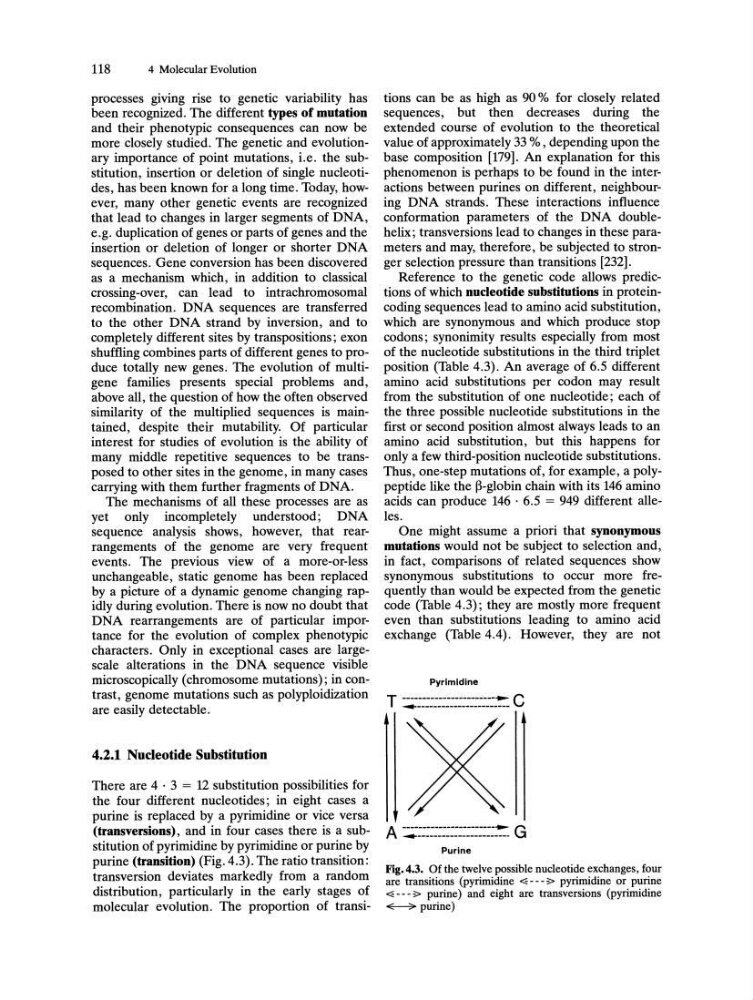
(transversions), and in four cases there is a substitution of pyrimidine by pyrimidine or purine by
purine (transition) (Fig. 4.3). The ratio transition:
transversion deviates markedly from a random
distribution, particularly in the early stages of
molecular evolution. The proportion of transitions can be as high as 90 % for closely related
sequences, but then decreases during the
extended course of evolution to the theoretical
value of approximately 33 % , depending upon the
base composition [179]. An explanation for this
phenomenon is perhaps to be found in the interactions between purines on different, neighbouring DNA strands. These interactions influence
conformation parameters of the DNA doublehelix; transversions lead to changes in these parameters and may, therefore, be subjected to stronger selection pressure than transitions [232].
Reference to the genetic code allows predictions of which nucleotide substitutions in proteincoding sequences lead to amino acid substitution,
which are synonymous and which produce stop
co dons ; synonimity results especially from most
of the nucleotide substitutions in the third triplet
position (Table 4.3). An average of 6.5 different
amino acid substitutions per codon may result
from the substitution of one nucleotide; each of
the three possible nucleotide substitutions in the
first or second position almost always leads to an
amino acid substitution, but this happens for
only a few third-position nucleotide substitutions.
Thus, one-step mutations of, for example, a polypeptide like the ~-globin chain with its 146 amino
acids can produce 146 . 6.5 = 949 different alleles.
One might assume a priori that synonymous
mutations would not be subject to selection and,
in fact, comparisons of related sequences show
synonymous substitutions to occur more frequently than would be expected from the genetic
code (Table 4.3); they are mostly more frequent
even than substitutions leading to amino acid
exchange (Table 4.4). However, they are not
Pyrimidine
T :;;:::::::::::::::::::_~ C
Purine
Fig.4.3. Of the twelve possible nucleotide exchanges, four
are transitions (pyrimidine ~ - - - ~ pyrimidine or purine
~ - - - ~ purine) and eight are transversions (pyrimidine
~purine)
4 Molecular Evolution
processes giving rise to genetic variability has
been recognized. The different types of mutation
and their phenotypic consequences can now be
more closely studied. The genetic and evolutionary importance of point mutations, i.e. the substitution, insertion or deletion of single nucleotides, has been known for a long time. Today, however, many other genetic events are recognized
that lead to changes in larger segments of DNA,
e.g. duplication of genes or parts of genes and the
insertion or deletion of longer or shorter DNA
sequences. Gene conversion has been discovered
as a mechanism which, in addition to classical
crossing-over, can lead to intrachromosomal
recombination. DNA sequences are transferred
to the other DNA strand by inversion, and to
completely different sites by transpositions; exon
shuffling combines parts of different genes to produce totally new genes. The evolution of multigene families presents special problems and,
above all, the question of how the often observed
similarity of the multiplied sequences is maintained, despite their mutability. Of particular
interest for studies of evolution is the ability of
many middle repetitive sequences to be transposed to other sites in the genome, in many cases
carrying with them further fragments of DNA.
The mechanisms of all these processes are as
yet only incompletely understood; DNA
sequence analysis shows, however, that rearrangements of the genome are very frequent
events. The previous view of a more-or-Iess
unchangeable, static genome has been replaced
by a picture of a dynamic genome changing rapidly during evolution. There is now no doubt that
DNA rearrangements are of particular importance for the evolution of complex phenotypic
characters. Only in exceptional cases are largescale alterations in the DNA sequence visible
microscopically (chromosome mutations); in contrast, genome mutations such as polyploidization
are easily detectable.
4.2.1 Nucleotide Substitution
There are 4 . 3 = 12 substitution possibilities for
the four different nucleotides; in eight cases a
purine is replaced by a pyrimidine or vice versa
(transversions), and in four cases there is a substitution of pyrimidine by pyrimidine or purine by
purine (transition) (Fig. 4.3). The ratio transition:
transversion deviates markedly from a random
distribution, particularly in the early stages of
molecular evolution. The proportion of transitions can be as high as 90 % for closely related
sequences, but then decreases during the
extended course of evolution to the theoretical
value of approximately 33 % , depending upon the
base composition [179]. An explanation for this
phenomenon is perhaps to be found in the interactions between purines on different, neighbouring DNA strands. These interactions influence
conformation parameters of the DNA doublehelix; transversions lead to changes in these parameters and may, therefore, be subjected to stronger selection pressure than transitions [232].
Reference to the genetic code allows predictions of which nucleotide substitutions in proteincoding sequences lead to amino acid substitution,
which are synonymous and which produce stop
co dons ; synonimity results especially from most
of the nucleotide substitutions in the third triplet
position (Table 4.3). An average of 6.5 different
amino acid substitutions per codon may result
from the substitution of one nucleotide; each of
the three possible nucleotide substitutions in the
first or second position almost always leads to an
amino acid substitution, but this happens for
only a few third-position nucleotide substitutions.
Thus, one-step mutations of, for example, a polypeptide like the ~-globin chain with its 146 amino
acids can produce 146 . 6.5 = 949 different alleles.
One might assume a priori that synonymous
mutations would not be subject to selection and,
in fact, comparisons of related sequences show
synonymous substitutions to occur more frequently than would be expected from the genetic
code (Table 4.3); they are mostly more frequent
even than substitutions leading to amino acid
exchange (Table 4.4). However, they are not
Pyrimidine
T :;;:::::::::::::::::::_~ C
Purine
Fig.4.3. Of the twelve possible nucleotide exchanges, four
are transitions (pyrimidine ~ - - - ~ pyrimidine or purine
~ - - - ~ purine) and eight are transversions (pyrimidine
~purine)