

4.2.1 Nucleotide Substitution
119
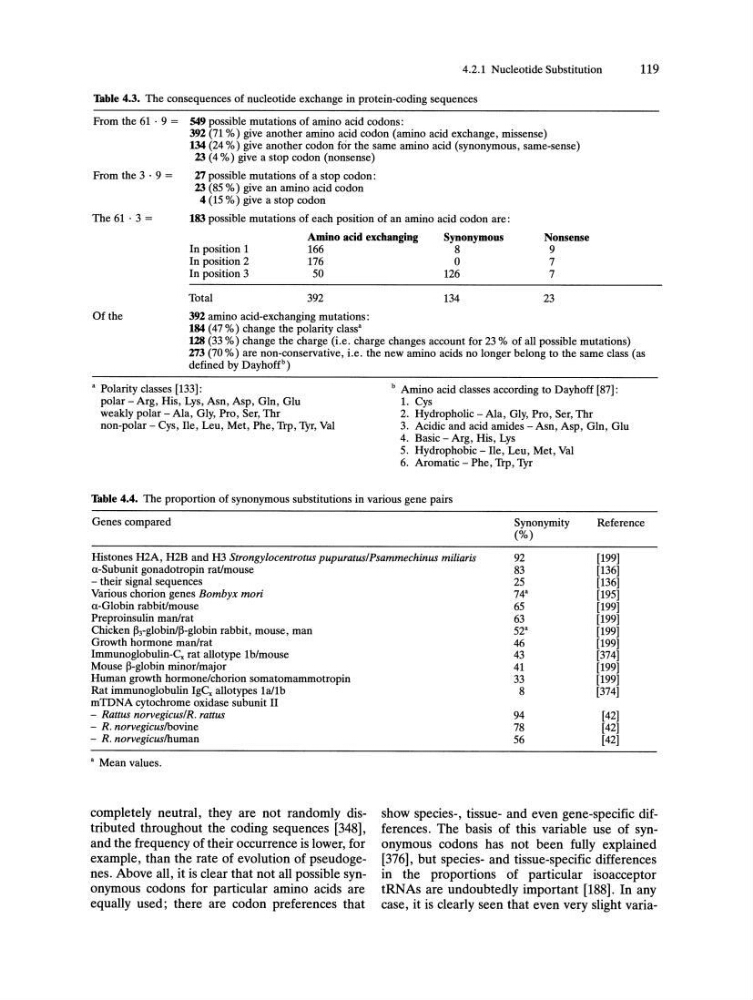
Table 4.3. The consequences of nucleotide exchange in protein-coding sequences
From the 61 . 9 = 549 possible mutations of amino acid codons:
392 (71 %) give another amino acid codon (amino acid exchange, missense)
134 (24 %) give another codon for the same amino acid (synonymous, same-sense)
23 (4 %) give a stop codon (nonsense)
From the 3 . 9 =
27 possible mutations of a stop codon:
23 (85 %) give an amino acid codon
The 61·3 =
Of the
4 (15 %) give a stop codon
183 possible mutations of each position of an amino acid codon are:
In position 1
In position 2
In position 3
Total
Amino acid exchanging
Synonymous
166
8
176
0
50
126
392
134
392 amino acid-exchanging mutations:
184 (47 % ) change the polarity class"
Nonsense
9
7
7
23
128 (33 %) change the charge (i.e. charge changes account for 23 % of all possible mutations)
273 (70 %) are non-conservative, i.e. the new amino acids no longer belong to the same class (as
defined by Dayhoffb)
" Polarity classes [133]:
polar - Arg, His, Lys, Asn, Asp, GIn, Glu
weakly polar - Ala, Gly, Pro, Ser, Thr
non-polar - Cys, lIe, Leu, Met, Phe, Trp, Tyr, Val
b Amino acid classes according to Dayhoff [87]:
1. Cys
2. Hydropholic - Ala, Gly, Pro, Ser, Thr
3. Acidic and acid amides - Asn, Asp, GIn, Glu
4. Basic - Arg, His, Lys
5. Hydrophobic - lIe, Leu, Met, Val
6. Aromatic - Phe, Trp, Tyr
Table 4.4. The proportion of synonymous substitutions in various gene pairs
Genes compared
Synonymity
Reference
(%)
Histones IDA, H2B and H3 Strongylocentrotus pupuratuslPsammechinus miliaris
a-Subunit gonadotropin rat/mouse
92
83
[199]
[136]
- their signal sequences
Various chorion genes Bombyx mori
a-Globin rabbit/mouse
Preproinsulin man/rat
Chicken ~3-globin/~-globin rabbit, mouse, man
Growth hormone man/rat
Immunoglobulin-Cx rat allotype Ib/mouse
Mouse ~-globin minor/major
Human growth hormone/chorion somatomammotropin
Rat immunoglobulin IgCx allotypes la11b
mTDNA cytochrome oxidase subunit II
- Rattus norvegicuslR. rattus
- R. norvegicus/bovine
- R. norvegicus/human
" Mean values.
completely neutral, they are not randomly distributed throughout the coding sequences [348],
and the frequency of their occurrence is lower, for
example, than the rate of evolution of pseudogenes. Above all, it is clear that not all possible synonymous codons for particular amino acids are
equally used; there are codon preferences that
25
[136]
74"
[195]
65
[199]
63
[199]
52"
[199]
46
[199]
43
[374]
41
[199]
33
[199]
8
[374]
94
[42]
78
[42]
56
[42]
show species-, tissue- and even gene-specific differences. The basis of this variable use of synonymous co dons has not been fully explained
[376], but species- and tissue-specific differences
in the proportions of particular isoacceptor
tRNAs are undoubtedly important [188]. In any
case, it is clearly seen that even very slight varia-
119
Table 4.3. The consequences of nucleotide exchange in protein-coding sequences
From the 61 . 9 = 549 possible mutations of amino acid codons:
392 (71 %) give another amino acid codon (amino acid exchange, missense)
134 (24 %) give another codon for the same amino acid (synonymous, same-sense)
23 (4 %) give a stop codon (nonsense)
From the 3 . 9 =
27 possible mutations of a stop codon:
23 (85 %) give an amino acid codon
The 61·3 =
Of the
4 (15 %) give a stop codon
183 possible mutations of each position of an amino acid codon are:
In position 1
In position 2
In position 3
Total
Amino acid exchanging
Synonymous
166
8
176
0
50
126
392
134
392 amino acid-exchanging mutations:
184 (47 % ) change the polarity class"
Nonsense
9
7
7
23
128 (33 %) change the charge (i.e. charge changes account for 23 % of all possible mutations)
273 (70 %) are non-conservative, i.e. the new amino acids no longer belong to the same class (as
defined by Dayhoffb)
" Polarity classes [133]:
polar - Arg, His, Lys, Asn, Asp, GIn, Glu
weakly polar - Ala, Gly, Pro, Ser, Thr
non-polar - Cys, lIe, Leu, Met, Phe, Trp, Tyr, Val
b Amino acid classes according to Dayhoff [87]:
1. Cys
2. Hydropholic - Ala, Gly, Pro, Ser, Thr
3. Acidic and acid amides - Asn, Asp, GIn, Glu
4. Basic - Arg, His, Lys
5. Hydrophobic - lIe, Leu, Met, Val
6. Aromatic - Phe, Trp, Tyr
Table 4.4. The proportion of synonymous substitutions in various gene pairs
Genes compared
Synonymity
Reference
(%)
Histones IDA, H2B and H3 Strongylocentrotus pupuratuslPsammechinus miliaris
a-Subunit gonadotropin rat/mouse
92
83
[199]
[136]
- their signal sequences
Various chorion genes Bombyx mori
a-Globin rabbit/mouse
Preproinsulin man/rat
Chicken ~3-globin/~-globin rabbit, mouse, man
Growth hormone man/rat
Immunoglobulin-Cx rat allotype Ib/mouse
Mouse ~-globin minor/major
Human growth hormone/chorion somatomammotropin
Rat immunoglobulin IgCx allotypes la11b
mTDNA cytochrome oxidase subunit II
- Rattus norvegicuslR. rattus
- R. norvegicus/bovine
- R. norvegicus/human
" Mean values.
completely neutral, they are not randomly distributed throughout the coding sequences [348],
and the frequency of their occurrence is lower, for
example, than the rate of evolution of pseudogenes. Above all, it is clear that not all possible synonymous codons for particular amino acids are
equally used; there are codon preferences that
25
[136]
74"
[195]
65
[199]
63
[199]
52"
[199]
46
[199]
43
[374]
41
[199]
33
[199]
8
[374]
94
[42]
78
[42]
56
[42]
show species-, tissue- and even gene-specific differences. The basis of this variable use of synonymous co dons has not been fully explained
[376], but species- and tissue-specific differences
in the proportions of particular isoacceptor
tRNAs are undoubtedly important [188]. In any
case, it is clearly seen that even very slight varia-