

92
3 The Structural Variety and Metabolism of Proteins
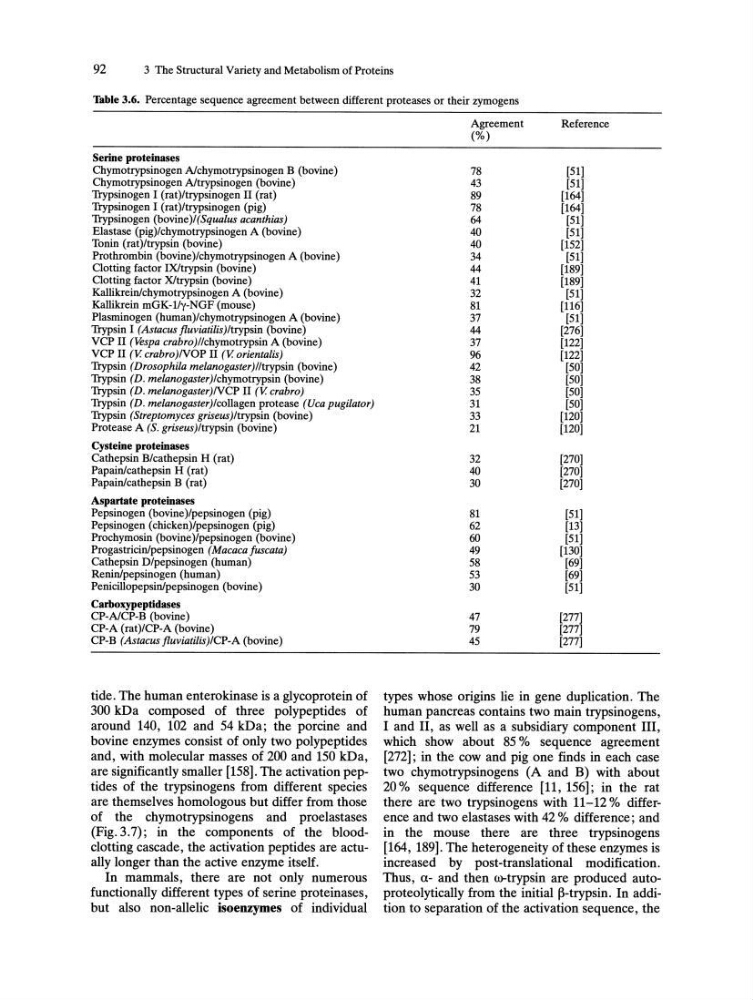
Thble 3.6. Percentage sequence agreement between different proteases or their zymogens
Serine proteinases
Chymotrypsinogen Nchymotrypsinogen B (bovine)
Chymotrypsinogen Ntrypsinogen (bovine)
Trypsinogen I (rat)/trypsinogen II (rat)
Trypsinogen I (rat)/trypsinogen (pig)
Trypsinogen (bovine)/(Squalus acanthias)
Elastase (pig)/chymotrypsinogen A (bovine)
Tonin (rat )/trypsin (bovine)
Prothrombin (bovine )/chymotrypsinogen A (bovine)
Clotting factor IX/trypsin (bovine)
Clotting factor X/trypsin (bovine)
Kallikrein/chymotrypsinogen A (bovine)
Kallikrein mGK-l/y-NGF (mouse)
Plasminogen (human)/chymotrypsinogen A (bovine)
Trypsin I (Astacus [luviatilis)/trypsin (bovine)
VCP II (Vespa crabro)lIchymotrypsin A (bovine)
VCP II (V crabro)NOP II (v. orientalis)
Trypsin (Drosophila melanogaster)lItrypsin (bovine)
Trypsin (Do melanogaster)/chymotrypsin (bovine)
Trypsin (Do melanogaster)NCP II (V crabro)
Trypsin (Do melanogaster)/collagen protease (Uca pugilator)
Trypsin (Streptomyces griseus)/trypsin (bovine)
Protease A (So griseus)/trypsin (bovine)
Cysteine proteinases
Cathepsin B/cathepsin H (rat)
Papain/cathepsin H (rat)
Papain/cathepsin B (rat)
Aspartate proteinases
Pepsinogen (bovine )/pepsinogen (pig)
Pepsinogen (chicken )/pepsinogen (pig)
Prochymosin (bovine )/pepsinogen (bovine)
Progastricin/pepsinogen (Macaca fuscata)
Cathepsin D/pepsinogen (human)
Renin/pepsinogen (human)
Penicillopepsin/pepsinogen (bovine)
Carboxypeptidases
CP-NCP-B (bovine)
CP-A (rat)/CP-A (bovine)
CP-B (Astacus [luviatilis)/CP-A (bovine)
tide. The human enterokinase is a glycoprotein of
300 kDa composed of three polypeptides of
around 140, 102 and 54 kDa; the porcine and
bovine enzymes consist of only two polypeptides
and, with molecular masses of 200 and 150 kDa,
are significantly smaller [158]. The activation peptides of the trypsinogens from different species
are themselves homologous but differ from those
of the chymotrypsinogens and proelastases
(Fig. 3.7); in the components of the bloodclotting cascade, the activation peptides are actually longer than the active enzyme itself.
In mammals, there are not only numerous
functionally different types of serine proteinases,
but also non-allelic isoenzymes of individual
Agreement
(%)
78
43
89
78
64
40
40
34
44
41
32
81
37
44
37
96
42
38
35
31
33
21
32
40
30
81
62
60
49
58
53
30
47
79
45
Reference
[51]
[51]
[164]
[164]
[51]
[51]
[152]
[51]
[189]
[189]
[51]
[116]
[51]
[276]
[122]
[122]
[50]
[50]
[50]
[50]
[120]
[120]
[270]
[270]
[270]
[51]
[13]
[51]
[130]
[69]
[69]
[51]
[277]
[277]
[277]
types whose origins lie in gene duplication. The
human pancreas contains two main trypsinogens,
I and II, as well as a subsidiary component III,
which show about 85 % sequence agreement
[272]; in the cow and pig one finds in each case
two chymotrypsinogens (A and B) with about
20 % sequence difference [11, 156]; in the rat
there are two trypsinogens with 11-12 % difference and two elastases with 42 % difference; and
in the mouse there are three trypsinogens
[164, 189]. The heterogeneity of these enzymes is
increased by post-translational modification.
Thus, a- and then oo-trypsin are produced autoproteolytically from the initial ~-trypsin. In addition to separation of the activation sequence, the
3 The Structural Variety and Metabolism of Proteins
Thble 3.6. Percentage sequence agreement between different proteases or their zymogens
Serine proteinases
Chymotrypsinogen Nchymotrypsinogen B (bovine)
Chymotrypsinogen Ntrypsinogen (bovine)
Trypsinogen I (rat)/trypsinogen II (rat)
Trypsinogen I (rat)/trypsinogen (pig)
Trypsinogen (bovine)/(Squalus acanthias)
Elastase (pig)/chymotrypsinogen A (bovine)
Tonin (rat )/trypsin (bovine)
Prothrombin (bovine )/chymotrypsinogen A (bovine)
Clotting factor IX/trypsin (bovine)
Clotting factor X/trypsin (bovine)
Kallikrein/chymotrypsinogen A (bovine)
Kallikrein mGK-l/y-NGF (mouse)
Plasminogen (human)/chymotrypsinogen A (bovine)
Trypsin I (Astacus [luviatilis)/trypsin (bovine)
VCP II (Vespa crabro)lIchymotrypsin A (bovine)
VCP II (V crabro)NOP II (v. orientalis)
Trypsin (Drosophila melanogaster)lItrypsin (bovine)
Trypsin (Do melanogaster)/chymotrypsin (bovine)
Trypsin (Do melanogaster)NCP II (V crabro)
Trypsin (Do melanogaster)/collagen protease (Uca pugilator)
Trypsin (Streptomyces griseus)/trypsin (bovine)
Protease A (So griseus)/trypsin (bovine)
Cysteine proteinases
Cathepsin B/cathepsin H (rat)
Papain/cathepsin H (rat)
Papain/cathepsin B (rat)
Aspartate proteinases
Pepsinogen (bovine )/pepsinogen (pig)
Pepsinogen (chicken )/pepsinogen (pig)
Prochymosin (bovine )/pepsinogen (bovine)
Progastricin/pepsinogen (Macaca fuscata)
Cathepsin D/pepsinogen (human)
Renin/pepsinogen (human)
Penicillopepsin/pepsinogen (bovine)
Carboxypeptidases
CP-NCP-B (bovine)
CP-A (rat)/CP-A (bovine)
CP-B (Astacus [luviatilis)/CP-A (bovine)
tide. The human enterokinase is a glycoprotein of
300 kDa composed of three polypeptides of
around 140, 102 and 54 kDa; the porcine and
bovine enzymes consist of only two polypeptides
and, with molecular masses of 200 and 150 kDa,
are significantly smaller [158]. The activation peptides of the trypsinogens from different species
are themselves homologous but differ from those
of the chymotrypsinogens and proelastases
(Fig. 3.7); in the components of the bloodclotting cascade, the activation peptides are actually longer than the active enzyme itself.
In mammals, there are not only numerous
functionally different types of serine proteinases,
but also non-allelic isoenzymes of individual
Agreement
(%)
78
43
89
78
64
40
40
34
44
41
32
81
37
44
37
96
42
38
35
31
33
21
32
40
30
81
62
60
49
58
53
30
47
79
45
Reference
[51]
[51]
[164]
[164]
[51]
[51]
[152]
[51]
[189]
[189]
[51]
[116]
[51]
[276]
[122]
[122]
[50]
[50]
[50]
[50]
[120]
[120]
[270]
[270]
[270]
[51]
[13]
[51]
[130]
[69]
[69]
[51]
[277]
[277]
[277]
types whose origins lie in gene duplication. The
human pancreas contains two main trypsinogens,
I and II, as well as a subsidiary component III,
which show about 85 % sequence agreement
[272]; in the cow and pig one finds in each case
two chymotrypsinogens (A and B) with about
20 % sequence difference [11, 156]; in the rat
there are two trypsinogens with 11-12 % difference and two elastases with 42 % difference; and
in the mouse there are three trypsinogens
[164, 189]. The heterogeneity of these enzymes is
increased by post-translational modification.
Thus, a- and then oo-trypsin are produced autoproteolytically from the initial ~-trypsin. In addition to separation of the activation sequence, the