

ment system. New serine proteinases with novel
functional characteristics are still being found,
e.g. tonin from the submaxillary gland of the rat,
or clipsin in the rat brain [152, 187]. A new serine
proteinase has even been found in human pancreatric secretions and makes up 4-6 % of the total
protein. It has a completely different specificity to
the other pancreatic enzymes; in accord with its
most prominent characteristic, it has become
known as cholesterol-binding pancreas protease
(CBPP) [265] .
Sequence comparisons clearly indicate that the
serine proteinases are all members of the same
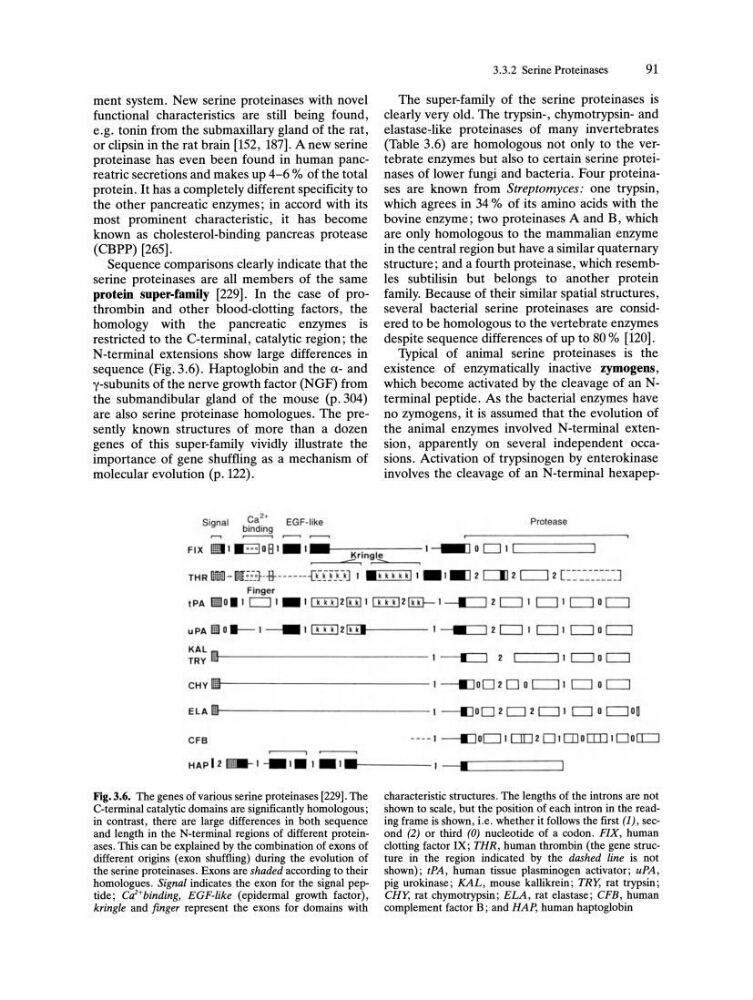
protein super-family [229]. In the case of prothrombin and other blood-clotting factors, the
homology with the pancreatic enzymes is
restricted to the C-terminal, catalytic region; the
N-terminal extensions show large differences in
sequence (Fig. 3.6). Haptoglobin and the u- and
y-subunits of the nerve growth factor (NGF) from
the submandibular gland of the mouse (p.304)
are also serine proteinase homologues. The presently known structures of more than a dozen
genes of this super-family vividly illustrate the
importance of gene shuffling as a mechanism of
molecular evolution (p. 122).
Signal
Ca 2 +
binding
..--------,
EGF- like
3.3.2 Serine Proteinases
91
The super-family of the serine proteinases is
clearly very old. The trypsin-, chymotrypsin- and
elastase-like proteinases of many invertebrates
(Table 3.6) are homologous not only to the vertebrate enzymes but also to certain serine proteinases of lower fungi and bacteria. Four protein ases are known from Streptomyces: one trypsin,
which agrees in 34 % of its amino acids with the
bovine enzyme; two proteinases A and B, which
are only homologous to the mammalian enzyme
in the central region but have a similar quaternary
structure; and a fourth proteinase, which resembles subtilisin but belongs to another protein
family. Because of their similar spatial structures,
several bacterial serine proteinases are considered to be homologous to the vertebrate enzymes
despite sequence differences of up to 80 % [120].
Typical of animal serine proteinases is the
existence of enzymatically inactive zymogens,
which become activated by the cleavage of an Nterminal peptide. As the bacterial enzymes have
no zymogens, it is assumed that the evolution of
the animal enzymes involved N-terminal extension, apparently on several independent occasions. Activation of trypsinogen by enterokinase
involves the cleavage of an N-terminal hexapepProtease
FIX . 1 ~ 0 81 _
I _1----:-:--:---:--- -
~-_",......:::K:....,r,in?;:..;t:::,e.>--...,
, 0 CJ 1 ,'--_ _ __ --'
Finger
t PA Ilii1I 0 • 1 CJ I _ 1 [ill] 2 [!J 1 [[IT] 2 [D}- 1 ----==:J 2 CJ I 0 I C=:J 0 c:::J
u PA Iii! 0 _
I _ _ 1 ITIIJ 2 [IJ-- - - I -----=:::J 2 CJ I CJ 1 C=:J 0 c:::J
KAL m
TRY 1m1! ! 1 r--- - - - - - - - - - - - - - I -c=J 2 ''--_---''1 c::::::::J 0 c::::::::J
CHY 11:--- - - - -- - - -- - - I ---I] 0 0 20 0 CJ 1 CJ 0 c:::J
ELA 1iI1--- - - - -- - - -- - - 1 - - I ] 0 0 2 D 2 CJ I CJ 0 CJ 00
CFB
HAP 12 ~ I _ _ I . 1 _1. ____ - -- - - 1 _ . -, - - -- - -- - ,
Fig.3.6. The genes of various serine proteinases [229]. The
C-terminal catalytic domains are significantly homologous;
in contrast, there are large differences in both sequence
and length in the N-terminal regions of different proteinases. This can be explained by the combination of exons of
different origins (exon shuffling) during the evolution of
the serine proteinases. Exons are shaded according to their
homologues. Signal indicates the exon for the signal peptide; cll+ binding, EG F-Uke (epidermal growth factor),
kringle and finger represent the exons for domains with
characteristic structures. The lengths of the introns are not
shown to scale, but the position of each intron in the reading frame is shown, i.e. whether it follows the first (1), second (2) or third (0) nucleotide of a codon. FIX, human
clotting factor IX; THR, human thrombin (the gene structure in the region indicated by the dashed line is not
shown); (PA, human tissue plasminogen activator; uPA,
pig urokinase; KAL, mouse kallikrein; TRY, rat trypsin;
CHY, rat chymotrypsin; ELA, rat elastase; CFB, human
complement factor B; and HAp, human haptoglobin
functional characteristics are still being found,
e.g. tonin from the submaxillary gland of the rat,
or clipsin in the rat brain [152, 187]. A new serine
proteinase has even been found in human pancreatric secretions and makes up 4-6 % of the total
protein. It has a completely different specificity to
the other pancreatic enzymes; in accord with its
most prominent characteristic, it has become
known as cholesterol-binding pancreas protease
(CBPP) [265] .
Sequence comparisons clearly indicate that the
serine proteinases are all members of the same
protein super-family [229]. In the case of prothrombin and other blood-clotting factors, the
homology with the pancreatic enzymes is
restricted to the C-terminal, catalytic region; the
N-terminal extensions show large differences in
sequence (Fig. 3.6). Haptoglobin and the u- and
y-subunits of the nerve growth factor (NGF) from
the submandibular gland of the mouse (p.304)
are also serine proteinase homologues. The presently known structures of more than a dozen
genes of this super-family vividly illustrate the
importance of gene shuffling as a mechanism of
molecular evolution (p. 122).
Signal
Ca 2 +
binding
..--------,
EGF- like
3.3.2 Serine Proteinases
91
The super-family of the serine proteinases is
clearly very old. The trypsin-, chymotrypsin- and
elastase-like proteinases of many invertebrates
(Table 3.6) are homologous not only to the vertebrate enzymes but also to certain serine proteinases of lower fungi and bacteria. Four protein ases are known from Streptomyces: one trypsin,
which agrees in 34 % of its amino acids with the
bovine enzyme; two proteinases A and B, which
are only homologous to the mammalian enzyme
in the central region but have a similar quaternary
structure; and a fourth proteinase, which resembles subtilisin but belongs to another protein
family. Because of their similar spatial structures,
several bacterial serine proteinases are considered to be homologous to the vertebrate enzymes
despite sequence differences of up to 80 % [120].
Typical of animal serine proteinases is the
existence of enzymatically inactive zymogens,
which become activated by the cleavage of an Nterminal peptide. As the bacterial enzymes have
no zymogens, it is assumed that the evolution of
the animal enzymes involved N-terminal extension, apparently on several independent occasions. Activation of trypsinogen by enterokinase
involves the cleavage of an N-terminal hexapepProtease
FIX . 1 ~ 0 81 _
I _1----:-:--:---:--- -
~-_",......:::K:....,r,in?;:..;t:::,e.>--...,
, 0 CJ 1 ,'--_ _ __ --'
Finger
t PA Ilii1I 0 • 1 CJ I _ 1 [ill] 2 [!J 1 [[IT] 2 [D}- 1 ----==:J 2 CJ I 0 I C=:J 0 c:::J
u PA Iii! 0 _
I _ _ 1 ITIIJ 2 [IJ-- - - I -----=:::J 2 CJ I CJ 1 C=:J 0 c:::J
KAL m
TRY 1m1! ! 1 r--- - - - - - - - - - - - - - I -c=J 2 ''--_---''1 c::::::::J 0 c::::::::J
CHY 11:--- - - - -- - - -- - - I ---I] 0 0 20 0 CJ 1 CJ 0 c:::J
ELA 1iI1--- - - - -- - - -- - - 1 - - I ] 0 0 2 D 2 CJ I CJ 0 CJ 00
CFB
HAP 12 ~ I _ _ I . 1 _1. ____ - -- - - 1 _ . -, - - -- - -- - ,
Fig.3.6. The genes of various serine proteinases [229]. The
C-terminal catalytic domains are significantly homologous;
in contrast, there are large differences in both sequence
and length in the N-terminal regions of different proteinases. This can be explained by the combination of exons of
different origins (exon shuffling) during the evolution of
the serine proteinases. Exons are shaded according to their
homologues. Signal indicates the exon for the signal peptide; cll+ binding, EG F-Uke (epidermal growth factor),
kringle and finger represent the exons for domains with
characteristic structures. The lengths of the introns are not
shown to scale, but the position of each intron in the reading frame is shown, i.e. whether it follows the first (1), second (2) or third (0) nucleotide of a codon. FIX, human
clotting factor IX; THR, human thrombin (the gene structure in the region indicated by the dashed line is not
shown); (PA, human tissue plasminogen activator; uPA,
pig urokinase; KAL, mouse kallikrein; TRY, rat trypsin;
CHY, rat chymotrypsin; ELA, rat elastase; CFB, human
complement factor B; and HAp, human haptoglobin