

16 Reefscape Ecology Within the South Pacific
253
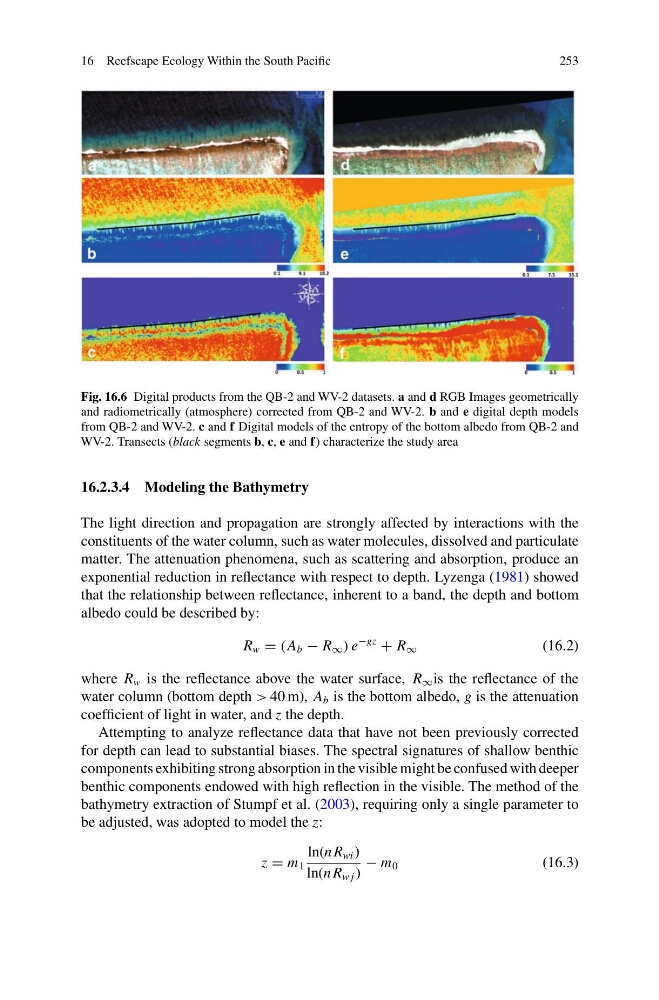
Fig. 16.6 Digital products from the QB-2 and WV-2 datasets. a and d RGB Images geometrically
and radiometrically (atmosphere) corrected from QB-2 and WV-2. b and e digital depth models
from QB-2 and WV-2. c and f Digital models of the entropy of the bottom albedo from QB-2 and
WV-2. Transects (black segments b, c, e and f) characterize the study area
16.2.3.4 Modeling the Bathymetry
The light direction and propagation are strongly affected by interactions with the
constituents of the water column, such as water molecules, dissolved and particulate
matter. The attenuation phenomena, such as scattering and absorption, produce an
exponential reduction in reflectance with respect to depth. Lyzenga (1981) showed
that the relationship between reflectance, inherent to a band, the depth and bottom
albedo could be described by:
R w = (A b − R ∞ ) e
−gz
+ R ∞
(16.2)
where R w is the reflectance above the water surface, R ∞ is the reflectance of the
water column (bottom depth > 40 m), A b is the bottom albedo, g is the attenuation
coefficient of light in water, and z the depth.
Attempting to analyze reflectance data that have not been previously corrected
for depth can lead to substantial biases. The spectral signatures of shallow benthic
components exhibiting strong absorption in the visible might be confused with deeper
benthic components endowed with high reflection in the visible. The method of the
bathymetry extraction of Stumpf et al. (2003), requiring only a single parameter to
be adjusted, was adopted to model the z:
z = m 1
ln(nR wi )
ln(nR wj )
− m 0
(16.3)
253
Fig. 16.6 Digital products from the QB-2 and WV-2 datasets. a and d RGB Images geometrically
and radiometrically (atmosphere) corrected from QB-2 and WV-2. b and e digital depth models
from QB-2 and WV-2. c and f Digital models of the entropy of the bottom albedo from QB-2 and
WV-2. Transects (black segments b, c, e and f) characterize the study area
16.2.3.4 Modeling the Bathymetry
The light direction and propagation are strongly affected by interactions with the
constituents of the water column, such as water molecules, dissolved and particulate
matter. The attenuation phenomena, such as scattering and absorption, produce an
exponential reduction in reflectance with respect to depth. Lyzenga (1981) showed
that the relationship between reflectance, inherent to a band, the depth and bottom
albedo could be described by:
R w = (A b − R ∞ ) e
−gz
+ R ∞
(16.2)
where R w is the reflectance above the water surface, R ∞ is the reflectance of the
water column (bottom depth > 40 m), A b is the bottom albedo, g is the attenuation
coefficient of light in water, and z the depth.
Attempting to analyze reflectance data that have not been previously corrected
for depth can lead to substantial biases. The spectral signatures of shallow benthic
components exhibiting strong absorption in the visible might be confused with deeper
benthic components endowed with high reflection in the visible. The method of the
bathymetry extraction of Stumpf et al. (2003), requiring only a single parameter to
be adjusted, was adopted to model the z:
z = m 1
ln(nR wi )
ln(nR wj )
− m 0
(16.3)