

166
A. Cheminée et al.
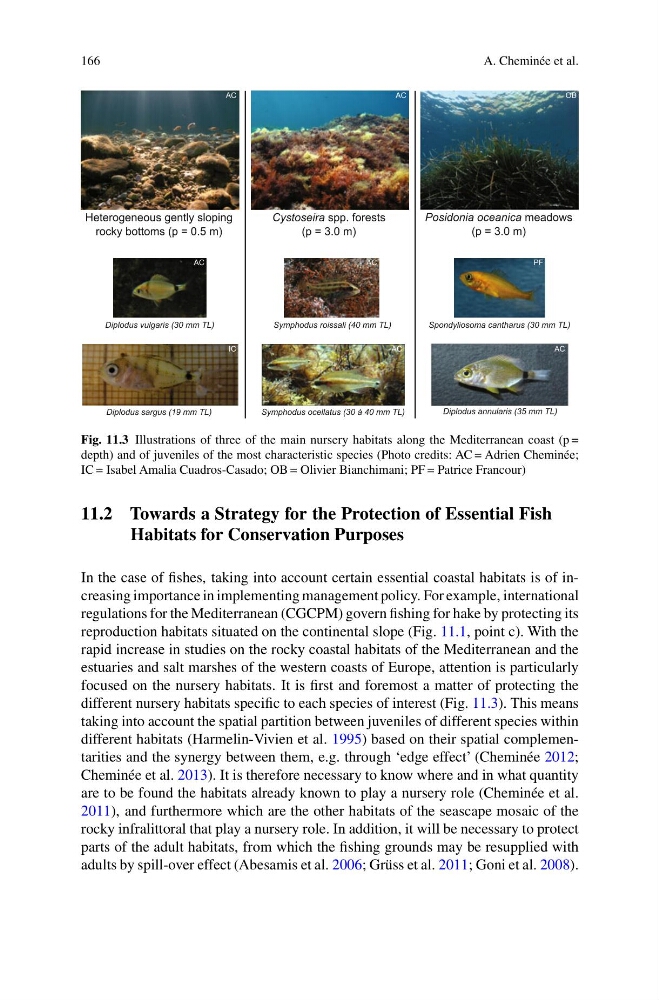
Fig. 11.3 Illustrations of three of the main nursery habitats along the Mediterranean coast (p =
depth) and of juveniles of the most characteristic species (Photo credits: AC = Adrien Cheminée;
IC = Isabel Amalia Cuadros-Casado; OB = Olivier Bianchimani; PF = Patrice Francour)
11.2 Towards a Strategy for the Protection of Essential Fish
Habitats for Conservation Purposes
In the case of fishes, taking into account certain essential coastal habitats is of increasing importance in implementing management policy. For example, international
regulations for the Mediterranean (CGCPM) govern fishing for hake by protecting its
reproduction habitats situated on the continental slope (Fig. 11.1, point c). With the
rapid increase in studies on the rocky coastal habitats of the Mediterranean and the
estuaries and salt marshes of the western coasts of Europe, attention is particularly
focused on the nursery habitats. It is first and foremost a matter of protecting the
different nursery habitats specific to each species of interest (Fig. 11.3). This means
taking into account the spatial partition between juveniles of different species within
different habitats (Harmelin-Vivien et al. 1995) based on their spatial complementarities and the synergy between them, e.g. through ‘edge effect’ (Cheminée 2012;
Cheminée et al. 2013). It is therefore necessary to know where and in what quantity
are to be found the habitats already known to play a nursery role (Cheminée et al.
2011), and furthermore which are the other habitats of the seascape mosaic of the
rocky infralittoral that play a nursery role. In addition, it will be necessary to protect
parts of the adult habitats, from which the fishing grounds may be resupplied with
adults by spill-over effect (Abesamis et al. 2006; Grüss et al. 2011; Goni et al. 2008).
A. Cheminée et al.
Fig. 11.3 Illustrations of three of the main nursery habitats along the Mediterranean coast (p =
depth) and of juveniles of the most characteristic species (Photo credits: AC = Adrien Cheminée;
IC = Isabel Amalia Cuadros-Casado; OB = Olivier Bianchimani; PF = Patrice Francour)
11.2 Towards a Strategy for the Protection of Essential Fish
Habitats for Conservation Purposes
In the case of fishes, taking into account certain essential coastal habitats is of increasing importance in implementing management policy. For example, international
regulations for the Mediterranean (CGCPM) govern fishing for hake by protecting its
reproduction habitats situated on the continental slope (Fig. 11.1, point c). With the
rapid increase in studies on the rocky coastal habitats of the Mediterranean and the
estuaries and salt marshes of the western coasts of Europe, attention is particularly
focused on the nursery habitats. It is first and foremost a matter of protecting the
different nursery habitats specific to each species of interest (Fig. 11.3). This means
taking into account the spatial partition between juveniles of different species within
different habitats (Harmelin-Vivien et al. 1995) based on their spatial complementarities and the synergy between them, e.g. through ‘edge effect’ (Cheminée 2012;
Cheminée et al. 2013). It is therefore necessary to know where and in what quantity
are to be found the habitats already known to play a nursery role (Cheminée et al.
2011), and furthermore which are the other habitats of the seascape mosaic of the
rocky infralittoral that play a nursery role. In addition, it will be necessary to protect
parts of the adult habitats, from which the fishing grounds may be resupplied with
adults by spill-over effect (Abesamis et al. 2006; Grüss et al. 2011; Goni et al. 2008).