

11 Management of Infralittoral Habitats: Towards a Seascape Scale Approach
165
Essenal habitats of the life cycle: altogether or confined into a limited space
reproducon
nurseries
feeding
resng
Dispersion
capacity
« Resident species »
« Migrant species »
GeneƟc
structuraƟon
MetapopulaƟons
Panmixia
ConnecƟvity
between
habitats
Essenal habitats of the life cycle: separated
reproducon
nurseries
feeding
resng
Low connecƟvity
High connecƟvity
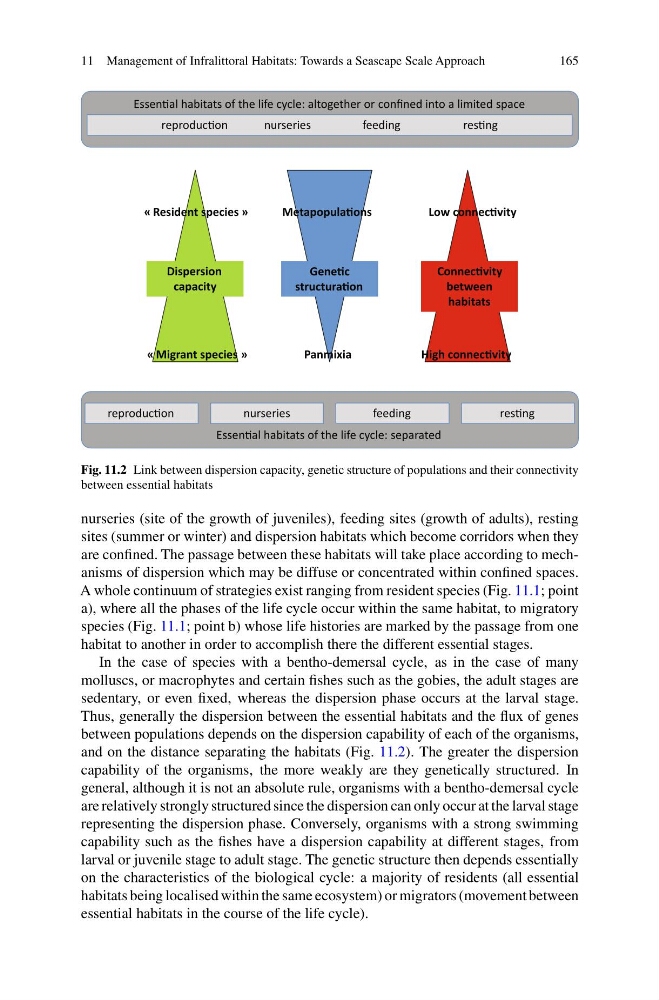
Fig. 11.2 Link between dispersion capacity, genetic structure of populations and their connectivity
between essential habitats
nurseries (site of the growth of juveniles), feeding sites (growth of adults), resting
sites (summer or winter) and dispersion habitats which become corridors when they
are confined. The passage between these habitats will take place according to mechanisms of dispersion which may be diffuse or concentrated within confined spaces.
A whole continuum of strategies exist ranging from resident species (Fig. 11.1; point
a), where all the phases of the life cycle occur within the same habitat, to migratory
species (Fig. 11.1; point b) whose life histories are marked by the passage from one
habitat to another in order to accomplish there the different essential stages.
In the case of species with a bentho-demersal cycle, as in the case of many
molluscs, or macrophytes and certain fishes such as the gobies, the adult stages are
sedentary, or even fixed, whereas the dispersion phase occurs at the larval stage.
Thus, generally the dispersion between the essential habitats and the flux of genes
between populations depends on the dispersion capability of each of the organisms,
and on the distance separating the habitats (Fig. 11.2). The greater the dispersion
capability of the organisms, the more weakly are they genetically structured. In
general, although it is not an absolute rule, organisms with a bentho-demersal cycle
are relatively strongly structured since the dispersion can only occur at the larval stage
representing the dispersion phase. Conversely, organisms with a strong swimming
capability such as the fishes have a dispersion capability at different stages, from
larval or juvenile stage to adult stage. The genetic structure then depends essentially
on the characteristics of the biological cycle: a majority of residents (all essential
habitats being localised within the same ecosystem) or migrators (movement between
essential habitats in the course of the life cycle).
165
Essenal habitats of the life cycle: altogether or confined into a limited space
reproducon
nurseries
feeding
resng
Dispersion
capacity
« Resident species »
« Migrant species »
GeneƟc
structuraƟon
MetapopulaƟons
Panmixia
ConnecƟvity
between
habitats
Essenal habitats of the life cycle: separated
reproducon
nurseries
feeding
resng
Low connecƟvity
High connecƟvity
Fig. 11.2 Link between dispersion capacity, genetic structure of populations and their connectivity
between essential habitats
nurseries (site of the growth of juveniles), feeding sites (growth of adults), resting
sites (summer or winter) and dispersion habitats which become corridors when they
are confined. The passage between these habitats will take place according to mechanisms of dispersion which may be diffuse or concentrated within confined spaces.
A whole continuum of strategies exist ranging from resident species (Fig. 11.1; point
a), where all the phases of the life cycle occur within the same habitat, to migratory
species (Fig. 11.1; point b) whose life histories are marked by the passage from one
habitat to another in order to accomplish there the different essential stages.
In the case of species with a bentho-demersal cycle, as in the case of many
molluscs, or macrophytes and certain fishes such as the gobies, the adult stages are
sedentary, or even fixed, whereas the dispersion phase occurs at the larval stage.
Thus, generally the dispersion between the essential habitats and the flux of genes
between populations depends on the dispersion capability of each of the organisms,
and on the distance separating the habitats (Fig. 11.2). The greater the dispersion
capability of the organisms, the more weakly are they genetically structured. In
general, although it is not an absolute rule, organisms with a bentho-demersal cycle
are relatively strongly structured since the dispersion can only occur at the larval stage
representing the dispersion phase. Conversely, organisms with a strong swimming
capability such as the fishes have a dispersion capability at different stages, from
larval or juvenile stage to adult stage. The genetic structure then depends essentially
on the characteristics of the biological cycle: a majority of residents (all essential
habitats being localised within the same ecosystem) or migrators (movement between
essential habitats in the course of the life cycle).