

11 Management of Infralittoral Habitats: Towards a Seascape Scale Approach
167
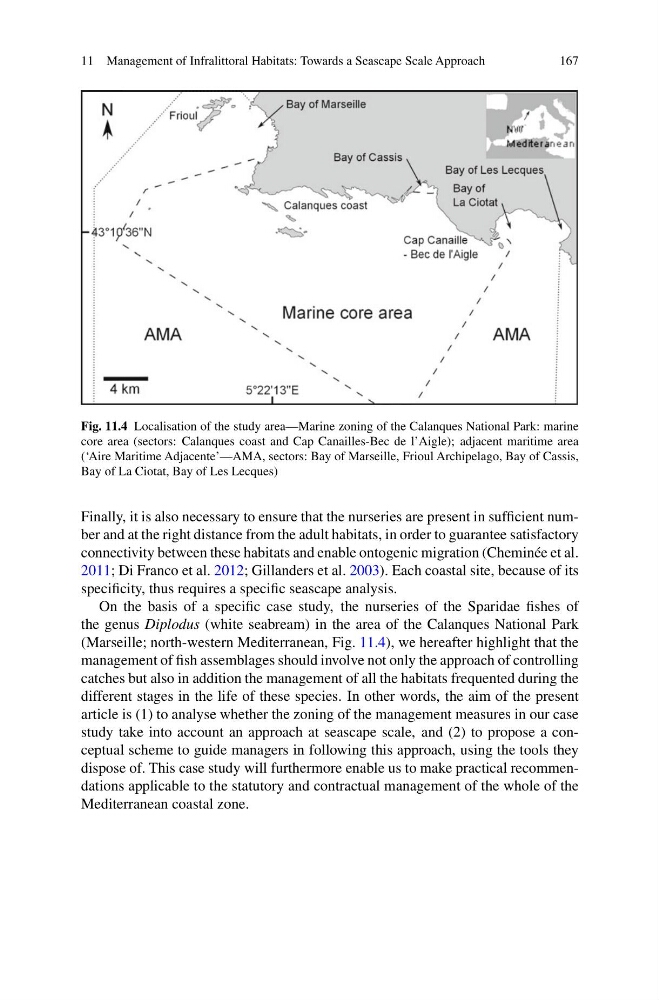
Fig. 11.4 Localisation of the study area—Marine zoning of the Calanques National Park: marine
core area (sectors: Calanques coast and Cap Canailles-Bec de l’Aigle); adjacent maritime area
(‘Aire Maritime Adjacente’—AMA, sectors: Bay of Marseille, Frioul Archipelago, Bay of Cassis,
Bay of La Ciotat, Bay of Les Lecques)
Finally, it is also necessary to ensure that the nurseries are present in sufficient number and at the right distance from the adult habitats, in order to guarantee satisfactory
connectivity between these habitats and enable ontogenic migration (Cheminée et al.
2011; Di Franco et al. 2012; Gillanders et al. 2003). Each coastal site, because of its
specificity, thus requires a specific seascape analysis.
On the basis of a specific case study, the nurseries of the Sparidae fishes of
the genus Diplodus (white seabream) in the area of the Calanques National Park
(Marseille; north-western Mediterranean, Fig. 11.4), we hereafter highlight that the
management of fish assemblages should involve not only the approach of controlling
catches but also in addition the management of all the habitats frequented during the
different stages in the life of these species. In other words, the aim of the present
article is (1) to analyse whether the zoning of the management measures in our case
study take into account an approach at seascape scale, and (2) to propose a conceptual scheme to guide managers in following this approach, using the tools they
dispose of. This case study will furthermore enable us to make practical recommendations applicable to the statutory and contractual management of the whole of the
Mediterranean coastal zone.
167
Fig. 11.4 Localisation of the study area—Marine zoning of the Calanques National Park: marine
core area (sectors: Calanques coast and Cap Canailles-Bec de l’Aigle); adjacent maritime area
(‘Aire Maritime Adjacente’—AMA, sectors: Bay of Marseille, Frioul Archipelago, Bay of Cassis,
Bay of La Ciotat, Bay of Les Lecques)
Finally, it is also necessary to ensure that the nurseries are present in sufficient number and at the right distance from the adult habitats, in order to guarantee satisfactory
connectivity between these habitats and enable ontogenic migration (Cheminée et al.
2011; Di Franco et al. 2012; Gillanders et al. 2003). Each coastal site, because of its
specificity, thus requires a specific seascape analysis.
On the basis of a specific case study, the nurseries of the Sparidae fishes of
the genus Diplodus (white seabream) in the area of the Calanques National Park
(Marseille; north-western Mediterranean, Fig. 11.4), we hereafter highlight that the
management of fish assemblages should involve not only the approach of controlling
catches but also in addition the management of all the habitats frequented during the
different stages in the life of these species. In other words, the aim of the present
article is (1) to analyse whether the zoning of the management measures in our case
study take into account an approach at seascape scale, and (2) to propose a conceptual scheme to guide managers in following this approach, using the tools they
dispose of. This case study will furthermore enable us to make practical recommendations applicable to the statutory and contractual management of the whole of the
Mediterranean coastal zone.