

10 The Concept of Marine Landscapes Within the French Information System . . .
157
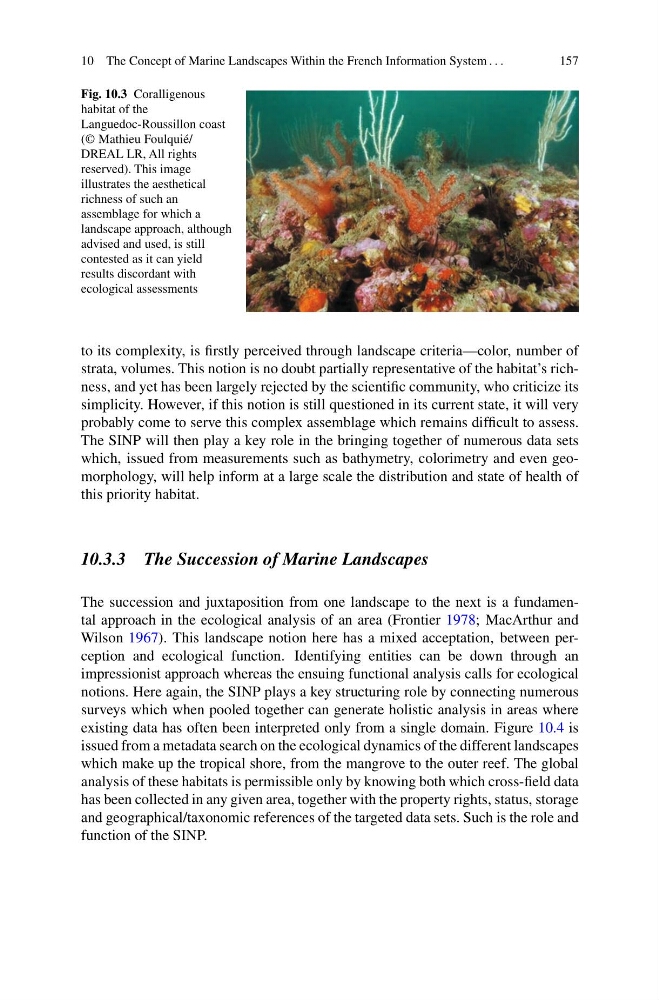
Fig. 10.3 Coralligenous
habitat of the
Languedoc-Roussillon coast
(© Mathieu Foulquié/
DREAL LR, All rights
reserved). This image
illustrates the aesthetical
richness of such an
assemblage for which a
landscape approach, although
advised and used, is still
contested as it can yield
results discordant with
ecological assessments
to its complexity, is firstly perceived through landscape criteria—color, number of
strata, volumes. This notion is no doubt partially representative of the habitat’s richness, and yet has been largely rejected by the scientific community, who criticize its
simplicity. However, if this notion is still questioned in its current state, it will very
probably come to serve this complex assemblage which remains difficult to assess.
The SINP will then play a key role in the bringing together of numerous data sets
which, issued from measurements such as bathymetry, colorimetry and even geomorphology, will help inform at a large scale the distribution and state of health of
this priority habitat.
10.3.3 The Succession of Marine Landscapes
The succession and juxtaposition from one landscape to the next is a fundamental approach in the ecological analysis of an area (Frontier 1978; MacArthur and
Wilson 1967). This landscape notion here has a mixed acceptation, between perception and ecological function. Identifying entities can be down through an
impressionist approach whereas the ensuing functional analysis calls for ecological
notions. Here again, the SINP plays a key structuring role by connecting numerous
surveys which when pooled together can generate holistic analysis in areas where
existing data has often been interpreted only from a single domain. Figure 10.4 is
issued from a metadata search on the ecological dynamics of the different landscapes
which make up the tropical shore, from the mangrove to the outer reef. The global
analysis of these habitats is permissible only by knowing both which cross-field data
has been collected in any given area, together with the property rights, status, storage
and geographical/taxonomic references of the targeted data sets. Such is the role and
function of the SINP.
157
Fig. 10.3 Coralligenous
habitat of the
Languedoc-Roussillon coast
(© Mathieu Foulquié/
DREAL LR, All rights
reserved). This image
illustrates the aesthetical
richness of such an
assemblage for which a
landscape approach, although
advised and used, is still
contested as it can yield
results discordant with
ecological assessments
to its complexity, is firstly perceived through landscape criteria—color, number of
strata, volumes. This notion is no doubt partially representative of the habitat’s richness, and yet has been largely rejected by the scientific community, who criticize its
simplicity. However, if this notion is still questioned in its current state, it will very
probably come to serve this complex assemblage which remains difficult to assess.
The SINP will then play a key role in the bringing together of numerous data sets
which, issued from measurements such as bathymetry, colorimetry and even geomorphology, will help inform at a large scale the distribution and state of health of
this priority habitat.
10.3.3 The Succession of Marine Landscapes
The succession and juxtaposition from one landscape to the next is a fundamental approach in the ecological analysis of an area (Frontier 1978; MacArthur and
Wilson 1967). This landscape notion here has a mixed acceptation, between perception and ecological function. Identifying entities can be down through an
impressionist approach whereas the ensuing functional analysis calls for ecological
notions. Here again, the SINP plays a key structuring role by connecting numerous
surveys which when pooled together can generate holistic analysis in areas where
existing data has often been interpreted only from a single domain. Figure 10.4 is
issued from a metadata search on the ecological dynamics of the different landscapes
which make up the tropical shore, from the mangrove to the outer reef. The global
analysis of these habitats is permissible only by knowing both which cross-field data
has been collected in any given area, together with the property rights, status, storage
and geographical/taxonomic references of the targeted data sets. Such is the role and
function of the SINP.