

66
J. Kuo and C. den Hartog
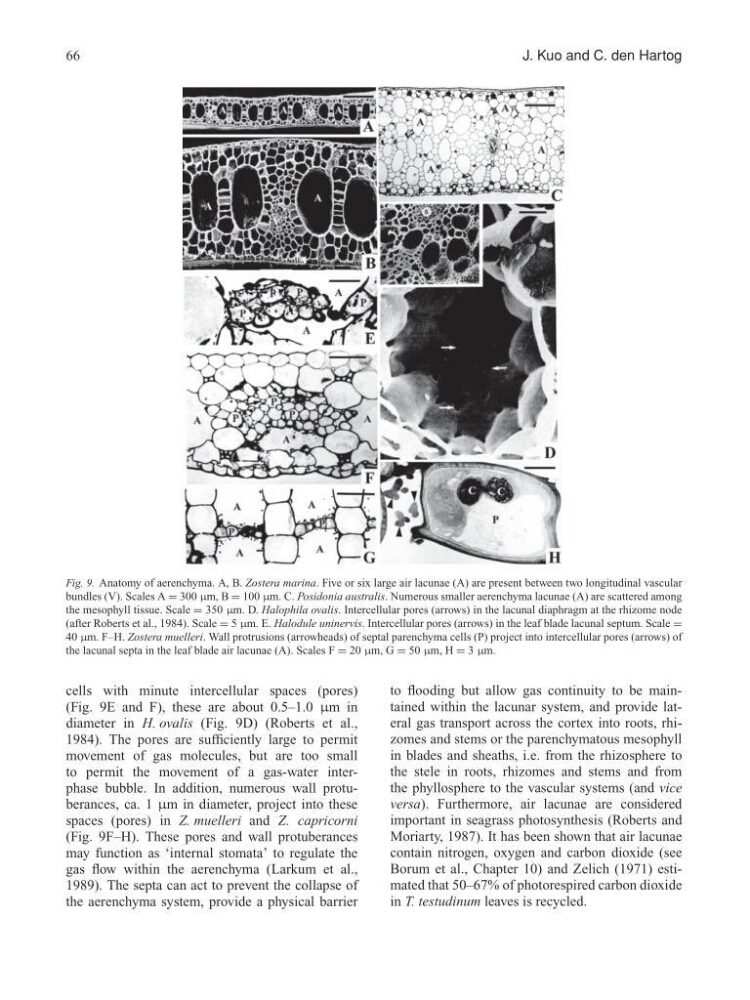
Fig. 9. Anatomy of aerenchyma. A, B. Zostera marina. Five or six large air lacunae (A) are present between two longitudinal vascular
bundles (V). Scales A = 300 µm, B = 100 µm. C. Posidonia australis. Numerous smaller aerenchyma lacunae (A) are scattered among
the mesophyll tissue. Scale = 350 µm. D. Halophila ovalis. Intercellular pores (arrows) in the lacunal diaphragm at the rhizome node
(after Roberts et al., 1984). Scale = 5 µm. E. Halodule uninervis. Intercellular pores (arrows) in the leaf blade lacunal septum. Scale =
40 µm. F–H. Zostera muelleri. Wall protrusions (arrowheads) of septal parenchyma cells (P) project into intercellular pores (arrows) of
the lacunal septa in the leaf blade air lacunae (A). Scales F = 20 µm, G = 50 µm, H = 3 µm.
cells with minute intercellular spaces (pores)
(Fig. 9E and F), these are about 0.5–1.0 µm in
diameter in H. ovalis (Fig. 9D) (Roberts et al.,
1984). The pores are sufficiently large to permit
movement of gas molecules, but are too small
to permit the movement of a gas-water interphase bubble. In addition, numerous wall protuberances, ca. 1 µm in diameter, project into these
spaces (pores) in Z. muelleri and Z. capricorni
(Fig. 9F–H). These pores and wall protuberances
may function as ‘internal stomata’ to regulate the
gas flow within the aerenchyma (Larkum et al.,
1989). The septa can act to prevent the collapse of
the aerenchyma system, provide a physical barrier
to flooding but allow gas continuity to be maintained within the lacunar system, and provide lateral gas transport across the cortex into roots, rhizomes and stems or the parenchymatous mesophyll
in blades and sheaths, i.e. from the rhizosphere to
the stele in roots, rhizomes and stems and from
the phyllosphere to the vascular systems (and vice
versa). Furthermore, air lacunae are considered
important in seagrass photosynthesis (Roberts and
Moriarty, 1987). It has been shown that air lacunae
contain nitrogen, oxygen and carbon dioxide (see
Borum et al., Chapter 10) and Zelich (1971) estimated that 50–67% of photorespired carbon dioxide
in T. testudinum leaves is recycled.
J. Kuo and C. den Hartog
Fig. 9. Anatomy of aerenchyma. A, B. Zostera marina. Five or six large air lacunae (A) are present between two longitudinal vascular
bundles (V). Scales A = 300 µm, B = 100 µm. C. Posidonia australis. Numerous smaller aerenchyma lacunae (A) are scattered among
the mesophyll tissue. Scale = 350 µm. D. Halophila ovalis. Intercellular pores (arrows) in the lacunal diaphragm at the rhizome node
(after Roberts et al., 1984). Scale = 5 µm. E. Halodule uninervis. Intercellular pores (arrows) in the leaf blade lacunal septum. Scale =
40 µm. F–H. Zostera muelleri. Wall protrusions (arrowheads) of septal parenchyma cells (P) project into intercellular pores (arrows) of
the lacunal septa in the leaf blade air lacunae (A). Scales F = 20 µm, G = 50 µm, H = 3 µm.
cells with minute intercellular spaces (pores)
(Fig. 9E and F), these are about 0.5–1.0 µm in
diameter in H. ovalis (Fig. 9D) (Roberts et al.,
1984). The pores are sufficiently large to permit
movement of gas molecules, but are too small
to permit the movement of a gas-water interphase bubble. In addition, numerous wall protuberances, ca. 1 µm in diameter, project into these
spaces (pores) in Z. muelleri and Z. capricorni
(Fig. 9F–H). These pores and wall protuberances
may function as ‘internal stomata’ to regulate the
gas flow within the aerenchyma (Larkum et al.,
1989). The septa can act to prevent the collapse of
the aerenchyma system, provide a physical barrier
to flooding but allow gas continuity to be maintained within the lacunar system, and provide lateral gas transport across the cortex into roots, rhizomes and stems or the parenchymatous mesophyll
in blades and sheaths, i.e. from the rhizosphere to
the stele in roots, rhizomes and stems and from
the phyllosphere to the vascular systems (and vice
versa). Furthermore, air lacunae are considered
important in seagrass photosynthesis (Roberts and
Moriarty, 1987). It has been shown that air lacunae
contain nitrogen, oxygen and carbon dioxide (see
Borum et al., Chapter 10) and Zelich (1971) estimated that 50–67% of photorespired carbon dioxide
in T. testudinum leaves is recycled.