

Chapter 21 Seagrasses, Fish, and Fisheries
519
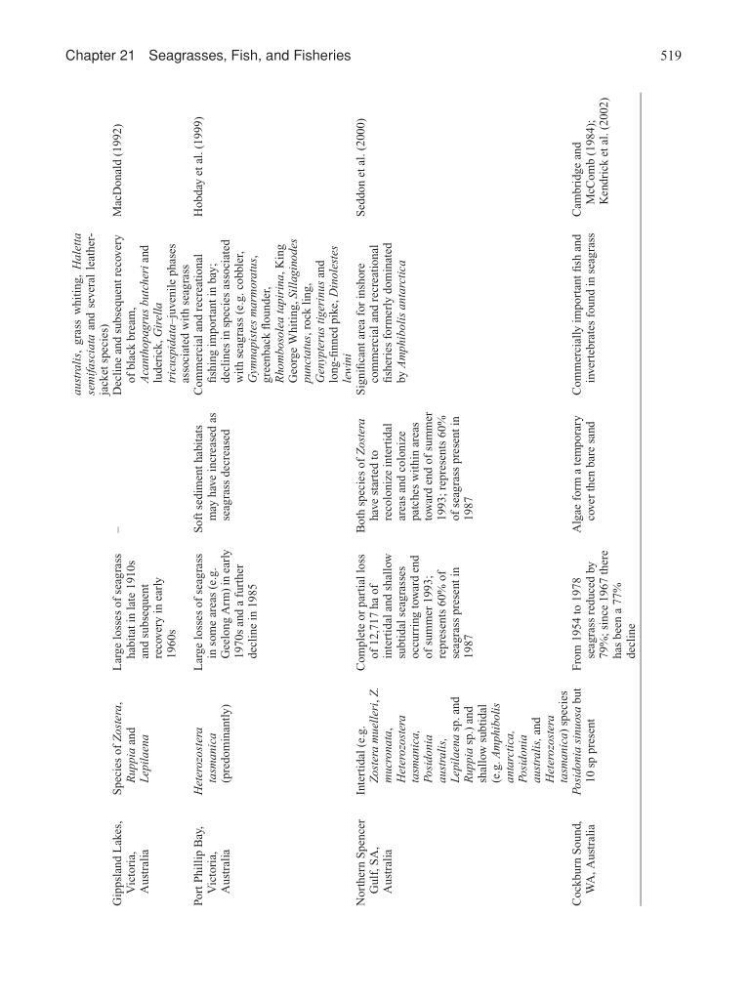
australis, grass whiting, Haletta
semifasciata and several leatherjacket species)
Gippsland Lakes,
Victoria,
Australia
Species of Zostera,
Ruppia and
Lepilaena
Large losses of seagrass
habitat in late 1910s
and subsequent
recovery in early
1960s
–
Decline and subsequent recovery
of black bream,
Acanthopagrus butcheri and
luderick, Girella
tricuspidata–juvenile phases
associated with seagrass
MacDonald (1992)
Port Phillip Bay,
Victoria,
Australia
Heterozostera
tasmanica
(predominantly)
Large losses of seagrass
in some areas (e.g.
Geelong Arm) in early
1970s and a further
decline in 1985
Soft sediment habitats
may have increased as
seagrass decreased
Commercial and recreational
fishing important in bay;
declines in species associated
with seagrass (e.g. cobbler,
Gymnapistes marmoratus,
greenback flounder,
Rhombosolea tapirina, King
George Whiting, Sillaginodes
punctatus, rock ling,
Genypterus tigerinus and
long-finned pike, Dinolestes
lewini
Hobday et al. (1999)
Northern Spencer
Gulf, SA,
Australia
Intertidal (e.g.
Zostera muelleri, Z.
mucronata,
Heterozostera
tasmanica,
Posidonia
australis,
Lepilaena sp. and
Ruppia sp.) and
shallow subtidal
(e.g. Amphibolis
antarctica,
Posidonia
australis, and
Heterozostera
tasmanica) species
Complete or partial loss
of 12,717 ha of
intertidal and shallow
subtidal seagrasses
occurring toward end
of summer 1993;
represents 60% of
seagrass present in
1987
Both species of Zostera
have started to
recolonize intertidal
areas and colonize
patches within areas
toward end of summer
1993; represents 60%
of seagrass present in
1987
Significant area for inshore
commercial and recreational
fisheries formerly dominated
by Amphibolis antarctica
Seddon et al. (2000)
Cockburn Sound,
WA, Australia
Posidonia sinuosa but
10 sp present
From 1954 to 1978
seagrass reduced by
79%; since 1967 there
has been a 77%
decline
Algae form a temporary
cover then bare sand
Commercially important fish and
invertebrates found in seagrass
Cambridge and
McComb (1984);
Kendrick et al. (2002)
519
australis, grass whiting, Haletta
semifasciata and several leatherjacket species)
Gippsland Lakes,
Victoria,
Australia
Species of Zostera,
Ruppia and
Lepilaena
Large losses of seagrass
habitat in late 1910s
and subsequent
recovery in early
1960s
–
Decline and subsequent recovery
of black bream,
Acanthopagrus butcheri and
luderick, Girella
tricuspidata–juvenile phases
associated with seagrass
MacDonald (1992)
Port Phillip Bay,
Victoria,
Australia
Heterozostera
tasmanica
(predominantly)
Large losses of seagrass
in some areas (e.g.
Geelong Arm) in early
1970s and a further
decline in 1985
Soft sediment habitats
may have increased as
seagrass decreased
Commercial and recreational
fishing important in bay;
declines in species associated
with seagrass (e.g. cobbler,
Gymnapistes marmoratus,
greenback flounder,
Rhombosolea tapirina, King
George Whiting, Sillaginodes
punctatus, rock ling,
Genypterus tigerinus and
long-finned pike, Dinolestes
lewini
Hobday et al. (1999)
Northern Spencer
Gulf, SA,
Australia
Intertidal (e.g.
Zostera muelleri, Z.
mucronata,
Heterozostera
tasmanica,
Posidonia
australis,
Lepilaena sp. and
Ruppia sp.) and
shallow subtidal
(e.g. Amphibolis
antarctica,
Posidonia
australis, and
Heterozostera
tasmanica) species
Complete or partial loss
of 12,717 ha of
intertidal and shallow
subtidal seagrasses
occurring toward end
of summer 1993;
represents 60% of
seagrass present in
1987
Both species of Zostera
have started to
recolonize intertidal
areas and colonize
patches within areas
toward end of summer
1993; represents 60%
of seagrass present in
1987
Significant area for inshore
commercial and recreational
fisheries formerly dominated
by Amphibolis antarctica
Seddon et al. (2000)
Cockburn Sound,
WA, Australia
Posidonia sinuosa but
10 sp present
From 1954 to 1978
seagrass reduced by
79%; since 1967 there
has been a 77%
decline
Algae form a temporary
cover then bare sand
Commercially important fish and
invertebrates found in seagrass
Cambridge and
McComb (1984);
Kendrick et al. (2002)