

518
Bronwyn M. Gillanders
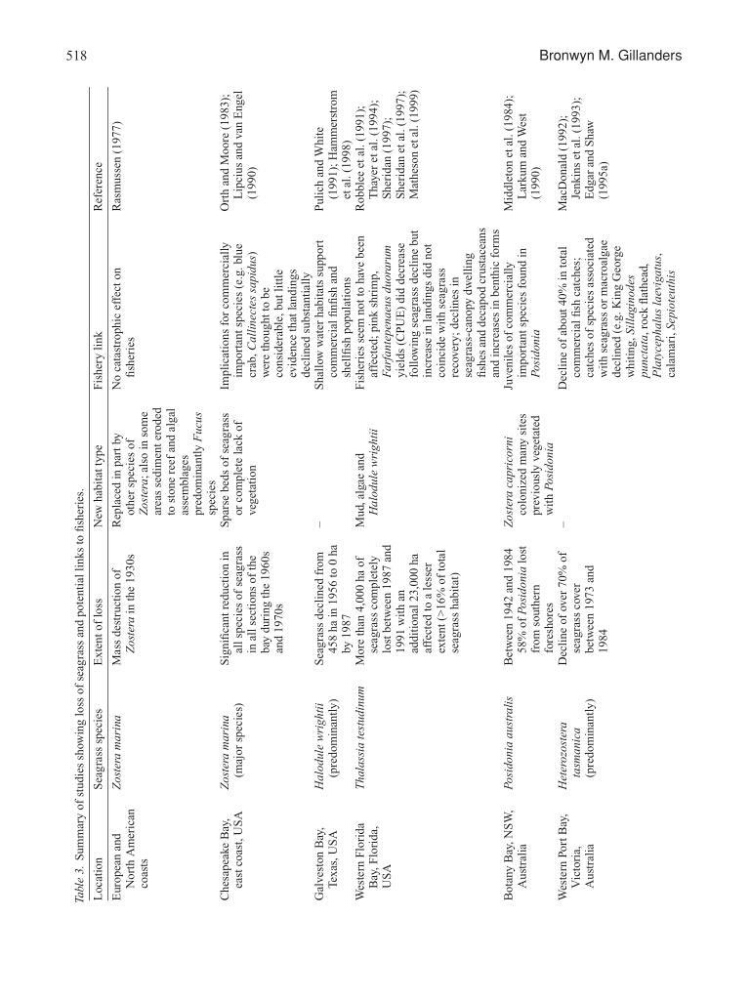
Table 3. Summary of studies showing loss of seagrass and potential links to fisheries.
Location
Seagrass species
Extent of loss
New habitat type
Fishery link
Reference
European and
North American
coasts
Zostera marina
Mass destruction of
Zostera in the 1930s
Replaced in part by
other species of
Zostera; also in some
areas sediment eroded
to stone reef and algal
assemblages
predominantly Fucus
species
No catastrophic effect on
fisheries
Rasmussen (1977)
Chesapeake Bay,
east coast, USA
Zostera marina
(major species)
Significant reduction in
all species of seagrass
in all sections of the
bay during the 1960s
and 1970s
Sparse beds of seagrass
or complete lack of
vegetation
Implications for commercially
important species (e.g. blue
crab, Callinectes sapidus)
were thought to be
considerable, but little
evidence that landings
declined substantially
Orth and Moore (1983);
Lipcius and van Engel
(1990)
Galveston Bay,
Texas, USA
Halodule wrightii
(predominantly)
Seagrass declined from
458 ha in 1956 to 0 ha
by 1987
–
Shallow water habitats support
commercial finfish and
shellfish populations
Pulich and White
(1991); Hammerstrom
et al. (1998)
Western Florida
Bay, Florida,
USA
Thalassia testudinum
More than 4,000 ha of
seagrass completely
lost between 1987 and
1991 with an
additional 23,000 ha
affected to a lesser
extent (>16% of total
seagrass habitat)
Mud, algae and
Halodule wrightii
Fisheries seem not to have been
affected; pink shrimp,
Farfantepenaeus duorarum
yields (CPUE) did decrease
following seagrass decline but
increase in landings did not
coincide with seagrass
recovery; declines in
seagrass-canopy dwelling
fishes and decapod crustaceans
and increases in benthic forms
Robblee et al. (1991);
Thayer et al. (1994);
Sheridan (1997);
Sheridan et al. (1997);
Matheson et al. (1999)
Botany Bay, NSW,
Australia
Posidonia australis
Between 1942 and 1984
58% of Posidonia lost
from southern
foreshores
Zostera capricorni
colonized many sites
previously vegetated
with Posidonia
Juveniles of commercially
important species found in
Posidonia
Middleton et al. (1984);
Larkum and West
(1990)
Western Port Bay,
Victoria,
Australia
Heterozostera
tasmanica
(predominantly)
Decline of over 70% of
seagrass cover
between 1973 and
1984
–
Decline of about 40% in total
commercial fish catches;
catches of species associated
with seagrass or macroalgae
declined (e.g. King George
whiting, Sillaginodes
punctata, rock flathead,
Platycephalus laevigatus,
calamari, Sepioteuthis
MacDonald (1992);
Jenkins et al. (1993);
Edgar and Shaw
(1995a)
Bronwyn M. Gillanders
Table 3. Summary of studies showing loss of seagrass and potential links to fisheries.
Location
Seagrass species
Extent of loss
New habitat type
Fishery link
Reference
European and
North American
coasts
Zostera marina
Mass destruction of
Zostera in the 1930s
Replaced in part by
other species of
Zostera; also in some
areas sediment eroded
to stone reef and algal
assemblages
predominantly Fucus
species
No catastrophic effect on
fisheries
Rasmussen (1977)
Chesapeake Bay,
east coast, USA
Zostera marina
(major species)
Significant reduction in
all species of seagrass
in all sections of the
bay during the 1960s
and 1970s
Sparse beds of seagrass
or complete lack of
vegetation
Implications for commercially
important species (e.g. blue
crab, Callinectes sapidus)
were thought to be
considerable, but little
evidence that landings
declined substantially
Orth and Moore (1983);
Lipcius and van Engel
(1990)
Galveston Bay,
Texas, USA
Halodule wrightii
(predominantly)
Seagrass declined from
458 ha in 1956 to 0 ha
by 1987
–
Shallow water habitats support
commercial finfish and
shellfish populations
Pulich and White
(1991); Hammerstrom
et al. (1998)
Western Florida
Bay, Florida,
USA
Thalassia testudinum
More than 4,000 ha of
seagrass completely
lost between 1987 and
1991 with an
additional 23,000 ha
affected to a lesser
extent (>16% of total
seagrass habitat)
Mud, algae and
Halodule wrightii
Fisheries seem not to have been
affected; pink shrimp,
Farfantepenaeus duorarum
yields (CPUE) did decrease
following seagrass decline but
increase in landings did not
coincide with seagrass
recovery; declines in
seagrass-canopy dwelling
fishes and decapod crustaceans
and increases in benthic forms
Robblee et al. (1991);
Thayer et al. (1994);
Sheridan (1997);
Sheridan et al. (1997);
Matheson et al. (1999)
Botany Bay, NSW,
Australia
Posidonia australis
Between 1942 and 1984
58% of Posidonia lost
from southern
foreshores
Zostera capricorni
colonized many sites
previously vegetated
with Posidonia
Juveniles of commercially
important species found in
Posidonia
Middleton et al. (1984);
Larkum and West
(1990)
Western Port Bay,
Victoria,
Australia
Heterozostera
tasmanica
(predominantly)
Decline of over 70% of
seagrass cover
between 1973 and
1984
–
Decline of about 40% in total
commercial fish catches;
catches of species associated
with seagrass or macroalgae
declined (e.g. King George
whiting, Sillaginodes
punctata, rock flathead,
Platycephalus laevigatus,
calamari, Sepioteuthis
MacDonald (1992);
Jenkins et al. (1993);
Edgar and Shaw
(1995a)