

520
Bronwyn M. Gillanders
Alternative methods have been used to examine
the effects of seagrass loss on fisheries. Three areas
with seagrass beds growing immediately offshore
were compared with three other areas where seagrass
was lost by the early 1970s, but few clear patterns
in numbers of species, numbers of individuals, and
biomasses could be related to the presence or absence of seagrass (Vanderklift and Jacoby, 2003).
However, it should be noted that areas with and
without seagrass were not interspersed in the above
study, thus spatial factors other than the presence or
absence of seagrass may have led to the observed
patterns. These results contrast with those of Wyda
et al. (2002) who found that numbers of species,
and biomass declined in areas that were degraded
and where seagrass was previously present. In addition, the relative species composition altered with
loss of SAV leading to higher proportions of pelagic
species. The effects of loss seagrass habitat on fish
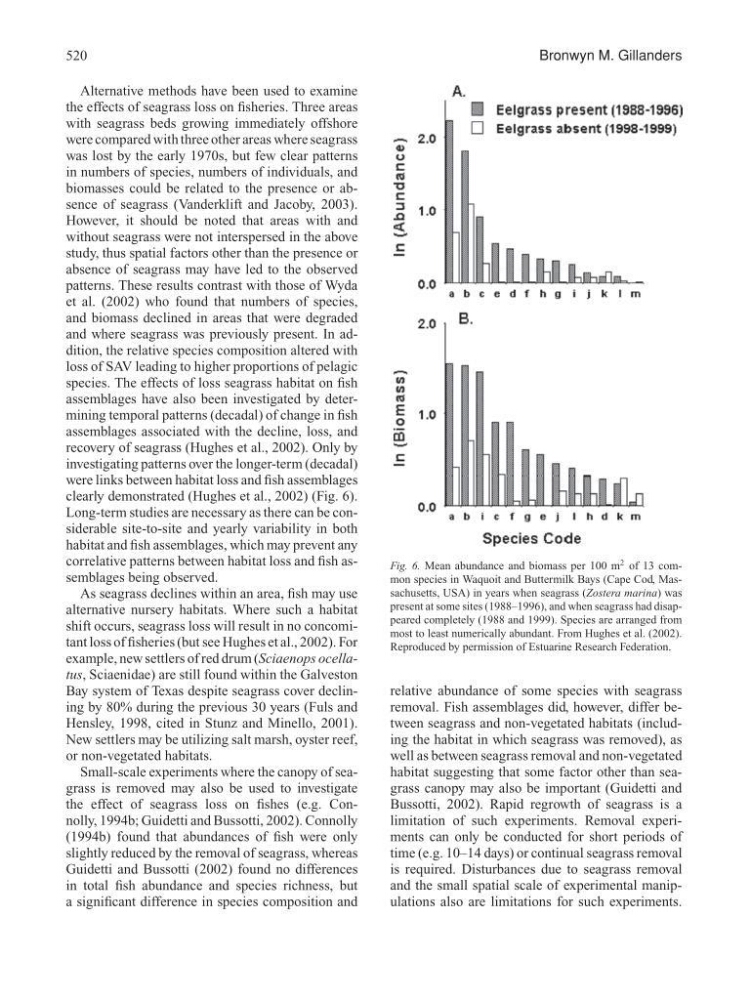
assemblages have also been investigated by determining temporal patterns (decadal) of change in fish
assemblages associated with the decline, loss, and
recovery of seagrass (Hughes et al., 2002). Only by
investigating patterns over the longer-term (decadal)
were links between habitat loss and fish assemblages
clearly demonstrated (Hughes et al., 2002) (Fig. 6).
Long-term studies are necessary as there can be considerable site-to-site and yearly variability in both
habitat and fish assemblages, which may prevent any
correlative patterns between habitat loss and fish assemblages being observed.
As seagrass declines within an area, fish may use
alternative nursery habitats. Where such a habitat
shift occurs, seagrass loss will result in no concomitant loss of fisheries (but see Hughes et al., 2002). For
example, new settlers of red drum (Sciaenops ocellatus, Sciaenidae) are still found within the Galveston
Bay system of Texas despite seagrass cover declining by 80% during the previous 30 years (Fuls and
Hensley, 1998, cited in Stunz and Minello, 2001).
New settlers may be utilizing salt marsh, oyster reef,
or non-vegetated habitats.
Small-scale experiments where the canopy of seagrass is removed may also be used to investigate
the effect of seagrass loss on fishes (e.g. Connolly, 1994b; Guidetti and Bussotti, 2002). Connolly
(1994b) found that abundances of fish were only
slightly reduced by the removal of seagrass, whereas
Guidetti and Bussotti (2002) found no differences
in total fish abundance and species richness, but
a significant difference in species composition and
Fig. 6. Mean abundance and biomass per 100 m
2 of 13 common species in Waquoit and Buttermilk Bays (Cape Cod, Massachusetts, USA) in years when seagrass (Zostera marina) was
present at some sites (1988–1996), and when seagrass had disappeared completely (1988 and 1999). Species are arranged from
most to least numerically abundant. From Hughes et al. (2002).
Reproduced by permission of Estuarine Research Federation.
relative abundance of some species with seagrass
removal. Fish assemblages did, however, differ between seagrass and non-vegetated habitats (including the habitat in which seagrass was removed), as
well as between seagrass removal and non-vegetated
habitat suggesting that some factor other than seagrass canopy may also be important (Guidetti and
Bussotti, 2002). Rapid regrowth of seagrass is a
limitation of such experiments. Removal experiments can only be conducted for short periods of
time (e.g. 10–14 days) or continual seagrass removal
is required. Disturbances due to seagrass removal
and the small spatial scale of experimental manipulations also are limitations for such experiments.
Bronwyn M. Gillanders
Alternative methods have been used to examine
the effects of seagrass loss on fisheries. Three areas
with seagrass beds growing immediately offshore
were compared with three other areas where seagrass
was lost by the early 1970s, but few clear patterns
in numbers of species, numbers of individuals, and
biomasses could be related to the presence or absence of seagrass (Vanderklift and Jacoby, 2003).
However, it should be noted that areas with and
without seagrass were not interspersed in the above
study, thus spatial factors other than the presence or
absence of seagrass may have led to the observed
patterns. These results contrast with those of Wyda
et al. (2002) who found that numbers of species,
and biomass declined in areas that were degraded
and where seagrass was previously present. In addition, the relative species composition altered with
loss of SAV leading to higher proportions of pelagic
species. The effects of loss seagrass habitat on fish
assemblages have also been investigated by determining temporal patterns (decadal) of change in fish
assemblages associated with the decline, loss, and
recovery of seagrass (Hughes et al., 2002). Only by
investigating patterns over the longer-term (decadal)
were links between habitat loss and fish assemblages
clearly demonstrated (Hughes et al., 2002) (Fig. 6).
Long-term studies are necessary as there can be considerable site-to-site and yearly variability in both
habitat and fish assemblages, which may prevent any
correlative patterns between habitat loss and fish assemblages being observed.
As seagrass declines within an area, fish may use
alternative nursery habitats. Where such a habitat
shift occurs, seagrass loss will result in no concomitant loss of fisheries (but see Hughes et al., 2002). For
example, new settlers of red drum (Sciaenops ocellatus, Sciaenidae) are still found within the Galveston
Bay system of Texas despite seagrass cover declining by 80% during the previous 30 years (Fuls and
Hensley, 1998, cited in Stunz and Minello, 2001).
New settlers may be utilizing salt marsh, oyster reef,
or non-vegetated habitats.
Small-scale experiments where the canopy of seagrass is removed may also be used to investigate
the effect of seagrass loss on fishes (e.g. Connolly, 1994b; Guidetti and Bussotti, 2002). Connolly
(1994b) found that abundances of fish were only
slightly reduced by the removal of seagrass, whereas
Guidetti and Bussotti (2002) found no differences
in total fish abundance and species richness, but
a significant difference in species composition and
Fig. 6. Mean abundance and biomass per 100 m
2 of 13 common species in Waquoit and Buttermilk Bays (Cape Cod, Massachusetts, USA) in years when seagrass (Zostera marina) was
present at some sites (1988–1996), and when seagrass had disappeared completely (1988 and 1999). Species are arranged from
most to least numerically abundant. From Hughes et al. (2002).
Reproduced by permission of Estuarine Research Federation.
relative abundance of some species with seagrass
removal. Fish assemblages did, however, differ between seagrass and non-vegetated habitats (including the habitat in which seagrass was removed), as
well as between seagrass removal and non-vegetated
habitat suggesting that some factor other than seagrass canopy may also be important (Guidetti and
Bussotti, 2002). Rapid regrowth of seagrass is a
limitation of such experiments. Removal experiments can only be conducted for short periods of
time (e.g. 10–14 days) or continual seagrass removal
is required. Disturbances due to seagrass removal
and the small spatial scale of experimental manipulations also are limitations for such experiments.