

474
John F. Valentine and J. Emmett Duffy
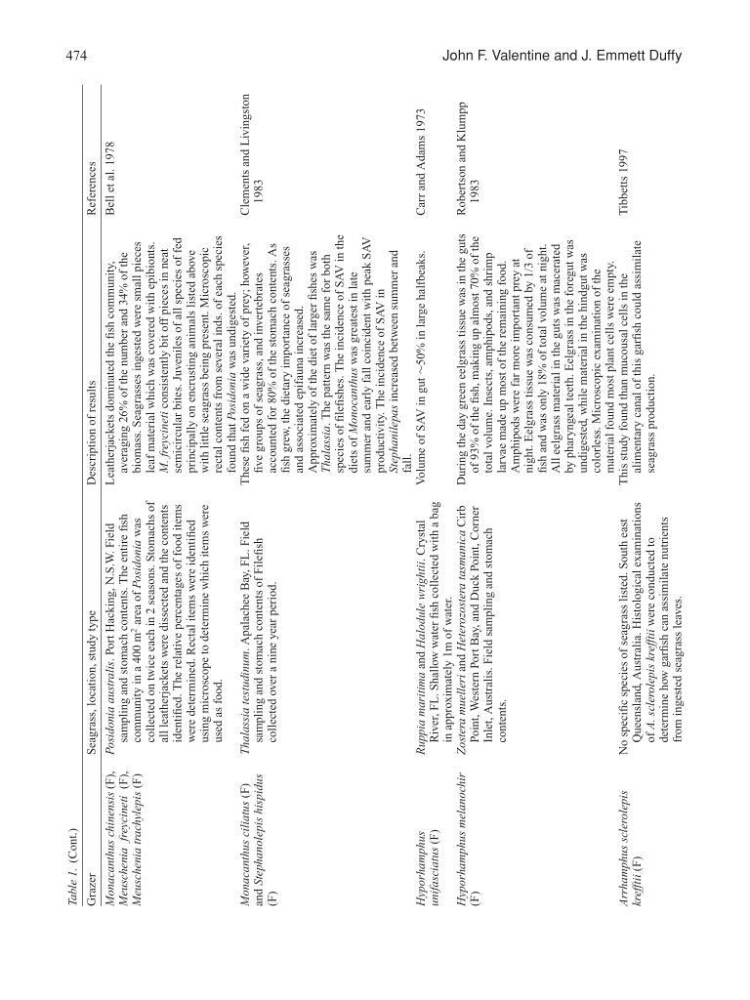
Table 1. (Cont.)
Grazer
Seagrass, location, study type
Description of results
References
Monacanthus chinensis (F),
Meuschenia freycineti (F),
Meuschenia trachylepis (F)
Posidonia australis. Port Hacking, N.S.W. Field
sampling and stomach contents. The entire fish
community in a 400 m
2
area of Posidonia was
collected on twice each in 2 seasons. Stomachs of
all leatherjackets were dissected and the contents
identified. The relative percentages of food items
were determined. Rectal items were identified
using microscope to determine which items were
used as food.
Leatherjackets dominated the fish community,
averaging 26% of the number and 34% of the
biomass. Seagrasses ingested were small pieces
leaf material which was covered with epibionts.
M. freycineti consistently bit off pieces in neat
semicircular bites. Juveniles of all species of fed
principally on encrusting animals listed above
with little seagrass being present. Microscopic
rectal contents from several inds. of each species
found that Posidonia was undigested.
Bell et al. 1978
Monacanthus ciliatus (F)
and Stephanolepis hispidus
(F)
Thalassia testudinum. Apalachee Bay, FL. Field
sampling and stomach contents of Filefish
collected over a nine year period.
These fish fed on a wide variety of prey; however,
five groups of seagrass, and invertebrates
accounted for 80% of the stomach contents. As
fish grew, the dietary importance of seagrasses
and associated epifauna increased.
Approximately of the diet of larger fishes was
Thalassia. The pattern was the same for both
species of filefishes. The incidence of SAV in the
diets of Monocanthus was greatest in late
summer and early fall coincident with peak SAV
productivity. The incidence of SAV in
Stephanilepas increased between summer and
fall.
Clements and Livingston
1983
Hyporhamphus
unifasciatus (F)
Ruppia maritima and Halodule wrightii. Crystal
River, FL. Shallow water fish collected with a bag
in approximately 1m of water.
Volume of SAV in gut
∼50% in large halfbeaks.
Carr and Adams 1973
Hyporhamphus melanochir
(F)
Zostera muelleri and Heterozostera tasmanica Cirb
Point, Western Port Bay, and Duck Point, Corner
Inlet, Australis. Field sampling and stomach
contents.
During the day green eelgrass tissue was in the guts
of 93% of the fish, making up almost 70% of the
total volume. Insects, amphipods, and shrimp
larvae made up most of the remaining food.
Amphipods were far more important prey at
night. Eelgrass tissue was consumed by 1/3 of
fish and was only 18% of total volume at night.
All eelgrass material in the guts was macerated
by pharyngeal teeth. Eelgrass in the foregut was
undigested, while material in the hindgut was
colorless. Microscopic examination of the
material found most plant cells were empty.
Robertson and Klumpp
1983
Arrhamphus sclerolepis
krefftii (F)
No specific species of seagrass listed. South east
Queensland, Australia. Histological examinations
of A. sclerolepis krefftii were conducted to
determine how garfish can assimilate nutrients
from ingested seagrass leaves.
This study found than mucousal cells in the
alimentary canal of this garfish could assimilate
seagrass production.
Tibbetts 1997
John F. Valentine and J. Emmett Duffy
Table 1. (Cont.)
Grazer
Seagrass, location, study type
Description of results
References
Monacanthus chinensis (F),
Meuschenia freycineti (F),
Meuschenia trachylepis (F)
Posidonia australis. Port Hacking, N.S.W. Field
sampling and stomach contents. The entire fish
community in a 400 m
2
area of Posidonia was
collected on twice each in 2 seasons. Stomachs of
all leatherjackets were dissected and the contents
identified. The relative percentages of food items
were determined. Rectal items were identified
using microscope to determine which items were
used as food.
Leatherjackets dominated the fish community,
averaging 26% of the number and 34% of the
biomass. Seagrasses ingested were small pieces
leaf material which was covered with epibionts.
M. freycineti consistently bit off pieces in neat
semicircular bites. Juveniles of all species of fed
principally on encrusting animals listed above
with little seagrass being present. Microscopic
rectal contents from several inds. of each species
found that Posidonia was undigested.
Bell et al. 1978
Monacanthus ciliatus (F)
and Stephanolepis hispidus
(F)
Thalassia testudinum. Apalachee Bay, FL. Field
sampling and stomach contents of Filefish
collected over a nine year period.
These fish fed on a wide variety of prey; however,
five groups of seagrass, and invertebrates
accounted for 80% of the stomach contents. As
fish grew, the dietary importance of seagrasses
and associated epifauna increased.
Approximately of the diet of larger fishes was
Thalassia. The pattern was the same for both
species of filefishes. The incidence of SAV in the
diets of Monocanthus was greatest in late
summer and early fall coincident with peak SAV
productivity. The incidence of SAV in
Stephanilepas increased between summer and
fall.
Clements and Livingston
1983
Hyporhamphus
unifasciatus (F)
Ruppia maritima and Halodule wrightii. Crystal
River, FL. Shallow water fish collected with a bag
in approximately 1m of water.
Volume of SAV in gut
∼50% in large halfbeaks.
Carr and Adams 1973
Hyporhamphus melanochir
(F)
Zostera muelleri and Heterozostera tasmanica Cirb
Point, Western Port Bay, and Duck Point, Corner
Inlet, Australis. Field sampling and stomach
contents.
During the day green eelgrass tissue was in the guts
of 93% of the fish, making up almost 70% of the
total volume. Insects, amphipods, and shrimp
larvae made up most of the remaining food.
Amphipods were far more important prey at
night. Eelgrass tissue was consumed by 1/3 of
fish and was only 18% of total volume at night.
All eelgrass material in the guts was macerated
by pharyngeal teeth. Eelgrass in the foregut was
undigested, while material in the hindgut was
colorless. Microscopic examination of the
material found most plant cells were empty.
Robertson and Klumpp
1983
Arrhamphus sclerolepis
krefftii (F)
No specific species of seagrass listed. South east
Queensland, Australia. Histological examinations
of A. sclerolepis krefftii were conducted to
determine how garfish can assimilate nutrients
from ingested seagrass leaves.
This study found than mucousal cells in the
alimentary canal of this garfish could assimilate
seagrass production.
Tibbetts 1997