

Chapter 20 Grazing in Seagrass Ecosystems
473
Tectura depicta (G)
Zostera marina. Monterey Bay, CA. Lab
Experiment. Zostera transplanted into plastic
flower pots, at natural densities of limpets were
maintained on eight plants while 8 others kept
grazer free. Seagrass growth was determined
weekly along with total leaf length. At the tend of
the experiment, plants were harvested and
analyzed for biomass (shoot, rhizome, root), rates
of leaf photosynthesis, respiration, and sucrose
enzymes were measured in leaves and shoots,
plus protein and sugar contents. Chlorophyll a
was extracted from leaf segments.
Growth rates, carbon reserves, root proliferation,
and net photosynthesis of grazed plants were
50–80% lower than on ungrazed plants. The
carbon allocated to the roots of ungrazed plants
was 800% higher for ungrazed plants than for
grazed plants. Limpet grazing induced carbon
limitation in eelgrass growing in an otherwise
light replete environment.
Zimmerman et al. 1996
Littorina sitkana (G),
Margarites helicinus (G),
Lacuna variegata (G),
Telmessus chieragonus (C),
Microcottus sellaris (F),
Branta canadensis (W),
Anas carolinensis (W),
Anas acuta (W)
Zostera marina. Izembek Lagoon, Alaska.
Sampling and 13C:12C analysis.
Eelgrass was found to be incorporated into the local
food chain through herbivory by at least 7 species.
McConnaughey and
McRoy 1979
Ampithoe spp. ( C )
Syringodium isoetifolium Fiji. Laboratory
determinations of ingestion rates of manatee
grass.
Initially amphipods fed at the top of the leaf. One
day later they made nests from fragments of
grazed grass. Grazing rates ranged from 1.7 mg
ww/ind/day to 26.4 mg ww/ind/day. Using a
carbon budget approach the authors estimated
that the amphipods grazed of the material
produced and further assimilated of it.
Mukai and Iijima 1995
Monocanthus chinensis (F)
Posidonia oceanica. Quibray Bay, Botany Bay, New
South Wales. Stomach analysis and field
sampling.
14
C labeled seagrass used to assess
seagrass assimilation by fishes.
Gut analysis showed fish ate SAV, along with 5 spp
of algae, crustaceans, and other invertebrates.
Seagrass and amphipods were most abundant in
fish guts. Microscopic examination of ingested
plant material suggested that plants were
untouched. (i.e., no cell wall damage observed).
However, radioactive labeling showed that
∼22%
of labeled SAV was in the liver and gut wall of
the fish, 32–33% in the feces. The remaining
label may have been in other tissues. This is
significant as it shows that microscopic
examination of the cell walls does not necessarily
provide a complete picture. The actual % of SAV
production removed was low.
Conacher et al. 1979
Nectocarcinus inegrifons,
(C), Hyporhamphus
melanochir (F)
Posidonia oceanica. Victoria Australia. Gut content
and biochemical marker analyses were used to
the importance of seagrass production to the local
food web.
Lipid and sterol analyses found that both
Nectocarcinus inegrifons, and Hyporhamphus
melanichir were found to rely heavily on seagrass
production to meet their nutritional needs.
Nichols et al. 1986
(cont.)
473
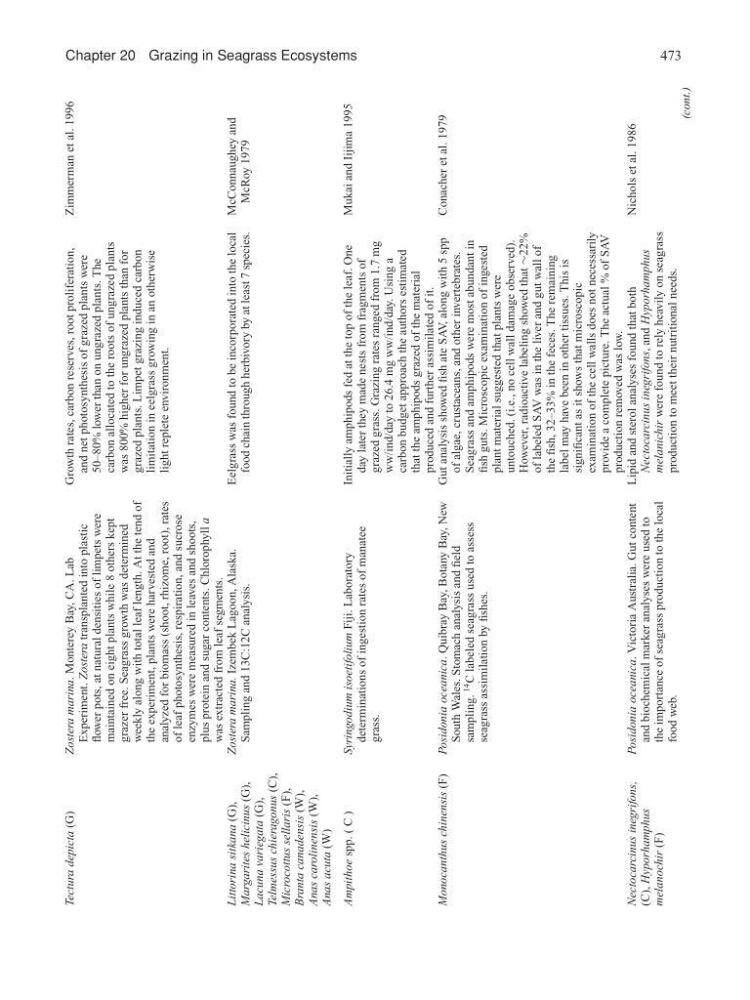
Tectura depicta (G)
Zostera marina. Monterey Bay, CA. Lab
Experiment. Zostera transplanted into plastic
flower pots, at natural densities of limpets were
maintained on eight plants while 8 others kept
grazer free. Seagrass growth was determined
weekly along with total leaf length. At the tend of
the experiment, plants were harvested and
analyzed for biomass (shoot, rhizome, root), rates
of leaf photosynthesis, respiration, and sucrose
enzymes were measured in leaves and shoots,
plus protein and sugar contents. Chlorophyll a
was extracted from leaf segments.
Growth rates, carbon reserves, root proliferation,
and net photosynthesis of grazed plants were
50–80% lower than on ungrazed plants. The
carbon allocated to the roots of ungrazed plants
was 800% higher for ungrazed plants than for
grazed plants. Limpet grazing induced carbon
limitation in eelgrass growing in an otherwise
light replete environment.
Zimmerman et al. 1996
Littorina sitkana (G),
Margarites helicinus (G),
Lacuna variegata (G),
Telmessus chieragonus (C),
Microcottus sellaris (F),
Branta canadensis (W),
Anas carolinensis (W),
Anas acuta (W)
Zostera marina. Izembek Lagoon, Alaska.
Sampling and 13C:12C analysis.
Eelgrass was found to be incorporated into the local
food chain through herbivory by at least 7 species.
McConnaughey and
McRoy 1979
Ampithoe spp. ( C )
Syringodium isoetifolium Fiji. Laboratory
determinations of ingestion rates of manatee
grass.
Initially amphipods fed at the top of the leaf. One
day later they made nests from fragments of
grazed grass. Grazing rates ranged from 1.7 mg
ww/ind/day to 26.4 mg ww/ind/day. Using a
carbon budget approach the authors estimated
that the amphipods grazed of the material
produced and further assimilated of it.
Mukai and Iijima 1995
Monocanthus chinensis (F)
Posidonia oceanica. Quibray Bay, Botany Bay, New
South Wales. Stomach analysis and field
sampling.
14
C labeled seagrass used to assess
seagrass assimilation by fishes.
Gut analysis showed fish ate SAV, along with 5 spp
of algae, crustaceans, and other invertebrates.
Seagrass and amphipods were most abundant in
fish guts. Microscopic examination of ingested
plant material suggested that plants were
untouched. (i.e., no cell wall damage observed).
However, radioactive labeling showed that
∼22%
of labeled SAV was in the liver and gut wall of
the fish, 32–33% in the feces. The remaining
label may have been in other tissues. This is
significant as it shows that microscopic
examination of the cell walls does not necessarily
provide a complete picture. The actual % of SAV
production removed was low.
Conacher et al. 1979
Nectocarcinus inegrifons,
(C), Hyporhamphus
melanochir (F)
Posidonia oceanica. Victoria Australia. Gut content
and biochemical marker analyses were used to
the importance of seagrass production to the local
food web.
Lipid and sterol analyses found that both
Nectocarcinus inegrifons, and Hyporhamphus
melanichir were found to rely heavily on seagrass
production to meet their nutritional needs.
Nichols et al. 1986
(cont.)