

472
John F. Valentine and J. Emmett Duffy
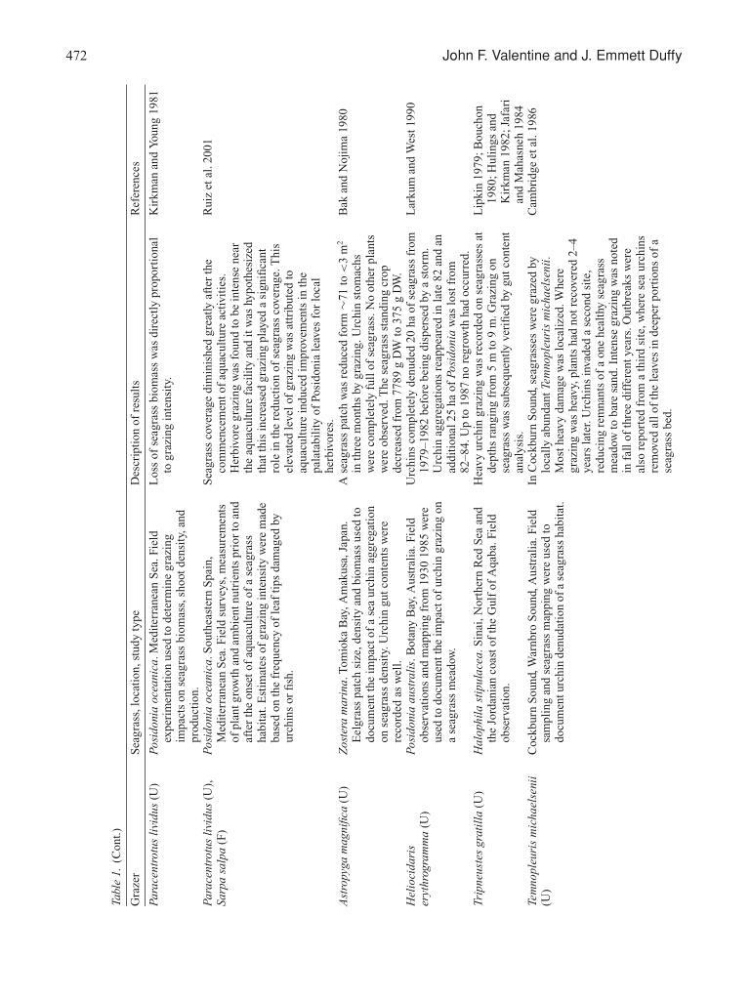
Table 1. (Cont.)
Grazer
Seagrass, location, study type
Description of results
References
Paracentrotus lividus (U)
Posidonia oceanica. Mediterranean Sea. Field
experimentation used to determine grazing
impacts on seagrass biomass, shoot density, and
production.
Loss of seagrass biomass was directly proportional
to grazing intensity.
Kirkman and Young 1981
Paracentrotus lividus (U),
Sarpa salpa (F)
Posidonia oceanica. Southeastern Spain,
Mediterranean Sea. Field surveys, measurements
of plant growth and ambient nutrients prior to and
after the onset of aquaculture of a seagrass
habitat. Estimates of grazing intensity were made
based on the frequency of leaf tips damaged by
urchins or fish.
Seagrass coverage diminished greatly after the
commencement of aquaculture activities.
Herbivore grazing was found to be intense near
the aquaculture facility and it was hypothesized
that this increased grazing played a significant
role in the reduction of seagrass coverage. This
elevated level of grazing was attributed to
aquaculture induced improvements in the
palatability of Posidonia leaves for local
herbivores.
Ruiz et al. 2001
Astropyga magnifica (U)
Zostera marina. Tomioka Bay, Amakusa, Japan.
Eelgrass patch size, density and biomass used to
document the impact of a sea urchin aggregation
on seagrass density. Urchin gut contents were
recorded as well.
A seagrass patch was reduced form
∼71 to
<3 m
2
in three months by grazing. Urchin stomachs
were completely full of seagrass. No other plants
were observed. The seagrass standing crop
decreased from 7789 g DW to 375 g DW.
Bak and Nojima 1980
Heliocidaris
erythrogramma (U)
Posidonia australis. Botany Bay, Australia. Field
observations and mapping from 1930 1985 were
used to document the impact of urchin grazing on
a seagrass meadow.
Urchins completely denuded 20 ha of seagrass from
1979–1982 before being dispersed by a storm.
Urchin aggregations reappeared in late 82 and an
additional 25 ha of Posidonia was lost from
82–84. Up to 1987 no regrowth had occurred.
Larkum and West 1990
Tripneustes gratilla (U)
Halophila stipulacea. Sinai, Northern Red Sea and
the Jordanian coast of the Gulf of Aqaba. Field
observation.
Heavy urchin grazing was recorded on seagrasses at
depths ranging from 5 m to 9 m. Grazing on
seagrass was subsequently verified by gut content
analysis.
Lipkin 1979; Bouchon
1980; Hulings and
Kirkman 1982; Jafari
and Mahasneh 1984
Temnopleuris michaelsenii
(U)
Cockburn Sound, Warnbro Sound, Australia. Field
sampling and seagrass mapping were used to
document urchin denudation of a seagrass habitat.
In Cockburn Sound, seagrasses were grazed by
locally abundant Temnopleuris michaelsenii.
Most heavy damage was localized. Where
grazing was heavy, plants had not recovered 2–4
years later. Urchins invaded a second site,
reducing remnants of a one healthy seagrass
meadow to bare sand. Intense grazing was noted
in fall of three different years. Outbreaks were
also reported from a third site, where sea urchins
removed all of the leaves in deeper portions of a
seagrass bed.
Cambridge et al. 1986
John F. Valentine and J. Emmett Duffy
Table 1. (Cont.)
Grazer
Seagrass, location, study type
Description of results
References
Paracentrotus lividus (U)
Posidonia oceanica. Mediterranean Sea. Field
experimentation used to determine grazing
impacts on seagrass biomass, shoot density, and
production.
Loss of seagrass biomass was directly proportional
to grazing intensity.
Kirkman and Young 1981
Paracentrotus lividus (U),
Sarpa salpa (F)
Posidonia oceanica. Southeastern Spain,
Mediterranean Sea. Field surveys, measurements
of plant growth and ambient nutrients prior to and
after the onset of aquaculture of a seagrass
habitat. Estimates of grazing intensity were made
based on the frequency of leaf tips damaged by
urchins or fish.
Seagrass coverage diminished greatly after the
commencement of aquaculture activities.
Herbivore grazing was found to be intense near
the aquaculture facility and it was hypothesized
that this increased grazing played a significant
role in the reduction of seagrass coverage. This
elevated level of grazing was attributed to
aquaculture induced improvements in the
palatability of Posidonia leaves for local
herbivores.
Ruiz et al. 2001
Astropyga magnifica (U)
Zostera marina. Tomioka Bay, Amakusa, Japan.
Eelgrass patch size, density and biomass used to
document the impact of a sea urchin aggregation
on seagrass density. Urchin gut contents were
recorded as well.
A seagrass patch was reduced form
∼71 to
<3 m
2
in three months by grazing. Urchin stomachs
were completely full of seagrass. No other plants
were observed. The seagrass standing crop
decreased from 7789 g DW to 375 g DW.
Bak and Nojima 1980
Heliocidaris
erythrogramma (U)
Posidonia australis. Botany Bay, Australia. Field
observations and mapping from 1930 1985 were
used to document the impact of urchin grazing on
a seagrass meadow.
Urchins completely denuded 20 ha of seagrass from
1979–1982 before being dispersed by a storm.
Urchin aggregations reappeared in late 82 and an
additional 25 ha of Posidonia was lost from
82–84. Up to 1987 no regrowth had occurred.
Larkum and West 1990
Tripneustes gratilla (U)
Halophila stipulacea. Sinai, Northern Red Sea and
the Jordanian coast of the Gulf of Aqaba. Field
observation.
Heavy urchin grazing was recorded on seagrasses at
depths ranging from 5 m to 9 m. Grazing on
seagrass was subsequently verified by gut content
analysis.
Lipkin 1979; Bouchon
1980; Hulings and
Kirkman 1982; Jafari
and Mahasneh 1984
Temnopleuris michaelsenii
(U)
Cockburn Sound, Warnbro Sound, Australia. Field
sampling and seagrass mapping were used to
document urchin denudation of a seagrass habitat.
In Cockburn Sound, seagrasses were grazed by
locally abundant Temnopleuris michaelsenii.
Most heavy damage was localized. Where
grazing was heavy, plants had not recovered 2–4
years later. Urchins invaded a second site,
reducing remnants of a one healthy seagrass
meadow to bare sand. Intense grazing was noted
in fall of three different years. Outbreaks were
also reported from a third site, where sea urchins
removed all of the leaves in deeper portions of a
seagrass bed.
Cambridge et al. 1986