

Chapter 20 Grazing in Seagrass Ecosystems
471
Lytechinus variegatus (U)
Thalassia testudinum. Offshore grass beds of west
Florida. Field observations and measurements.
An episodic settlement of sea urchins led to
significant reductions of seagrass coverage of
some. Grazing was found to denude an estimated
20 hectare area of seagrass habitat.
Camp et al. 1973
L. variegatus (U) and
Tripneustes ventricosus (U)
Thalassia testudinum. Discovery Bay, Jamaica.
Field experiment tested for intra- and
interspecific competition between two species of
urchins. Aboveground biomass within cages was
used to document the effects urchin
manipulations.
Tripneustes grazing had a highly significant effect
on seagrass biomass in enclosure treatments.
Lytechinus had a moderate effect on seagrass
biomass.
Keller 1983
L. variegatus (U)
Thalassia testudinum. Biscayne Bay Florida.
Laboratory estimate of sea urchin ingestion rates
and preferences when fed live seagrass and
seagrass detritus.
Urchins ingested decayed leaves at a significantly
higher rate than when fed green leaves. No
evidence of a significant preference for decayed
leaves over green ones was found.
Montague et al. 1991
L. variegatus (U)
Thalassia testudinum. Miskito Cays, Nicaragua.
Laboratory measurements, field collections and
observations. Feeding preferences determined by
turning over urchins. Urchin gut contents
examined at one station.
Sea urchins were estimated to consume some 0.5 g
DW/urchin/day of seagrass. However, gut
contents indicated that 40% of this urchin’s diet
was detrital turtlegrass. Less than 5% of the diet
was live grasses.
Vadas et al. 1982
Mixed grazer assemblage
including: L. variegatus
(U), Sparisoma radians (F)
Archosargus rhomboides
(F), Monocanthus setiferus
(F), Acanthurus chirurigus
(F), Sphaeroides spengleri
(F), and Acanthostracion
quadricornis (F)
Thalassia testudinum, Kingston Harbour Jamaica.
Laboratory measurements, field sampling,
stomach content analysis, and field
experimentation to estimate herbivory on grazers
on seagrass.
5 species of fish found to feed on both live and
detrital seagrass along with algae and
crustaceans. Only the sea urchin Lytechinus and
the buck tooth parrotfish S. radians were found to
feed predominantly on seagrass. Lytechinus was
estimated to consume some 49% of the SAV leaf
tissue produced each day. A small fraction of this
production was consumed by fishes.
Greenway 1976 and 1995
L. variegatus (U)
Thalassia testudinum. Card Sound Florida. Field
Observations.
A large population of sea urchins consumed all
benthic plants in a several hectare area of Card
Sound.
Bach 1979
Tripneustes gratilla (U)
Thalassodendron ciliatum. Mombassa lagoon,
Kenya. Multiple sampling approaches and
mathematical estimates were used to determine
the degree to which sea urchins impact seagrass
density and coverage.
Urchins grazing was found to exert a controlling
influence over T. ciliatum density in Mombassa
Lagoon.
Alcoverro and Mariani
2002
Tripneustes gratilla (U),
Salmacis sphaeroides (U)
Thalassia hemprichii. Bolinao, Phillippines. Field
and laboratory measurements of sea urchin
consumption of seagrass biomass. Food
preferences for several plant species also
examined.
Preferences tests showed Tripneustes chose live
SAV alternative food choices. Salmacis
consumed equal quantities of all plant species.
Both urchins efficiently digested and absorbed
seagrass (>60%). Estimates of total SAV
consumption by both sea urchins was 240–400 g
DW/m
2
/day, an average of
∼17% of SAV
produced with a range from 3–100% of SAV
production).
Klumpp et al. 1993
(cont.)
471
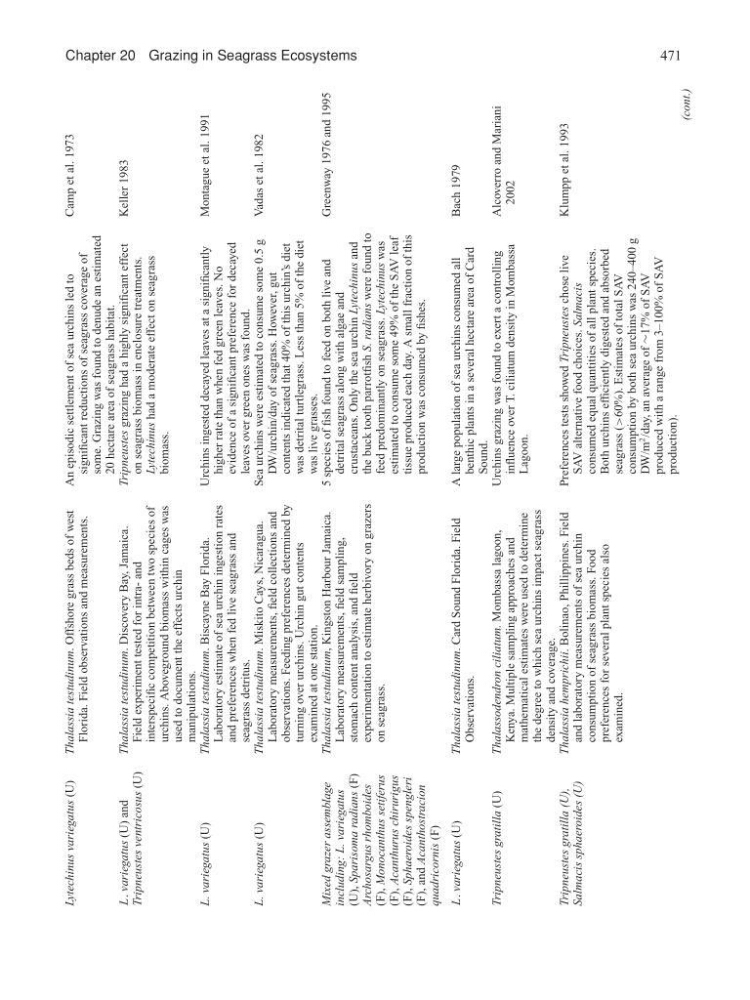
Lytechinus variegatus (U)
Thalassia testudinum. Offshore grass beds of west
Florida. Field observations and measurements.
An episodic settlement of sea urchins led to
significant reductions of seagrass coverage of
some. Grazing was found to denude an estimated
20 hectare area of seagrass habitat.
Camp et al. 1973
L. variegatus (U) and
Tripneustes ventricosus (U)
Thalassia testudinum. Discovery Bay, Jamaica.
Field experiment tested for intra- and
interspecific competition between two species of
urchins. Aboveground biomass within cages was
used to document the effects urchin
manipulations.
Tripneustes grazing had a highly significant effect
on seagrass biomass in enclosure treatments.
Lytechinus had a moderate effect on seagrass
biomass.
Keller 1983
L. variegatus (U)
Thalassia testudinum. Biscayne Bay Florida.
Laboratory estimate of sea urchin ingestion rates
and preferences when fed live seagrass and
seagrass detritus.
Urchins ingested decayed leaves at a significantly
higher rate than when fed green leaves. No
evidence of a significant preference for decayed
leaves over green ones was found.
Montague et al. 1991
L. variegatus (U)
Thalassia testudinum. Miskito Cays, Nicaragua.
Laboratory measurements, field collections and
observations. Feeding preferences determined by
turning over urchins. Urchin gut contents
examined at one station.
Sea urchins were estimated to consume some 0.5 g
DW/urchin/day of seagrass. However, gut
contents indicated that 40% of this urchin’s diet
was detrital turtlegrass. Less than 5% of the diet
was live grasses.
Vadas et al. 1982
Mixed grazer assemblage
including: L. variegatus
(U), Sparisoma radians (F)
Archosargus rhomboides
(F), Monocanthus setiferus
(F), Acanthurus chirurigus
(F), Sphaeroides spengleri
(F), and Acanthostracion
quadricornis (F)
Thalassia testudinum, Kingston Harbour Jamaica.
Laboratory measurements, field sampling,
stomach content analysis, and field
experimentation to estimate herbivory on grazers
on seagrass.
5 species of fish found to feed on both live and
detrital seagrass along with algae and
crustaceans. Only the sea urchin Lytechinus and
the buck tooth parrotfish S. radians were found to
feed predominantly on seagrass. Lytechinus was
estimated to consume some 49% of the SAV leaf
tissue produced each day. A small fraction of this
production was consumed by fishes.
Greenway 1976 and 1995
L. variegatus (U)
Thalassia testudinum. Card Sound Florida. Field
Observations.
A large population of sea urchins consumed all
benthic plants in a several hectare area of Card
Sound.
Bach 1979
Tripneustes gratilla (U)
Thalassodendron ciliatum. Mombassa lagoon,
Kenya. Multiple sampling approaches and
mathematical estimates were used to determine
the degree to which sea urchins impact seagrass
density and coverage.
Urchins grazing was found to exert a controlling
influence over T. ciliatum density in Mombassa
Lagoon.
Alcoverro and Mariani
2002
Tripneustes gratilla (U),
Salmacis sphaeroides (U)
Thalassia hemprichii. Bolinao, Phillippines. Field
and laboratory measurements of sea urchin
consumption of seagrass biomass. Food
preferences for several plant species also
examined.
Preferences tests showed Tripneustes chose live
SAV alternative food choices. Salmacis
consumed equal quantities of all plant species.
Both urchins efficiently digested and absorbed
seagrass (>60%). Estimates of total SAV
consumption by both sea urchins was 240–400 g
DW/m
2
/day, an average of
∼17% of SAV
produced with a range from 3–100% of SAV
production).
Klumpp et al. 1993
(cont.)