

Chapter 16 Biology of Zostera
363
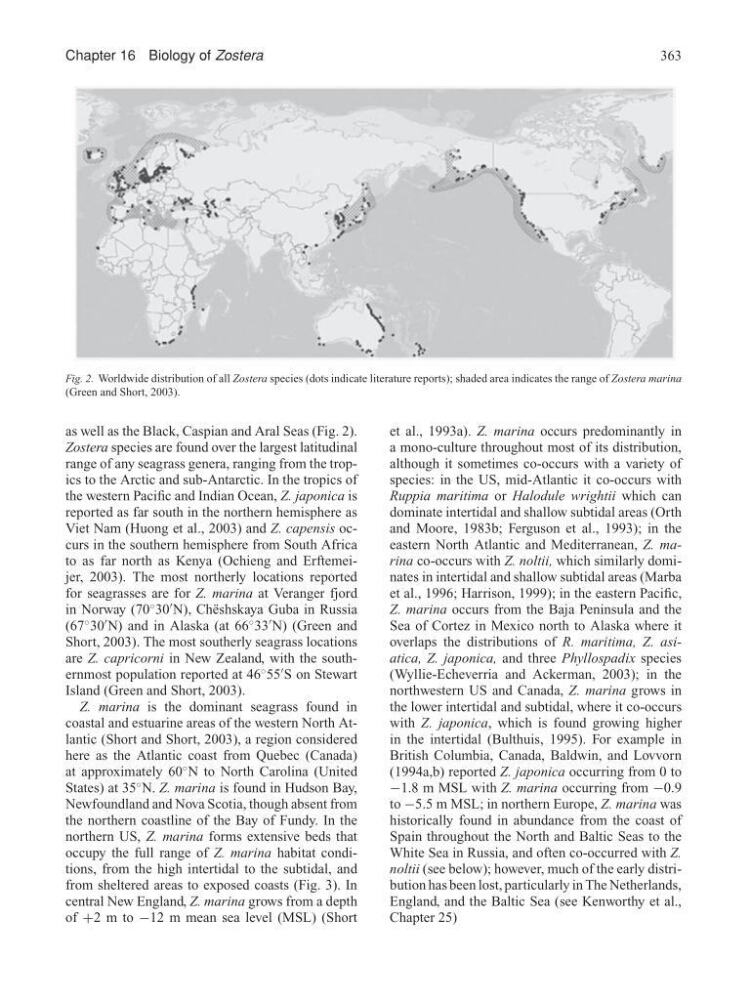
Fig. 2. Worldwide distribution of all Zostera species (dots indicate literature reports); shaded area indicates the range of Zostera marina
(Green and Short, 2003).
as well as the Black, Caspian and Aral Seas (Fig. 2).
Zostera species are found over the largest latitudinal
range of any seagrass genera, ranging from the tropics to the Arctic and sub-Antarctic. In the tropics of
the western Pacific and Indian Ocean, Z. japonica is
reported as far south in the northern hemisphere as
Viet Nam (Huong et al., 2003) and Z. capensis occurs in the southern hemisphere from South Africa
to as far north as Kenya (Ochieng and Erftemeijer, 2003). The most northerly locations reported
for seagrasses are for Z. marina at Veranger fjord
in Norway (70
◦ 30
N), Ch¨ eshskaya Guba in Russia
(67
◦ 30
N) and in Alaska (at 66
◦ 33
N) (Green and
Short, 2003). The most southerly seagrass locations
are Z. capricorni in New Zealand, with the southernmost population reported at 46
◦ 55
S on Stewart
Island (Green and Short, 2003).
Z. marina is the dominant seagrass found in
coastal and estuarine areas of the western North Atlantic (Short and Short, 2003), a region considered
here as the Atlantic coast from Quebec (Canada)
at approximately 60
◦ N to North Carolina (United
States) at 35
◦ N. Z. marina is found in Hudson Bay,
Newfoundland and Nova Scotia, though absent from
the northern coastline of the Bay of Fundy. In the
northern US, Z. marina forms extensive beds that
occupy the full range of Z. marina habitat conditions, from the high intertidal to the subtidal, and
from sheltered areas to exposed coasts (Fig. 3). In
central New England, Z. marina grows from a depth
of +2 m to −12 m mean sea level (MSL) (Short
et al., 1993a). Z. marina occurs predominantly in
a mono-culture throughout most of its distribution,
although it sometimes co-occurs with a variety of
species: in the US, mid-Atlantic it co-occurs with
Ruppia maritima or Halodule wrightii which can
dominate intertidal and shallow subtidal areas (Orth
and Moore, 1983b; Ferguson et al., 1993); in the
eastern North Atlantic and Mediterranean, Z. marina co-occurs with Z. noltii, which similarly dominates in intertidal and shallow subtidal areas (Marba
et al., 1996; Harrison, 1999); in the eastern Pacific,
Z. marina occurs from the Baja Peninsula and the
Sea of Cortez in Mexico north to Alaska where it
overlaps the distributions of R. maritima, Z. asiatica, Z. japonica, and three Phyllospadix species
(Wyllie-Echeverria and Ackerman, 2003); in the
northwestern US and Canada, Z. marina grows in
the lower intertidal and subtidal, where it co-occurs
with Z. japonica, which is found growing higher
in the intertidal (Bulthuis, 1995). For example in
British Columbia, Canada, Baldwin, and Lovvorn
(1994a,b) reported Z. japonica occurring from 0 to
−1.8 m MSL with Z. marina occurring from −0.9
to −5.5 m MSL; in northern Europe, Z. marina was
historically found in abundance from the coast of
Spain throughout the North and Baltic Seas to the
White Sea in Russia, and often co-occurred with Z.
noltii (see below); however, much of the early distribution has been lost, particularly in The Netherlands,
England, and the Baltic Sea (see Kenworthy et al.,
Chapter 25)
363
Fig. 2. Worldwide distribution of all Zostera species (dots indicate literature reports); shaded area indicates the range of Zostera marina
(Green and Short, 2003).
as well as the Black, Caspian and Aral Seas (Fig. 2).
Zostera species are found over the largest latitudinal
range of any seagrass genera, ranging from the tropics to the Arctic and sub-Antarctic. In the tropics of
the western Pacific and Indian Ocean, Z. japonica is
reported as far south in the northern hemisphere as
Viet Nam (Huong et al., 2003) and Z. capensis occurs in the southern hemisphere from South Africa
to as far north as Kenya (Ochieng and Erftemeijer, 2003). The most northerly locations reported
for seagrasses are for Z. marina at Veranger fjord
in Norway (70
◦ 30
N), Ch¨ eshskaya Guba in Russia
(67
◦ 30
N) and in Alaska (at 66
◦ 33
N) (Green and
Short, 2003). The most southerly seagrass locations
are Z. capricorni in New Zealand, with the southernmost population reported at 46
◦ 55
S on Stewart
Island (Green and Short, 2003).
Z. marina is the dominant seagrass found in
coastal and estuarine areas of the western North Atlantic (Short and Short, 2003), a region considered
here as the Atlantic coast from Quebec (Canada)
at approximately 60
◦ N to North Carolina (United
States) at 35
◦ N. Z. marina is found in Hudson Bay,
Newfoundland and Nova Scotia, though absent from
the northern coastline of the Bay of Fundy. In the
northern US, Z. marina forms extensive beds that
occupy the full range of Z. marina habitat conditions, from the high intertidal to the subtidal, and
from sheltered areas to exposed coasts (Fig. 3). In
central New England, Z. marina grows from a depth
of +2 m to −12 m mean sea level (MSL) (Short
et al., 1993a). Z. marina occurs predominantly in
a mono-culture throughout most of its distribution,
although it sometimes co-occurs with a variety of
species: in the US, mid-Atlantic it co-occurs with
Ruppia maritima or Halodule wrightii which can
dominate intertidal and shallow subtidal areas (Orth
and Moore, 1983b; Ferguson et al., 1993); in the
eastern North Atlantic and Mediterranean, Z. marina co-occurs with Z. noltii, which similarly dominates in intertidal and shallow subtidal areas (Marba
et al., 1996; Harrison, 1999); in the eastern Pacific,
Z. marina occurs from the Baja Peninsula and the
Sea of Cortez in Mexico north to Alaska where it
overlaps the distributions of R. maritima, Z. asiatica, Z. japonica, and three Phyllospadix species
(Wyllie-Echeverria and Ackerman, 2003); in the
northwestern US and Canada, Z. marina grows in
the lower intertidal and subtidal, where it co-occurs
with Z. japonica, which is found growing higher
in the intertidal (Bulthuis, 1995). For example in
British Columbia, Canada, Baldwin, and Lovvorn
(1994a,b) reported Z. japonica occurring from 0 to
−1.8 m MSL with Z. marina occurring from −0.9
to −5.5 m MSL; in northern Europe, Z. marina was
historically found in abundance from the coast of
Spain throughout the North and Baltic Seas to the
White Sea in Russia, and often co-occurred with Z.
noltii (see below); however, much of the early distribution has been lost, particularly in The Netherlands,
England, and the Baltic Sea (see Kenworthy et al.,
Chapter 25)