

332
A. W. D. Larkum, E. A. Drew, and P. J. Ralph
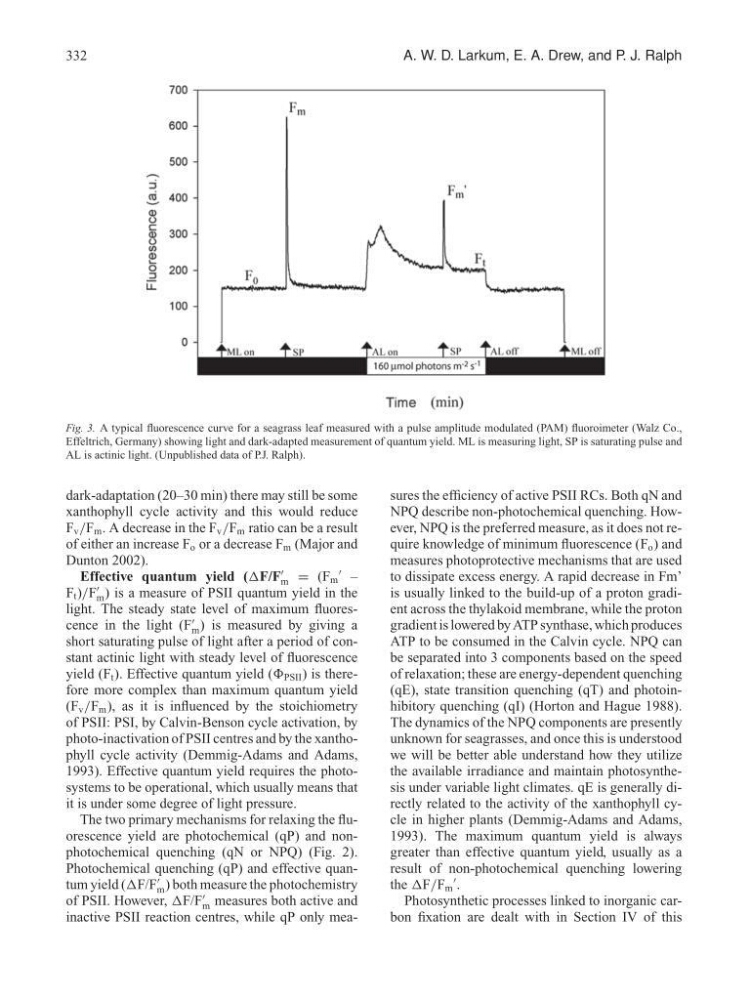
Fig. 3. A typical fluorescence curve for a seagrass leaf measured with a pulse amplitude modulated (PAM) fluoroimeter (Walz Co.,
Effeltrich, Germany) showing light and dark-adapted measurement of quantum yield. ML is measuring light, SP is saturating pulse and
AL is actinic light. (Unpublished data of P.J. Ralph).
dark-adaptation (20–30 min) there may still be some
xanthophyll cycle activity and this would reduce
F v /F m . A decrease in the F v /F m ratio can be a result
of either an increase F o or a decrease F m (Major and
Dunton 2002).
Effective quantum yield (F/F
m = (F m
–
F t )/F
m ) is a measure of PSII quantum yield in the
light. The steady state level of maximum fluorescence in the light (F
m ) is measured by giving a
short saturating pulse of light after a period of constant actinic light with steady level of fluorescence
yield (F t ). Effective quantum yield ( PSII ) is therefore more complex than maximum quantum yield
(F v /F m ), as it is influenced by the stoichiometry
of PSII: PSI, by Calvin-Benson cycle activation, by
photo-inactivation of PSII centres and by the xanthophyll cycle activity (Demmig-Adams and Adams,
1993). Effective quantum yield requires the photosystems to be operational, which usually means that
it is under some degree of light pressure.
The two primary mechanisms for relaxing the fluorescence yield are photochemical (qP) and nonphotochemical quenching (qN or NPQ) (Fig. 2).
Photochemical quenching (qP) and effective quantum yield (F/F
m ) both measure the photochemistry
of PSII. However, F/F
m measures both active and
inactive PSII reaction centres, while qP only measures the efficiency of active PSII RCs. Both qN and
NPQ describe non-photochemical quenching. However, NPQ is the preferred measure, as it does not require knowledge of minimum fluorescence (F o ) and
measures photoprotective mechanisms that are used
to dissipate excess energy. A rapid decrease in Fm’
is usually linked to the build-up of a proton gradient across the thylakoid membrane, while the proton
gradient is lowered by ATP synthase, which produces
ATP to be consumed in the Calvin cycle. NPQ can
be separated into 3 components based on the speed
of relaxation; these are energy-dependent quenching
(qE), state transition quenching (qT) and photoinhibitory quenching (qI) (Horton and Hague 1988).
The dynamics of the NPQ components are presently
unknown for seagrasses, and once this is understood
we will be better able understand how they utilize
the available irradiance and maintain photosynthesis under variable light climates. qE is generally directly related to the activity of the xanthophyll cycle in higher plants (Demmig-Adams and Adams,
1993). The maximum quantum yield is always
greater than effective quantum yield, usually as a
result of non-photochemical quenching lowering
the F/F m
.
Photosynthetic processes linked to inorganic carbon fixation are dealt with in Section IV of this
A. W. D. Larkum, E. A. Drew, and P. J. Ralph
Fig. 3. A typical fluorescence curve for a seagrass leaf measured with a pulse amplitude modulated (PAM) fluoroimeter (Walz Co.,
Effeltrich, Germany) showing light and dark-adapted measurement of quantum yield. ML is measuring light, SP is saturating pulse and
AL is actinic light. (Unpublished data of P.J. Ralph).
dark-adaptation (20–30 min) there may still be some
xanthophyll cycle activity and this would reduce
F v /F m . A decrease in the F v /F m ratio can be a result
of either an increase F o or a decrease F m (Major and
Dunton 2002).
Effective quantum yield (F/F
m = (F m
–
F t )/F
m ) is a measure of PSII quantum yield in the
light. The steady state level of maximum fluorescence in the light (F
m ) is measured by giving a
short saturating pulse of light after a period of constant actinic light with steady level of fluorescence
yield (F t ). Effective quantum yield ( PSII ) is therefore more complex than maximum quantum yield
(F v /F m ), as it is influenced by the stoichiometry
of PSII: PSI, by Calvin-Benson cycle activation, by
photo-inactivation of PSII centres and by the xanthophyll cycle activity (Demmig-Adams and Adams,
1993). Effective quantum yield requires the photosystems to be operational, which usually means that
it is under some degree of light pressure.
The two primary mechanisms for relaxing the fluorescence yield are photochemical (qP) and nonphotochemical quenching (qN or NPQ) (Fig. 2).
Photochemical quenching (qP) and effective quantum yield (F/F
m ) both measure the photochemistry
of PSII. However, F/F
m measures both active and
inactive PSII reaction centres, while qP only measures the efficiency of active PSII RCs. Both qN and
NPQ describe non-photochemical quenching. However, NPQ is the preferred measure, as it does not require knowledge of minimum fluorescence (F o ) and
measures photoprotective mechanisms that are used
to dissipate excess energy. A rapid decrease in Fm’
is usually linked to the build-up of a proton gradient across the thylakoid membrane, while the proton
gradient is lowered by ATP synthase, which produces
ATP to be consumed in the Calvin cycle. NPQ can
be separated into 3 components based on the speed
of relaxation; these are energy-dependent quenching
(qE), state transition quenching (qT) and photoinhibitory quenching (qI) (Horton and Hague 1988).
The dynamics of the NPQ components are presently
unknown for seagrasses, and once this is understood
we will be better able understand how they utilize
the available irradiance and maintain photosynthesis under variable light climates. qE is generally directly related to the activity of the xanthophyll cycle in higher plants (Demmig-Adams and Adams,
1993). The maximum quantum yield is always
greater than effective quantum yield, usually as a
result of non-photochemical quenching lowering
the F/F m
.
Photosynthetic processes linked to inorganic carbon fixation are dealt with in Section IV of this