

Chapter 14 Photosynthesis in Seagrasses
333
chapter; however, several issues related to fluorescence are discussed here. The redox state of the primary electron acceptor (Q A ) and the fluorescence
emission is influenced by CO 2 fixation processes.
Therefore, F/F
m , qP and qN are influenced by Rubisco activity, which has a feedback loop to the electron transport rate (Fig. 2). Therefore, fluorescence
can potentially be used to assess inorganic carbon
(C i ) uptake (Schwarz et al. 2000; Hellblom et al.,
2001; Beer et al., 2002), where it was shown that the
photosynthesis of H. ovalis and C. serrulata were
limited by inorganic carbon availability.
B. Photosynthetic Rates:
Electron Transport Rates (ETRs)
Conventionally photosynthetic rates have been measured by the rates of evolution of O 2 or the uptake of CO 2 . However, the electron transport rate
(ETR) through PSII is directly related to both the
former rates and can therefore be used to measure
rates of photosynthesis (Genty et al., 1989). ETR
can be calculated from the effective quantum efficiency (F/F
m ), the absolute amount of incident
irradiance (PAR), the absorption of that irradiance
and the partitioning of incident irradiance between
the two photosystems, a follows:
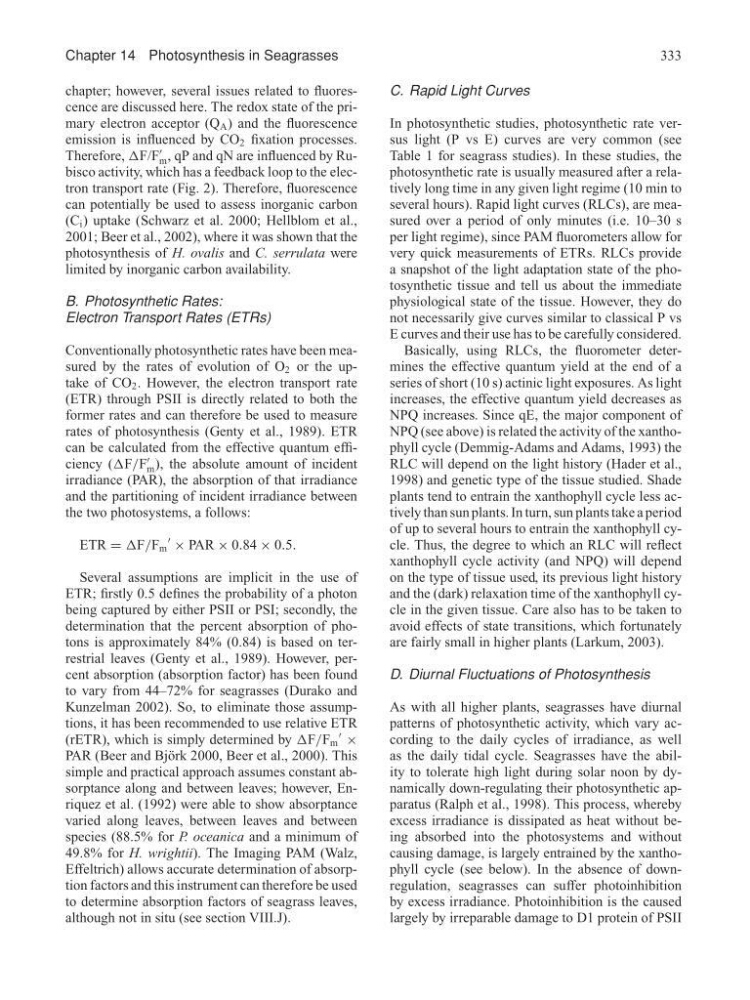
ETR = F/F m
× PAR × 0.84 × 0.5.
Several assumptions are implicit in the use of
ETR; firstly 0.5 defines the probability of a photon
being captured by either PSII or PSI; secondly, the
determination that the percent absorption of photons is approximately 84% (0.84) is based on terrestrial leaves (Genty et al., 1989). However, percent absorption (absorption factor) has been found
to vary from 44–72% for seagrasses (Durako and
Kunzelman 2002). So, to eliminate those assumptions, it has been recommended to use relative ETR
(rETR), which is simply determined by F/F m
×
PAR (Beer and Bj¨ ork 2000, Beer et al., 2000). This
simple and practical approach assumes constant absorptance along and between leaves; however, Enriquez et al. (1992) were able to show absorptance
varied along leaves, between leaves and between
species (88.5% for P. oceanica and a minimum of
49.8% for H. wrightii). The Imaging PAM (Walz,
Effeltrich) allows accurate determination of absorption factors and this instrument can therefore be used
to determine absorption factors of seagrass leaves,
although not in situ (see section VIII.J).
C. Rapid Light Curves
In photosynthetic studies, photosynthetic rate versus light (P vs E) curves are very common (see
Table 1 for seagrass studies). In these studies, the
photosynthetic rate is usually measured after a relatively long time in any given light regime (10 min to
several hours). Rapid light curves (RLCs), are measured over a period of only minutes (i.e. 10–30 s
per light regime), since PAM fluorometers allow for
very quick measurements of ETRs. RLCs provide
a snapshot of the light adaptation state of the photosynthetic tissue and tell us about the immediate
physiological state of the tissue. However, they do
not necessarily give curves similar to classical P vs
E curves and their use has to be carefully considered.
Basically, using RLCs, the fluorometer determines the effective quantum yield at the end of a
series of short (10 s) actinic light exposures. As light
increases, the effective quantum yield decreases as
NPQ increases. Since qE, the major component of
NPQ (see above) is related the activity of the xanthophyll cycle (Demmig-Adams and Adams, 1993) the
RLC will depend on the light history (Hader et al.,
1998) and genetic type of the tissue studied. Shade
plants tend to entrain the xanthophyll cycle less actively than sun plants. In turn, sun plants take a period
of up to several hours to entrain the xanthophyll cycle. Thus, the degree to which an RLC will reflect
xanthophyll cycle activity (and NPQ) will depend
on the type of tissue used, its previous light history
and the (dark) relaxation time of the xanthophyll cycle in the given tissue. Care also has to be taken to
avoid effects of state transitions, which fortunately
are fairly small in higher plants (Larkum, 2003).
D. Diurnal Fluctuations of Photosynthesis
As with all higher plants, seagrasses have diurnal
patterns of photosynthetic activity, which vary according to the daily cycles of irradiance, as well
as the daily tidal cycle. Seagrasses have the ability to tolerate high light during solar noon by dynamically down-regulating their photosynthetic apparatus (Ralph et al., 1998). This process, whereby
excess irradiance is dissipated as heat without being absorbed into the photosystems and without
causing damage, is largely entrained by the xanthophyll cycle (see below). In the absence of downregulation, seagrasses can suffer photoinhibition
by excess irradiance. Photoinhibition is the caused
largely by irreparable damage to D1 protein of PSII
333
chapter; however, several issues related to fluorescence are discussed here. The redox state of the primary electron acceptor (Q A ) and the fluorescence
emission is influenced by CO 2 fixation processes.
Therefore, F/F
m , qP and qN are influenced by Rubisco activity, which has a feedback loop to the electron transport rate (Fig. 2). Therefore, fluorescence
can potentially be used to assess inorganic carbon
(C i ) uptake (Schwarz et al. 2000; Hellblom et al.,
2001; Beer et al., 2002), where it was shown that the
photosynthesis of H. ovalis and C. serrulata were
limited by inorganic carbon availability.
B. Photosynthetic Rates:
Electron Transport Rates (ETRs)
Conventionally photosynthetic rates have been measured by the rates of evolution of O 2 or the uptake of CO 2 . However, the electron transport rate
(ETR) through PSII is directly related to both the
former rates and can therefore be used to measure
rates of photosynthesis (Genty et al., 1989). ETR
can be calculated from the effective quantum efficiency (F/F
m ), the absolute amount of incident
irradiance (PAR), the absorption of that irradiance
and the partitioning of incident irradiance between
the two photosystems, a follows:
ETR = F/F m
× PAR × 0.84 × 0.5.
Several assumptions are implicit in the use of
ETR; firstly 0.5 defines the probability of a photon
being captured by either PSII or PSI; secondly, the
determination that the percent absorption of photons is approximately 84% (0.84) is based on terrestrial leaves (Genty et al., 1989). However, percent absorption (absorption factor) has been found
to vary from 44–72% for seagrasses (Durako and
Kunzelman 2002). So, to eliminate those assumptions, it has been recommended to use relative ETR
(rETR), which is simply determined by F/F m
×
PAR (Beer and Bj¨ ork 2000, Beer et al., 2000). This
simple and practical approach assumes constant absorptance along and between leaves; however, Enriquez et al. (1992) were able to show absorptance
varied along leaves, between leaves and between
species (88.5% for P. oceanica and a minimum of
49.8% for H. wrightii). The Imaging PAM (Walz,
Effeltrich) allows accurate determination of absorption factors and this instrument can therefore be used
to determine absorption factors of seagrass leaves,
although not in situ (see section VIII.J).
C. Rapid Light Curves
In photosynthetic studies, photosynthetic rate versus light (P vs E) curves are very common (see
Table 1 for seagrass studies). In these studies, the
photosynthetic rate is usually measured after a relatively long time in any given light regime (10 min to
several hours). Rapid light curves (RLCs), are measured over a period of only minutes (i.e. 10–30 s
per light regime), since PAM fluorometers allow for
very quick measurements of ETRs. RLCs provide
a snapshot of the light adaptation state of the photosynthetic tissue and tell us about the immediate
physiological state of the tissue. However, they do
not necessarily give curves similar to classical P vs
E curves and their use has to be carefully considered.
Basically, using RLCs, the fluorometer determines the effective quantum yield at the end of a
series of short (10 s) actinic light exposures. As light
increases, the effective quantum yield decreases as
NPQ increases. Since qE, the major component of
NPQ (see above) is related the activity of the xanthophyll cycle (Demmig-Adams and Adams, 1993) the
RLC will depend on the light history (Hader et al.,
1998) and genetic type of the tissue studied. Shade
plants tend to entrain the xanthophyll cycle less actively than sun plants. In turn, sun plants take a period
of up to several hours to entrain the xanthophyll cycle. Thus, the degree to which an RLC will reflect
xanthophyll cycle activity (and NPQ) will depend
on the type of tissue used, its previous light history
and the (dark) relaxation time of the xanthophyll cycle in the given tissue. Care also has to be taken to
avoid effects of state transitions, which fortunately
are fairly small in higher plants (Larkum, 2003).
D. Diurnal Fluctuations of Photosynthesis
As with all higher plants, seagrasses have diurnal
patterns of photosynthetic activity, which vary according to the daily cycles of irradiance, as well
as the daily tidal cycle. Seagrasses have the ability to tolerate high light during solar noon by dynamically down-regulating their photosynthetic apparatus (Ralph et al., 1998). This process, whereby
excess irradiance is dissipated as heat without being absorbed into the photosystems and without
causing damage, is largely entrained by the xanthophyll cycle (see below). In the absence of downregulation, seagrasses can suffer photoinhibition
by excess irradiance. Photoinhibition is the caused
largely by irreparable damage to D1 protein of PSII