

Chapter 14 Photosynthesis in Seagrasses
331
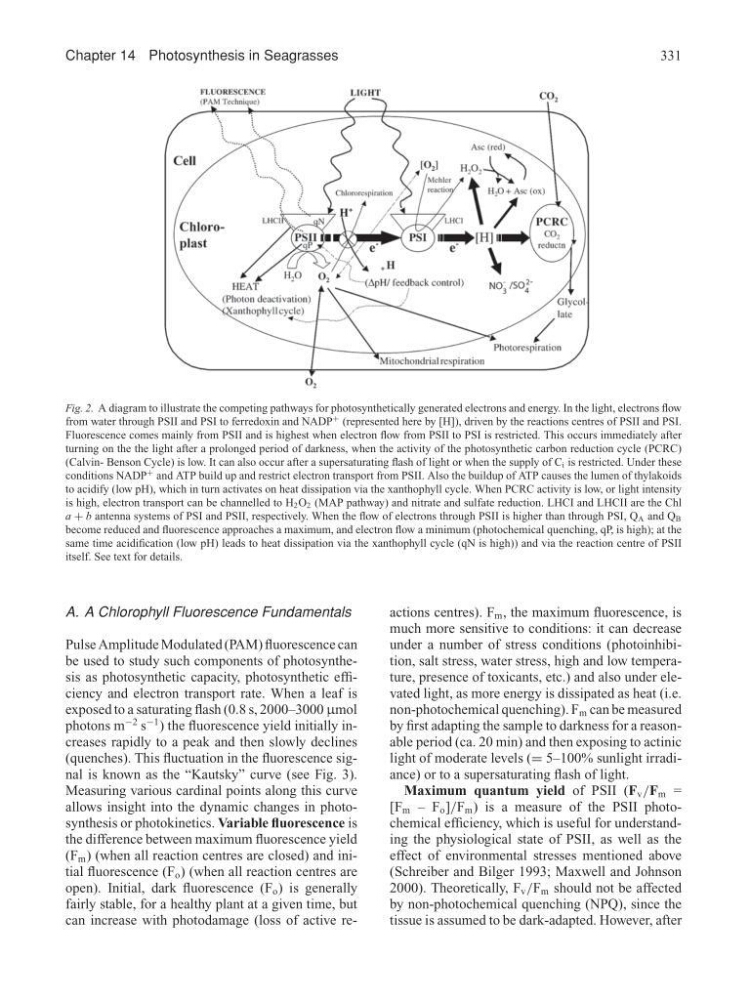
Fig. 2. A diagram to illustrate the competing pathways for photosynthetically generated electrons and energy. In the light, electrons flow
from water through PSII and PSI to ferredoxin and NADP
+ (represented here by [H]), driven by the reactions centres of PSII and PSI.
Fluorescence comes mainly from PSII and is highest when electron flow from PSII to PSI is restricted. This occurs immediately after
turning on the the light after a prolonged period of darkness, when the activity of the photosynthetic carbon reduction cycle (PCRC)
(Calvin- Benson Cycle) is low. It can also occur after a supersaturating flash of light or when the supply of C i is restricted. Under these
conditions NADP
+ and ATP build up and restrict electron transport from PSII. Also the buildup of ATP causes the lumen of thylakoids
to acidify (low pH), which in turn activates on heat dissipation via the xanthophyll cycle. When PCRC activity is low, or light intensity
is high, electron transport can be channelled to H 2 O 2 (MAP pathway) and nitrate and sulfate reduction. LHCI and LHCII are the Chl
a + b antenna systems of PSI and PSII, respectively. When the flow of electrons through PSII is higher than through PSI, Q A and Q B
become reduced and fluorescence approaches a maximum, and electron flow a minimum (photochemical quenching, qP, is high); at the
same time acidification (low pH) leads to heat dissipation via the xanthophyll cycle (qN is high)) and via the reaction centre of PSII
itself. See text for details.
A. A Chlorophyll Fluorescence Fundamentals
Pulse Amplitude Modulated (PAM) fluorescence can
be used to study such components of photosynthesis as photosynthetic capacity, photosynthetic efficiency and electron transport rate. When a leaf is
exposed to a saturating flash (0.8 s, 2000–3000 µmol
photons m
−2 s
−1 ) the fluorescence yield initially increases rapidly to a peak and then slowly declines
(quenches). This fluctuation in the fluorescence signal is known as the “Kautsky” curve (see Fig. 3).
Measuring various cardinal points along this curve
allows insight into the dynamic changes in photosynthesis or photokinetics. Variable fluorescence is
the difference between maximum fluorescence yield
(F m ) (when all reaction centres are closed) and initial fluorescence (F o ) (when all reaction centres are
open). Initial, dark fluorescence (F o ) is generally
fairly stable, for a healthy plant at a given time, but
can increase with photodamage (loss of active reactions centres). F m , the maximum fluorescence, is
much more sensitive to conditions: it can decrease
under a number of stress conditions (photoinhibition, salt stress, water stress, high and low temperature, presence of toxicants, etc.) and also under elevated light, as more energy is dissipated as heat (i.e.
non-photochemical quenching). F m can be measured
by first adapting the sample to darkness for a reasonable period (ca. 20 min) and then exposing to actinic
light of moderate levels (= 5–100% sunlight irradiance) or to a supersaturating flash of light.
Maximum quantum yield of PSII (F v /F m =
[F m – F o ]/F m ) is a measure of the PSII photochemical efficiency, which is useful for understanding the physiological state of PSII, as well as the
effect of environmental stresses mentioned above
(Schreiber and Bilger 1993; Maxwell and Johnson
2000). Theoretically, F v /F m should not be affected
by non-photochemical quenching (NPQ), since the
tissue is assumed to be dark-adapted. However, after
331
Fig. 2. A diagram to illustrate the competing pathways for photosynthetically generated electrons and energy. In the light, electrons flow
from water through PSII and PSI to ferredoxin and NADP
+ (represented here by [H]), driven by the reactions centres of PSII and PSI.
Fluorescence comes mainly from PSII and is highest when electron flow from PSII to PSI is restricted. This occurs immediately after
turning on the the light after a prolonged period of darkness, when the activity of the photosynthetic carbon reduction cycle (PCRC)
(Calvin- Benson Cycle) is low. It can also occur after a supersaturating flash of light or when the supply of C i is restricted. Under these
conditions NADP
+ and ATP build up and restrict electron transport from PSII. Also the buildup of ATP causes the lumen of thylakoids
to acidify (low pH), which in turn activates on heat dissipation via the xanthophyll cycle. When PCRC activity is low, or light intensity
is high, electron transport can be channelled to H 2 O 2 (MAP pathway) and nitrate and sulfate reduction. LHCI and LHCII are the Chl
a + b antenna systems of PSI and PSII, respectively. When the flow of electrons through PSII is higher than through PSI, Q A and Q B
become reduced and fluorescence approaches a maximum, and electron flow a minimum (photochemical quenching, qP, is high); at the
same time acidification (low pH) leads to heat dissipation via the xanthophyll cycle (qN is high)) and via the reaction centre of PSII
itself. See text for details.
A. A Chlorophyll Fluorescence Fundamentals
Pulse Amplitude Modulated (PAM) fluorescence can
be used to study such components of photosynthesis as photosynthetic capacity, photosynthetic efficiency and electron transport rate. When a leaf is
exposed to a saturating flash (0.8 s, 2000–3000 µmol
photons m
−2 s
−1 ) the fluorescence yield initially increases rapidly to a peak and then slowly declines
(quenches). This fluctuation in the fluorescence signal is known as the “Kautsky” curve (see Fig. 3).
Measuring various cardinal points along this curve
allows insight into the dynamic changes in photosynthesis or photokinetics. Variable fluorescence is
the difference between maximum fluorescence yield
(F m ) (when all reaction centres are closed) and initial fluorescence (F o ) (when all reaction centres are
open). Initial, dark fluorescence (F o ) is generally
fairly stable, for a healthy plant at a given time, but
can increase with photodamage (loss of active reactions centres). F m , the maximum fluorescence, is
much more sensitive to conditions: it can decrease
under a number of stress conditions (photoinhibition, salt stress, water stress, high and low temperature, presence of toxicants, etc.) and also under elevated light, as more energy is dissipated as heat (i.e.
non-photochemical quenching). F m can be measured
by first adapting the sample to darkness for a reasonable period (ca. 20 min) and then exposing to actinic
light of moderate levels (= 5–100% sunlight irradiance) or to a supersaturating flash of light.
Maximum quantum yield of PSII (F v /F m =
[F m – F o ]/F m ) is a measure of the PSII photochemical efficiency, which is useful for understanding the physiological state of PSII, as well as the
effect of environmental stresses mentioned above
(Schreiber and Bilger 1993; Maxwell and Johnson
2000). Theoretically, F v /F m should not be affected
by non-photochemical quenching (NPQ), since the
tissue is assumed to be dark-adapted. However, after