

310
R. C. Zimmerman
Sample
Φ o
Φ t
PMT
Sample
Φ o
Φ t
Φ R
PMT
A. Absorbance
B. Reflectance
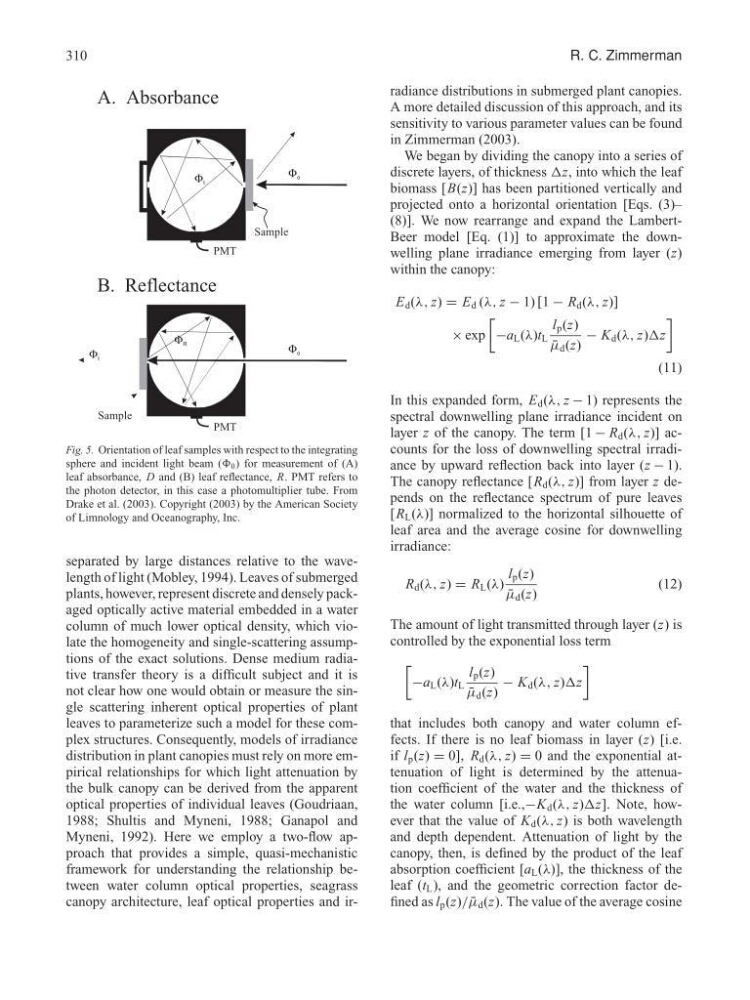
Fig. 5. Orientation of leaf samples with respect to the integrating
sphere and incident light beam ( 0 ) for measurement of (A)
leaf absorbance, D and (B) leaf reflectance, R. PMT refers to
the photon detector, in this case a photomultiplier tube. From
Drake et al. (2003). Copyright (2003) by the American Society
of Limnology and Oceanography, Inc.
separated by large distances relative to the wavelength of light (Mobley, 1994). Leaves of submerged
plants, however, represent discrete and densely packaged optically active material embedded in a water
column of much lower optical density, which violate the homogeneity and single-scattering assumptions of the exact solutions. Dense medium radiative transfer theory is a difficult subject and it is
not clear how one would obtain or measure the single scattering inherent optical properties of plant
leaves to parameterize such a model for these complex structures. Consequently, models of irradiance
distribution in plant canopies must rely on more empirical relationships for which light attenuation by
the bulk canopy can be derived from the apparent
optical properties of individual leaves (Goudriaan,
1988; Shultis and Myneni, 1988; Ganapol and
Myneni, 1992). Here we employ a two-flow approach that provides a simple, quasi-mechanistic
framework for understanding the relationship between water column optical properties, seagrass
canopy architecture, leaf optical properties and irradiance distributions in submerged plant canopies.
A more detailed discussion of this approach, and its
sensitivity to various parameter values can be found
in Zimmerman (2003).
We began by dividing the canopy into a series of
discrete layers, of thickness z, into which the leaf
biomass [B(z)] has been partitioned vertically and
projected onto a horizontal orientation [Eqs. (3)–
(8)]. We now rearrange and expand the LambertBeer model [Eq. (1)] to approximate the downwelling plane irradiance emerging from layer (z)
within the canopy:
E d (λ, z) = E d (λ, z − 1) [1 − R d (λ, z)]
× exp
−a L (λ)t L
l p (z)
¯
µ d (z)
− K d (λ, z)z
(11)
In this expanded form, E d (λ, z − 1) represents the
spectral downwelling plane irradiance incident on
layer z of the canopy. The term [1 − R d (λ, z)] accounts for the loss of downwelling spectral irradiance by upward reflection back into layer (z − 1).
The canopy reflectance [R d (λ, z)] from layer z depends on the reflectance spectrum of pure leaves
[R L (λ)] normalized to the horizontal silhouette of
leaf area and the average cosine for downwelling
irradiance:
R d (λ, z) = R L (λ)
l p (z)
¯
µ d (z)
(12)
The amount of light transmitted through layer (z) is
controlled by the exponential loss term
−a L (λ)t L
l p (z)
¯
µ d (z)
− K d (λ, z)z
that includes both canopy and water column effects. If there is no leaf biomass in layer (z) [i.e.
if l p (z) = 0], R d (λ, z) = 0 and the exponential attenuation of light is determined by the attenuation coefficient of the water and the thickness of
the water column [i.e.,−K d (λ, z)z]. Note, however that the value of K d (λ, z) is both wavelength
and depth dependent. Attenuation of light by the
canopy, then, is defined by the product of the leaf
absorption coefficient [a L (λ)], the thickness of the
leaf (t L ), and the geometric correction factor defined as l p (z)/ ¯
µ d (z). The value of the average cosine
R. C. Zimmerman
Sample
Φ o
Φ t
PMT
Sample
Φ o
Φ t
Φ R
PMT
A. Absorbance
B. Reflectance
Fig. 5. Orientation of leaf samples with respect to the integrating
sphere and incident light beam ( 0 ) for measurement of (A)
leaf absorbance, D and (B) leaf reflectance, R. PMT refers to
the photon detector, in this case a photomultiplier tube. From
Drake et al. (2003). Copyright (2003) by the American Society
of Limnology and Oceanography, Inc.
separated by large distances relative to the wavelength of light (Mobley, 1994). Leaves of submerged
plants, however, represent discrete and densely packaged optically active material embedded in a water
column of much lower optical density, which violate the homogeneity and single-scattering assumptions of the exact solutions. Dense medium radiative transfer theory is a difficult subject and it is
not clear how one would obtain or measure the single scattering inherent optical properties of plant
leaves to parameterize such a model for these complex structures. Consequently, models of irradiance
distribution in plant canopies must rely on more empirical relationships for which light attenuation by
the bulk canopy can be derived from the apparent
optical properties of individual leaves (Goudriaan,
1988; Shultis and Myneni, 1988; Ganapol and
Myneni, 1992). Here we employ a two-flow approach that provides a simple, quasi-mechanistic
framework for understanding the relationship between water column optical properties, seagrass
canopy architecture, leaf optical properties and irradiance distributions in submerged plant canopies.
A more detailed discussion of this approach, and its
sensitivity to various parameter values can be found
in Zimmerman (2003).
We began by dividing the canopy into a series of
discrete layers, of thickness z, into which the leaf
biomass [B(z)] has been partitioned vertically and
projected onto a horizontal orientation [Eqs. (3)–
(8)]. We now rearrange and expand the LambertBeer model [Eq. (1)] to approximate the downwelling plane irradiance emerging from layer (z)
within the canopy:
E d (λ, z) = E d (λ, z − 1) [1 − R d (λ, z)]
× exp
−a L (λ)t L
l p (z)
¯
µ d (z)
− K d (λ, z)z
(11)
In this expanded form, E d (λ, z − 1) represents the
spectral downwelling plane irradiance incident on
layer z of the canopy. The term [1 − R d (λ, z)] accounts for the loss of downwelling spectral irradiance by upward reflection back into layer (z − 1).
The canopy reflectance [R d (λ, z)] from layer z depends on the reflectance spectrum of pure leaves
[R L (λ)] normalized to the horizontal silhouette of
leaf area and the average cosine for downwelling
irradiance:
R d (λ, z) = R L (λ)
l p (z)
¯
µ d (z)
(12)
The amount of light transmitted through layer (z) is
controlled by the exponential loss term
−a L (λ)t L
l p (z)
¯
µ d (z)
− K d (λ, z)z
that includes both canopy and water column effects. If there is no leaf biomass in layer (z) [i.e.
if l p (z) = 0], R d (λ, z) = 0 and the exponential attenuation of light is determined by the attenuation coefficient of the water and the thickness of
the water column [i.e.,−K d (λ, z)z]. Note, however that the value of K d (λ, z) is both wavelength
and depth dependent. Attenuation of light by the
canopy, then, is defined by the product of the leaf
absorption coefficient [a L (λ)], the thickness of the
leaf (t L ), and the geometric correction factor defined as l p (z)/ ¯
µ d (z). The value of the average cosine