

Chapter 13 Light and Photosynthesis in Seagrass Meadows
309
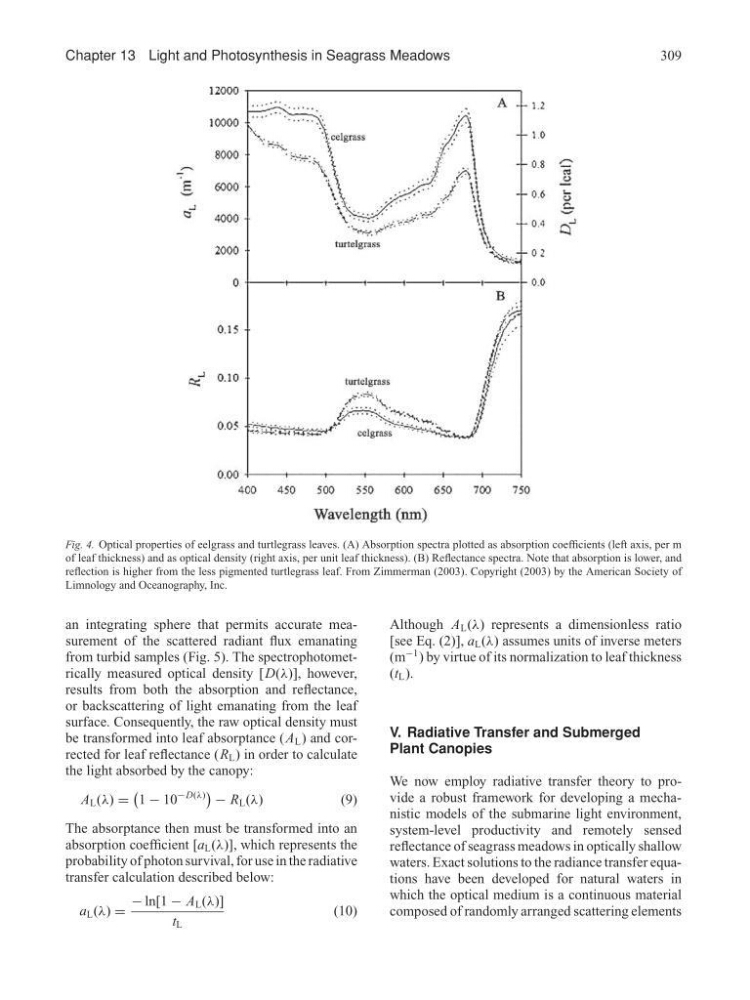
Fig. 4. Optical properties of eelgrass and turtlegrass leaves. (A) Absorption spectra plotted as absorption coefficients (left axis, per m
of leaf thickness) and as optical density (right axis, per unit leaf thickness). (B) Reflectance spectra. Note that absorption is lower, and
reflection is higher from the less pigmented turtlegrass leaf. From Zimmerman (2003). Copyright (2003) by the American Society of
Limnology and Oceanography, Inc.
an integrating sphere that permits accurate measurement of the scattered radiant flux emanating
from turbid samples (Fig. 5). The spectrophotometrically measured optical density [D(λ)], however,
results from both the absorption and reflectance,
or backscattering of light emanating from the leaf
surface. Consequently, the raw optical density must
be transformed into leaf absorptance (A L ) and corrected for leaf reflectance (R L ) in order to calculate
the light absorbed by the canopy:
A L (λ) =
1 − 10
−D(λ)
− R L (λ)
(9)
The absorptance then must be transformed into an
absorption coefficient [a L (λ)], which represents the
probability of photon survival, for use in the radiative
transfer calculation described below:
a L (λ) =
− ln[1 − A L (λ)]
t L
(10)
Although A L (λ) represents a dimensionless ratio
[see Eq. (2)], a L (λ) assumes units of inverse meters
(m
−1 ) by virtue of its normalization to leaf thickness
(t L ).
V. Radiative Transfer and Submerged
Plant Canopies
We now employ radiative transfer theory to provide a robust framework for developing a mechanistic models of the submarine light environment,
system-level productivity and remotely sensed
reflectance of seagrass meadows in optically shallow
waters. Exact solutions to the radiance transfer equations have been developed for natural waters in
which the optical medium is a continuous material
composed of randomly arranged scattering elements
309
Fig. 4. Optical properties of eelgrass and turtlegrass leaves. (A) Absorption spectra plotted as absorption coefficients (left axis, per m
of leaf thickness) and as optical density (right axis, per unit leaf thickness). (B) Reflectance spectra. Note that absorption is lower, and
reflection is higher from the less pigmented turtlegrass leaf. From Zimmerman (2003). Copyright (2003) by the American Society of
Limnology and Oceanography, Inc.
an integrating sphere that permits accurate measurement of the scattered radiant flux emanating
from turbid samples (Fig. 5). The spectrophotometrically measured optical density [D(λ)], however,
results from both the absorption and reflectance,
or backscattering of light emanating from the leaf
surface. Consequently, the raw optical density must
be transformed into leaf absorptance (A L ) and corrected for leaf reflectance (R L ) in order to calculate
the light absorbed by the canopy:
A L (λ) =
1 − 10
−D(λ)
− R L (λ)
(9)
The absorptance then must be transformed into an
absorption coefficient [a L (λ)], which represents the
probability of photon survival, for use in the radiative
transfer calculation described below:
a L (λ) =
− ln[1 − A L (λ)]
t L
(10)
Although A L (λ) represents a dimensionless ratio
[see Eq. (2)], a L (λ) assumes units of inverse meters
(m
−1 ) by virtue of its normalization to leaf thickness
(t L ).
V. Radiative Transfer and Submerged
Plant Canopies
We now employ radiative transfer theory to provide a robust framework for developing a mechanistic models of the submarine light environment,
system-level productivity and remotely sensed
reflectance of seagrass meadows in optically shallow
waters. Exact solutions to the radiance transfer equations have been developed for natural waters in
which the optical medium is a continuous material
composed of randomly arranged scattering elements