

308
R. C. Zimmerman
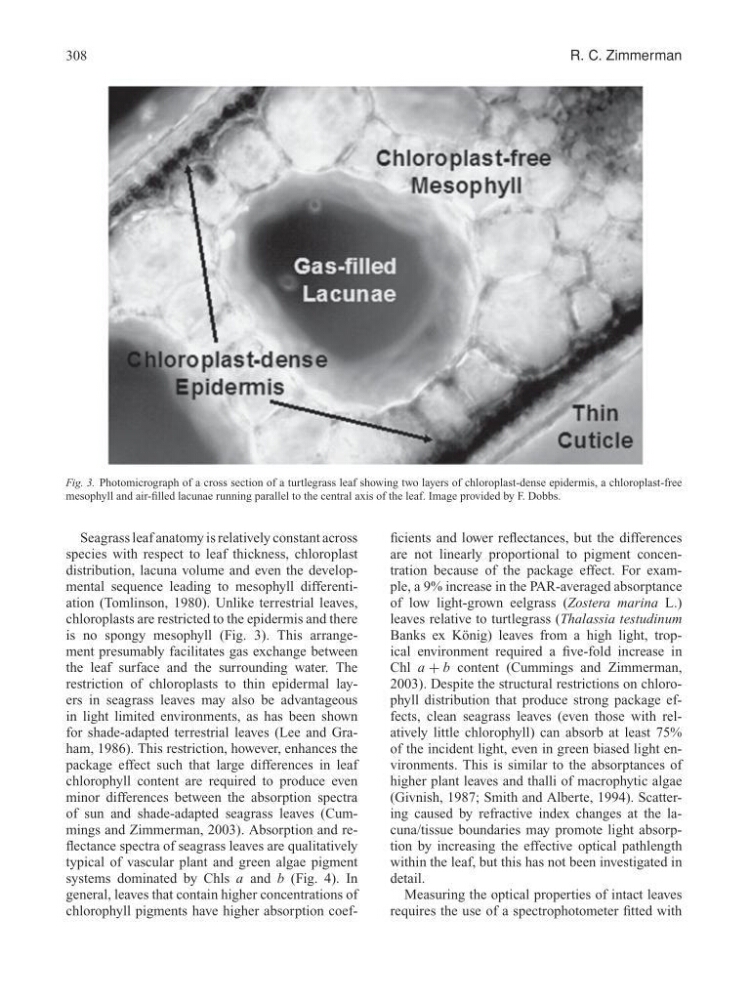
Fig. 3. Photomicrograph of a cross section of a turtlegrass leaf showing two layers of chloroplast-dense epidermis, a chloroplast-free
mesophyll and air-filled lacunae running parallel to the central axis of the leaf. Image provided by F. Dobbs.
Seagrass leaf anatomy is relatively constant across
species with respect to leaf thickness, chloroplast
distribution, lacuna volume and even the developmental sequence leading to mesophyll differentiation (Tomlinson, 1980). Unlike terrestrial leaves,
chloroplasts are restricted to the epidermis and there
is no spongy mesophyll (Fig. 3). This arrangement presumably facilitates gas exchange between
the leaf surface and the surrounding water. The
restriction of chloroplasts to thin epidermal layers in seagrass leaves may also be advantageous
in light limited environments, as has been shown
for shade-adapted terrestrial leaves (Lee and Graham, 1986). This restriction, however, enhances the
package effect such that large differences in leaf
chlorophyll content are required to produce even
minor differences between the absorption spectra
of sun and shade-adapted seagrass leaves (Cummings and Zimmerman, 2003). Absorption and reflectance spectra of seagrass leaves are qualitatively
typical of vascular plant and green algae pigment
systems dominated by Chls a and b (Fig. 4). In
general, leaves that contain higher concentrations of
chlorophyll pigments have higher absorption coefficients and lower reflectances, but the differences
are not linearly proportional to pigment concentration because of the package effect. For example, a 9% increase in the PAR-averaged absorptance
of low light-grown eelgrass (Zostera marina L.)
leaves relative to turtlegrass (Thalassia testudinum
Banks ex K¨ onig) leaves from a high light, tropical environment required a five-fold increase in
Chl a + b content (Cummings and Zimmerman,
2003). Despite the structural restrictions on chlorophyll distribution that produce strong package effects, clean seagrass leaves (even those with relatively little chlorophyll) can absorb at least 75%
of the incident light, even in green biased light environments. This is similar to the absorptances of
higher plant leaves and thalli of macrophytic algae
(Givnish, 1987; Smith and Alberte, 1994). Scattering caused by refractive index changes at the lacuna/tissue boundaries may promote light absorption by increasing the effective optical pathlength
within the leaf, but this has not been investigated in
detail.
Measuring the optical properties of intact leaves
requires the use of a spectrophotometer fitted with
R. C. Zimmerman
Fig. 3. Photomicrograph of a cross section of a turtlegrass leaf showing two layers of chloroplast-dense epidermis, a chloroplast-free
mesophyll and air-filled lacunae running parallel to the central axis of the leaf. Image provided by F. Dobbs.
Seagrass leaf anatomy is relatively constant across
species with respect to leaf thickness, chloroplast
distribution, lacuna volume and even the developmental sequence leading to mesophyll differentiation (Tomlinson, 1980). Unlike terrestrial leaves,
chloroplasts are restricted to the epidermis and there
is no spongy mesophyll (Fig. 3). This arrangement presumably facilitates gas exchange between
the leaf surface and the surrounding water. The
restriction of chloroplasts to thin epidermal layers in seagrass leaves may also be advantageous
in light limited environments, as has been shown
for shade-adapted terrestrial leaves (Lee and Graham, 1986). This restriction, however, enhances the
package effect such that large differences in leaf
chlorophyll content are required to produce even
minor differences between the absorption spectra
of sun and shade-adapted seagrass leaves (Cummings and Zimmerman, 2003). Absorption and reflectance spectra of seagrass leaves are qualitatively
typical of vascular plant and green algae pigment
systems dominated by Chls a and b (Fig. 4). In
general, leaves that contain higher concentrations of
chlorophyll pigments have higher absorption coefficients and lower reflectances, but the differences
are not linearly proportional to pigment concentration because of the package effect. For example, a 9% increase in the PAR-averaged absorptance
of low light-grown eelgrass (Zostera marina L.)
leaves relative to turtlegrass (Thalassia testudinum
Banks ex K¨ onig) leaves from a high light, tropical environment required a five-fold increase in
Chl a + b content (Cummings and Zimmerman,
2003). Despite the structural restrictions on chlorophyll distribution that produce strong package effects, clean seagrass leaves (even those with relatively little chlorophyll) can absorb at least 75%
of the incident light, even in green biased light environments. This is similar to the absorptances of
higher plant leaves and thalli of macrophytic algae
(Givnish, 1987; Smith and Alberte, 1994). Scattering caused by refractive index changes at the lacuna/tissue boundaries may promote light absorption by increasing the effective optical pathlength
within the leaf, but this has not been investigated in
detail.
Measuring the optical properties of intact leaves
requires the use of a spectrophotometer fitted with