

Chapter 13 Light and Photosynthesis in Seagrass Meadows
307
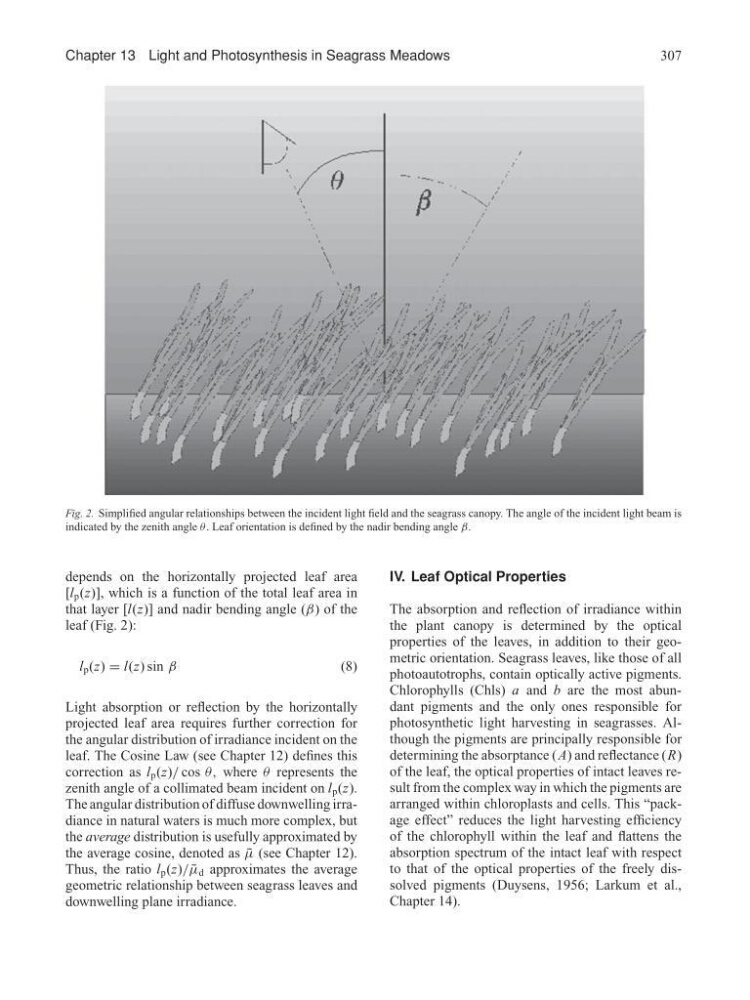
Fig. 2. Simplified angular relationships between the incident light field and the seagrass canopy. The angle of the incident light beam is
indicated by the zenith angle θ. Leaf orientation is defined by the nadir bending angle β.
depends on the horizontally projected leaf area
[l p (z)], which is a function of the total leaf area in
that layer [l(z)] and nadir bending angle (β) of the
leaf (Fig. 2):
l p (z) = l(z) sin β
(8)
Light absorption or reflection by the horizontally
projected leaf area requires further correction for
the angular distribution of irradiance incident on the
leaf. The Cosine Law (see Chapter 12) defines this
correction as l p (z)/ cos θ, where θ represents the
zenith angle of a collimated beam incident on l p (z).
The angular distribution of diffuse downwelling irradiance in natural waters is much more complex, but
the average distribution is usefully approximated by
the average cosine, denoted as ¯
µ (see Chapter 12).
Thus, the ratio l p (z)/ ¯
µ d approximates the average
geometric relationship between seagrass leaves and
downwelling plane irradiance.
IV. Leaf Optical Properties
The absorption and reflection of irradiance within
the plant canopy is determined by the optical
properties of the leaves, in addition to their geometric orientation. Seagrass leaves, like those of all
photoautotrophs, contain optically active pigments.
Chlorophylls (Chls) a and b are the most abundant pigments and the only ones responsible for
photosynthetic light harvesting in seagrasses. Although the pigments are principally responsible for
determining the absorptance ( A) and reflectance (R)
of the leaf, the optical properties of intact leaves result from the complex way in which the pigments are
arranged within chloroplasts and cells. This “package effect” reduces the light harvesting efficiency
of the chlorophyll within the leaf and flattens the
absorption spectrum of the intact leaf with respect
to that of the optical properties of the freely dissolved pigments (Duysens, 1956; Larkum et al.,
Chapter 14).
307
Fig. 2. Simplified angular relationships between the incident light field and the seagrass canopy. The angle of the incident light beam is
indicated by the zenith angle θ. Leaf orientation is defined by the nadir bending angle β.
depends on the horizontally projected leaf area
[l p (z)], which is a function of the total leaf area in
that layer [l(z)] and nadir bending angle (β) of the
leaf (Fig. 2):
l p (z) = l(z) sin β
(8)
Light absorption or reflection by the horizontally
projected leaf area requires further correction for
the angular distribution of irradiance incident on the
leaf. The Cosine Law (see Chapter 12) defines this
correction as l p (z)/ cos θ, where θ represents the
zenith angle of a collimated beam incident on l p (z).
The angular distribution of diffuse downwelling irradiance in natural waters is much more complex, but
the average distribution is usefully approximated by
the average cosine, denoted as ¯
µ (see Chapter 12).
Thus, the ratio l p (z)/ ¯
µ d approximates the average
geometric relationship between seagrass leaves and
downwelling plane irradiance.
IV. Leaf Optical Properties
The absorption and reflection of irradiance within
the plant canopy is determined by the optical
properties of the leaves, in addition to their geometric orientation. Seagrass leaves, like those of all
photoautotrophs, contain optically active pigments.
Chlorophylls (Chls) a and b are the most abundant pigments and the only ones responsible for
photosynthetic light harvesting in seagrasses. Although the pigments are principally responsible for
determining the absorptance ( A) and reflectance (R)
of the leaf, the optical properties of intact leaves result from the complex way in which the pigments are
arranged within chloroplasts and cells. This “package effect” reduces the light harvesting efficiency
of the chlorophyll within the leaf and flattens the
absorption spectrum of the intact leaf with respect
to that of the optical properties of the freely dissolved pigments (Duysens, 1956; Larkum et al.,
Chapter 14).