

Chapter 11 Dynamics of Seagrasses
287
0
1000
2000
3000
Biomass (g m
-2
)
Depth (m)
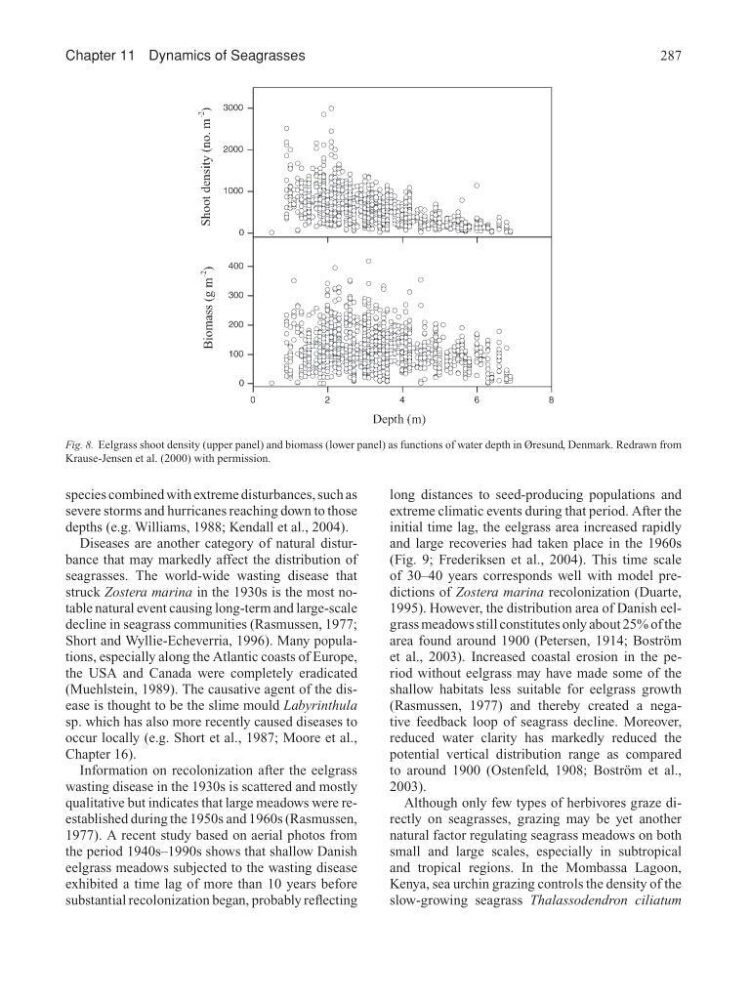
Fig. 8. Eelgrass shoot density (upper panel) and biomass (lower panel) as functions of water depth in Øresund, Denmark. Redrawn from
Krause-Jensen et al. (2000) with permission.
species combined with extreme disturbances, such as
severe storms and hurricanes reaching down to those
depths (e.g. Williams, 1988; Kendall et al., 2004).
Diseases are another category of natural disturbance that may markedly affect the distribution of
seagrasses. The world-wide wasting disease that
struck Zostera marina in the 1930s is the most notable natural event causing long-term and large-scale
decline in seagrass communities (Rasmussen, 1977;
Short and Wyllie-Echeverria, 1996). Many populations, especially along the Atlantic coasts of Europe,
the USA and Canada were completely eradicated
(Muehlstein, 1989). The causative agent of the disease is thought to be the slime mould Labyrinthula
sp. which has also more recently caused diseases to
occur locally (e.g. Short et al., 1987; Moore et al.,
Chapter 16).
Information on recolonization after the eelgrass
wasting disease in the 1930s is scattered and mostly
qualitative but indicates that large meadows were reestablished during the 1950s and 1960s (Rasmussen,
1977). A recent study based on aerial photos from
the period 1940s–1990s shows that shallow Danish
eelgrass meadows subjected to the wasting disease
exhibited a time lag of more than 10 years before
substantial recolonization began, probably reflecting
long distances to seed-producing populations and
extreme climatic events during that period. After the
initial time lag, the eelgrass area increased rapidly
and large recoveries had taken place in the 1960s
(Fig. 9; Frederiksen et al., 2004). This time scale
of 30–40 years corresponds well with model predictions of Zostera marina recolonization (Duarte,
1995). However, the distribution area of Danish eelgrass meadows still constitutes only about 25% of the
area found around 1900 (Petersen, 1914; Bostr¨ om
et al., 2003). Increased coastal erosion in the period without eelgrass may have made some of the
shallow habitats less suitable for eelgrass growth
(Rasmussen, 1977) and thereby created a negative feedback loop of seagrass decline. Moreover,
reduced water clarity has markedly reduced the
potential vertical distribution range as compared
to around 1900 (Ostenfeld, 1908; Bostr¨ om et al.,
2003).
Although only few types of herbivores graze directly on seagrasses, grazing may be yet another
natural factor regulating seagrass meadows on both
small and large scales, especially in subtropical
and tropical regions. In the Mombassa Lagoon,
Kenya, sea urchin grazing controls the density of the
slow-growing seagrass Thalassodendron ciliatum
287
0
1000
2000
3000
Biomass (g m
-2
)
Depth (m)
Fig. 8. Eelgrass shoot density (upper panel) and biomass (lower panel) as functions of water depth in Øresund, Denmark. Redrawn from
Krause-Jensen et al. (2000) with permission.
species combined with extreme disturbances, such as
severe storms and hurricanes reaching down to those
depths (e.g. Williams, 1988; Kendall et al., 2004).
Diseases are another category of natural disturbance that may markedly affect the distribution of
seagrasses. The world-wide wasting disease that
struck Zostera marina in the 1930s is the most notable natural event causing long-term and large-scale
decline in seagrass communities (Rasmussen, 1977;
Short and Wyllie-Echeverria, 1996). Many populations, especially along the Atlantic coasts of Europe,
the USA and Canada were completely eradicated
(Muehlstein, 1989). The causative agent of the disease is thought to be the slime mould Labyrinthula
sp. which has also more recently caused diseases to
occur locally (e.g. Short et al., 1987; Moore et al.,
Chapter 16).
Information on recolonization after the eelgrass
wasting disease in the 1930s is scattered and mostly
qualitative but indicates that large meadows were reestablished during the 1950s and 1960s (Rasmussen,
1977). A recent study based on aerial photos from
the period 1940s–1990s shows that shallow Danish
eelgrass meadows subjected to the wasting disease
exhibited a time lag of more than 10 years before
substantial recolonization began, probably reflecting
long distances to seed-producing populations and
extreme climatic events during that period. After the
initial time lag, the eelgrass area increased rapidly
and large recoveries had taken place in the 1960s
(Fig. 9; Frederiksen et al., 2004). This time scale
of 30–40 years corresponds well with model predictions of Zostera marina recolonization (Duarte,
1995). However, the distribution area of Danish eelgrass meadows still constitutes only about 25% of the
area found around 1900 (Petersen, 1914; Bostr¨ om
et al., 2003). Increased coastal erosion in the period without eelgrass may have made some of the
shallow habitats less suitable for eelgrass growth
(Rasmussen, 1977) and thereby created a negative feedback loop of seagrass decline. Moreover,
reduced water clarity has markedly reduced the
potential vertical distribution range as compared
to around 1900 (Ostenfeld, 1908; Bostr¨ om et al.,
2003).
Although only few types of herbivores graze directly on seagrasses, grazing may be yet another
natural factor regulating seagrass meadows on both
small and large scales, especially in subtropical
and tropical regions. In the Mombassa Lagoon,
Kenya, sea urchin grazing controls the density of the
slow-growing seagrass Thalassodendron ciliatum