

286
Carlos M. Duarte, James W. Fourqurean, Dorte Krause-Jensen, and Birgit Olesen
0
2 0
4 0
6 0
8 0
1 0 0
Percent cover prior to storm
% cover lost due to storm
% cover^2 - 235.6451 % cover^3
% lost = 152.8547 - 484.3109 % cover + 567.7285
0
20
40
60
80
100
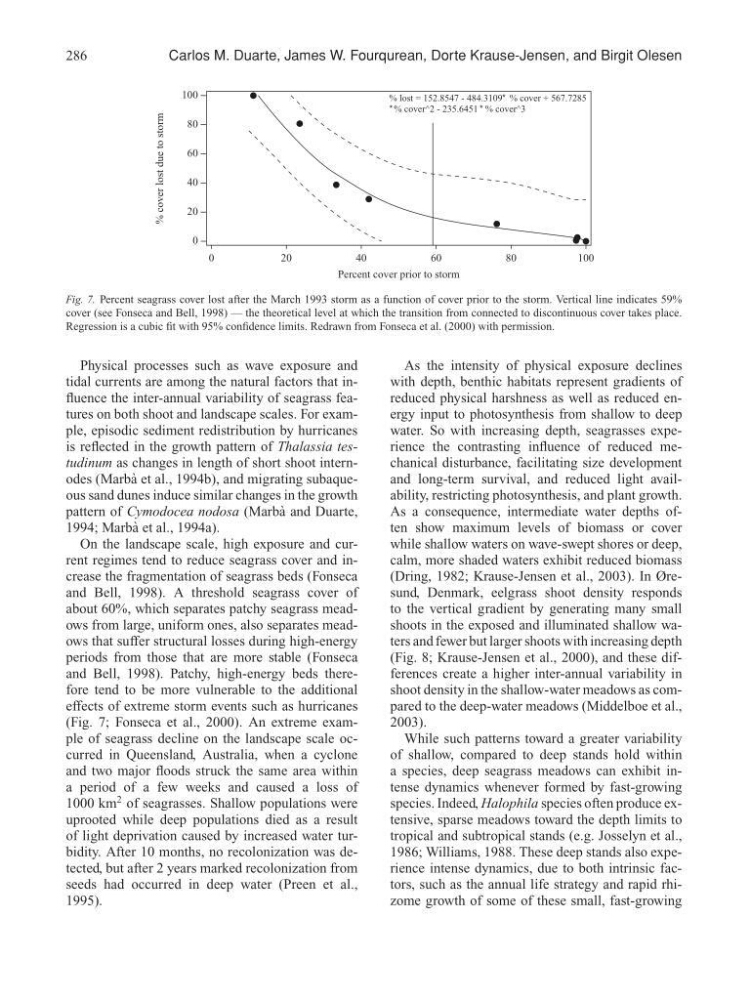
Fig. 7. Percent seagrass cover lost after the March 1993 storm as a function of cover prior to the storm. Vertical line indicates 59%
cover (see Fonseca and Bell, 1998) — the theoretical level at which the transition from connected to discontinuous cover takes place.
Regression is a cubic fit with 95% confidence limits. Redrawn from Fonseca et al. (2000) with permission.
Physical processes such as wave exposure and
tidal currents are among the natural factors that influence the inter-annual variability of seagrass features on both shoot and landscape scales. For example, episodic sediment redistribution by hurricanes
is reflected in the growth pattern of Thalassia testudinum as changes in length of short shoot internodes (Marb` a et al., 1994b), and migrating subaqueous sand dunes induce similar changes in the growth
pattern of Cymodocea nodosa (Marb` a and Duarte,
1994; Marb` a et al., 1994a).
On the landscape scale, high exposure and current regimes tend to reduce seagrass cover and increase the fragmentation of seagrass beds (Fonseca
and Bell, 1998). A threshold seagrass cover of
about 60%, which separates patchy seagrass meadows from large, uniform ones, also separates meadows that suffer structural losses during high-energy
periods from those that are more stable (Fonseca
and Bell, 1998). Patchy, high-energy beds therefore tend to be more vulnerable to the additional
effects of extreme storm events such as hurricanes
(Fig. 7; Fonseca et al., 2000). An extreme example of seagrass decline on the landscape scale occurred in Queensland, Australia, when a cyclone
and two major floods struck the same area within
a period of a few weeks and caused a loss of
1000 km
2 of seagrasses. Shallow populations were
uprooted while deep populations died as a result
of light deprivation caused by increased water turbidity. After 10 months, no recolonization was detected, but after 2 years marked recolonization from
seeds had occurred in deep water (Preen et al.,
1995).
As the intensity of physical exposure declines
with depth, benthic habitats represent gradients of
reduced physical harshness as well as reduced energy input to photosynthesis from shallow to deep
water. So with increasing depth, seagrasses experience the contrasting influence of reduced mechanical disturbance, facilitating size development
and long-term survival, and reduced light availability, restricting photosynthesis, and plant growth.
As a consequence, intermediate water depths often show maximum levels of biomass or cover
while shallow waters on wave-swept shores or deep,
calm, more shaded waters exhibit reduced biomass
(Dring, 1982; Krause-Jensen et al., 2003). In Øresund, Denmark, eelgrass shoot density responds
to the vertical gradient by generating many small
shoots in the exposed and illuminated shallow waters and fewer but larger shoots with increasing depth
(Fig. 8; Krause-Jensen et al., 2000), and these differences create a higher inter-annual variability in
shoot density in the shallow-water meadows as compared to the deep-water meadows (Middelboe et al.,
2003).
While such patterns toward a greater variability
of shallow, compared to deep stands hold within
a species, deep seagrass meadows can exhibit intense dynamics whenever formed by fast-growing
species. Indeed, Halophila species often produce extensive, sparse meadows toward the depth limits to
tropical and subtropical stands (e.g. Josselyn et al.,
1986; Williams, 1988. These deep stands also experience intense dynamics, due to both intrinsic factors, such as the annual life strategy and rapid rhizome growth of some of these small, fast-growing
Carlos M. Duarte, James W. Fourqurean, Dorte Krause-Jensen, and Birgit Olesen
0
2 0
4 0
6 0
8 0
1 0 0
Percent cover prior to storm
% cover lost due to storm
% cover^2 - 235.6451 % cover^3
% lost = 152.8547 - 484.3109 % cover + 567.7285
0
20
40
60
80
100
Fig. 7. Percent seagrass cover lost after the March 1993 storm as a function of cover prior to the storm. Vertical line indicates 59%
cover (see Fonseca and Bell, 1998) — the theoretical level at which the transition from connected to discontinuous cover takes place.
Regression is a cubic fit with 95% confidence limits. Redrawn from Fonseca et al. (2000) with permission.
Physical processes such as wave exposure and
tidal currents are among the natural factors that influence the inter-annual variability of seagrass features on both shoot and landscape scales. For example, episodic sediment redistribution by hurricanes
is reflected in the growth pattern of Thalassia testudinum as changes in length of short shoot internodes (Marb` a et al., 1994b), and migrating subaqueous sand dunes induce similar changes in the growth
pattern of Cymodocea nodosa (Marb` a and Duarte,
1994; Marb` a et al., 1994a).
On the landscape scale, high exposure and current regimes tend to reduce seagrass cover and increase the fragmentation of seagrass beds (Fonseca
and Bell, 1998). A threshold seagrass cover of
about 60%, which separates patchy seagrass meadows from large, uniform ones, also separates meadows that suffer structural losses during high-energy
periods from those that are more stable (Fonseca
and Bell, 1998). Patchy, high-energy beds therefore tend to be more vulnerable to the additional
effects of extreme storm events such as hurricanes
(Fig. 7; Fonseca et al., 2000). An extreme example of seagrass decline on the landscape scale occurred in Queensland, Australia, when a cyclone
and two major floods struck the same area within
a period of a few weeks and caused a loss of
1000 km
2 of seagrasses. Shallow populations were
uprooted while deep populations died as a result
of light deprivation caused by increased water turbidity. After 10 months, no recolonization was detected, but after 2 years marked recolonization from
seeds had occurred in deep water (Preen et al.,
1995).
As the intensity of physical exposure declines
with depth, benthic habitats represent gradients of
reduced physical harshness as well as reduced energy input to photosynthesis from shallow to deep
water. So with increasing depth, seagrasses experience the contrasting influence of reduced mechanical disturbance, facilitating size development
and long-term survival, and reduced light availability, restricting photosynthesis, and plant growth.
As a consequence, intermediate water depths often show maximum levels of biomass or cover
while shallow waters on wave-swept shores or deep,
calm, more shaded waters exhibit reduced biomass
(Dring, 1982; Krause-Jensen et al., 2003). In Øresund, Denmark, eelgrass shoot density responds
to the vertical gradient by generating many small
shoots in the exposed and illuminated shallow waters and fewer but larger shoots with increasing depth
(Fig. 8; Krause-Jensen et al., 2000), and these differences create a higher inter-annual variability in
shoot density in the shallow-water meadows as compared to the deep-water meadows (Middelboe et al.,
2003).
While such patterns toward a greater variability
of shallow, compared to deep stands hold within
a species, deep seagrass meadows can exhibit intense dynamics whenever formed by fast-growing
species. Indeed, Halophila species often produce extensive, sparse meadows toward the depth limits to
tropical and subtropical stands (e.g. Josselyn et al.,
1986; Williams, 1988. These deep stands also experience intense dynamics, due to both intrinsic factors, such as the annual life strategy and rapid rhizome growth of some of these small, fast-growing