

Chapter 11 Dynamics of Seagrasses
285
0
20
40
60
80
100
120
140
160
180
0
1 0
2 0
3 0
4 0
5 0
6 0
Latitude (degrees)
Biomass variability (CV, %)
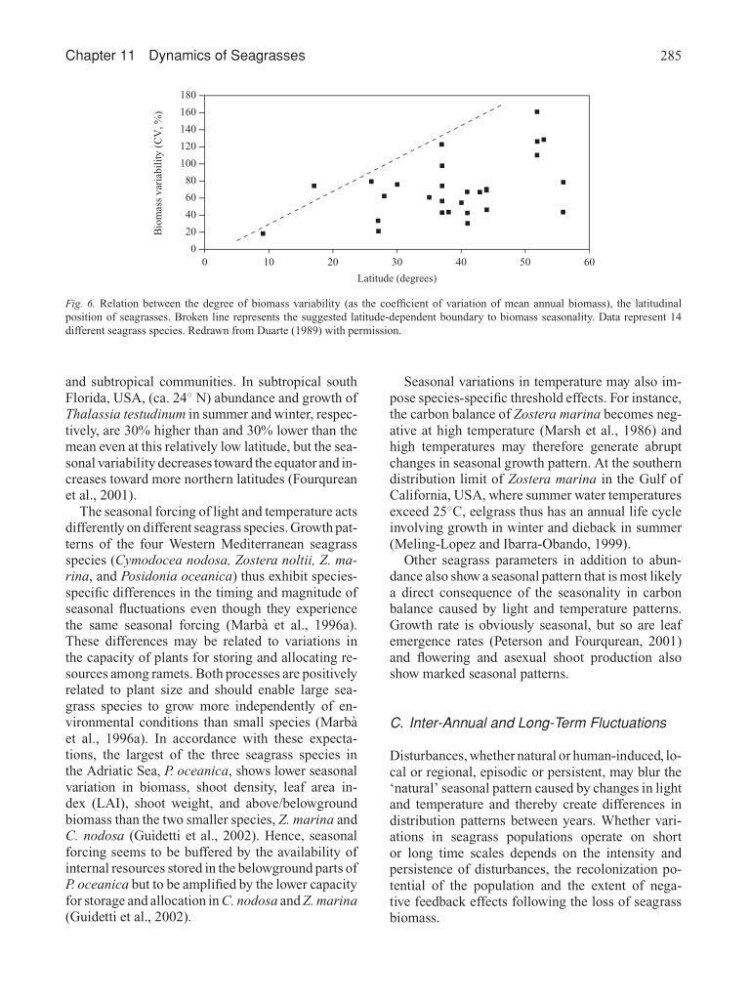
Fig. 6. Relation between the degree of biomass variability (as the coefficient of variation of mean annual biomass), the latitudinal
position of seagrasses. Broken line represents the suggested latitude-dependent boundary to biomass seasonality. Data represent 14
different seagrass species. Redrawn from Duarte (1989) with permission.
and subtropical communities. In subtropical south
Florida, USA, (ca. 24
◦ N) abundance and growth of
Thalassia testudinum in summer and winter, respectively, are 30% higher than and 30% lower than the
mean even at this relatively low latitude, but the seasonal variability decreases toward the equator and increases toward more northern latitudes (Fourqurean
et al., 2001).
The seasonal forcing of light and temperature acts
differently on different seagrass species. Growth patterns of the four Western Mediterranean seagrass
species (Cymodocea nodosa, Zostera noltii, Z. marina, and Posidonia oceanica) thus exhibit speciesspecific differences in the timing and magnitude of
seasonal fluctuations even though they experience
the same seasonal forcing (Marb` a et al., 1996a).
These differences may be related to variations in
the capacity of plants for storing and allocating resources among ramets. Both processes are positively
related to plant size and should enable large seagrass species to grow more independently of environmental conditions than small species (Marb` a
et al., 1996a). In accordance with these expectations, the largest of the three seagrass species in
the Adriatic Sea, P. oceanica, shows lower seasonal
variation in biomass, shoot density, leaf area index (LAI), shoot weight, and above/belowground
biomass than the two smaller species, Z. marina and
C. nodosa (Guidetti et al., 2002). Hence, seasonal
forcing seems to be buffered by the availability of
internal resources stored in the belowground parts of
P. oceanica but to be amplified by the lower capacity
for storage and allocation in C. nodosa and Z. marina
(Guidetti et al., 2002).
Seasonal variations in temperature may also impose species-specific threshold effects. For instance,
the carbon balance of Zostera marina becomes negative at high temperature (Marsh et al., 1986) and
high temperatures may therefore generate abrupt
changes in seasonal growth pattern. At the southern
distribution limit of Zostera marina in the Gulf of
California, USA, where summer water temperatures
exceed 25
◦ C, eelgrass thus has an annual life cycle
involving growth in winter and dieback in summer
(Meling-Lopez and Ibarra-Obando, 1999).
Other seagrass parameters in addition to abundance also show a seasonal pattern that is most likely
a direct consequence of the seasonality in carbon
balance caused by light and temperature patterns.
Growth rate is obviously seasonal, but so are leaf
emergence rates (Peterson and Fourqurean, 2001)
and flowering and asexual shoot production also
show marked seasonal patterns.
C. Inter-Annual and Long-Term Fluctuations
Disturbances, whether natural or human-induced, local or regional, episodic or persistent, may blur the
‘natural’ seasonal pattern caused by changes in light
and temperature and thereby create differences in
distribution patterns between years. Whether variations in seagrass populations operate on short
or long time scales depends on the intensity and
persistence of disturbances, the recolonization potential of the population and the extent of negative feedback effects following the loss of seagrass
biomass.
285
0
20
40
60
80
100
120
140
160
180
0
1 0
2 0
3 0
4 0
5 0
6 0
Latitude (degrees)
Biomass variability (CV, %)
Fig. 6. Relation between the degree of biomass variability (as the coefficient of variation of mean annual biomass), the latitudinal
position of seagrasses. Broken line represents the suggested latitude-dependent boundary to biomass seasonality. Data represent 14
different seagrass species. Redrawn from Duarte (1989) with permission.
and subtropical communities. In subtropical south
Florida, USA, (ca. 24
◦ N) abundance and growth of
Thalassia testudinum in summer and winter, respectively, are 30% higher than and 30% lower than the
mean even at this relatively low latitude, but the seasonal variability decreases toward the equator and increases toward more northern latitudes (Fourqurean
et al., 2001).
The seasonal forcing of light and temperature acts
differently on different seagrass species. Growth patterns of the four Western Mediterranean seagrass
species (Cymodocea nodosa, Zostera noltii, Z. marina, and Posidonia oceanica) thus exhibit speciesspecific differences in the timing and magnitude of
seasonal fluctuations even though they experience
the same seasonal forcing (Marb` a et al., 1996a).
These differences may be related to variations in
the capacity of plants for storing and allocating resources among ramets. Both processes are positively
related to plant size and should enable large seagrass species to grow more independently of environmental conditions than small species (Marb` a
et al., 1996a). In accordance with these expectations, the largest of the three seagrass species in
the Adriatic Sea, P. oceanica, shows lower seasonal
variation in biomass, shoot density, leaf area index (LAI), shoot weight, and above/belowground
biomass than the two smaller species, Z. marina and
C. nodosa (Guidetti et al., 2002). Hence, seasonal
forcing seems to be buffered by the availability of
internal resources stored in the belowground parts of
P. oceanica but to be amplified by the lower capacity
for storage and allocation in C. nodosa and Z. marina
(Guidetti et al., 2002).
Seasonal variations in temperature may also impose species-specific threshold effects. For instance,
the carbon balance of Zostera marina becomes negative at high temperature (Marsh et al., 1986) and
high temperatures may therefore generate abrupt
changes in seasonal growth pattern. At the southern
distribution limit of Zostera marina in the Gulf of
California, USA, where summer water temperatures
exceed 25
◦ C, eelgrass thus has an annual life cycle
involving growth in winter and dieback in summer
(Meling-Lopez and Ibarra-Obando, 1999).
Other seagrass parameters in addition to abundance also show a seasonal pattern that is most likely
a direct consequence of the seasonality in carbon
balance caused by light and temperature patterns.
Growth rate is obviously seasonal, but so are leaf
emergence rates (Peterson and Fourqurean, 2001)
and flowering and asexual shoot production also
show marked seasonal patterns.
C. Inter-Annual and Long-Term Fluctuations
Disturbances, whether natural or human-induced, local or regional, episodic or persistent, may blur the
‘natural’ seasonal pattern caused by changes in light
and temperature and thereby create differences in
distribution patterns between years. Whether variations in seagrass populations operate on short
or long time scales depends on the intensity and
persistence of disturbances, the recolonization potential of the population and the extent of negative feedback effects following the loss of seagrass
biomass.