

Chapter 11 Dynamics of Seagrasses
273
grow slowly (Duarte, 1991; Marb` a and Duarte, 1998;
Hemminga and Duarte, 2000). On the basis of the existence of such allometric relationships, the seagrass
flora has been described as composed of scale models of a generic design (Marb` a and Duarte, 1998).
Whereas this statement holds if examining individual properties, the simultaneous variation in average clonal properties across species renders clonal
patterns complex, thereby resulting in contrasting
growth strategies across species.
The simplest models of clonal growth could not
elucidate these differences for they portrayed clonal
growth as a simple radial growth process, with
circular-shaped clones extending at a constant radial
growth rate equivalent to the average rhizome elongation rate of the modeled species (Duarte, 1995;
Kendrick et al., 1999). However, comparison of
the resulting prediction of colonization rates with
observed dynamics provided evidence that clonal
growth does not proceed at a constant rate, but that it
accelerates over time (Kendrick et al., 1999). More
elaborate models of clonal growth used all components of clonal growth, as represented by their average value and observed within-species variability, to
examine the development of clonal networks (Marb` a
and Duarte, 1998; Sintes et al., 2005. Models using clonal growth rules to simulate clonal growth
provided evidence that, as suggested by field observations (Vidondo et al., 1997; Kendrick et al.,
1999), this is a strongly non-linear process (Marb` a
and Duarte, 1998; Sintes et al., 2005). The radial
growth of seagrass clones accelerates from very low
values at the early stages of growth to high rates
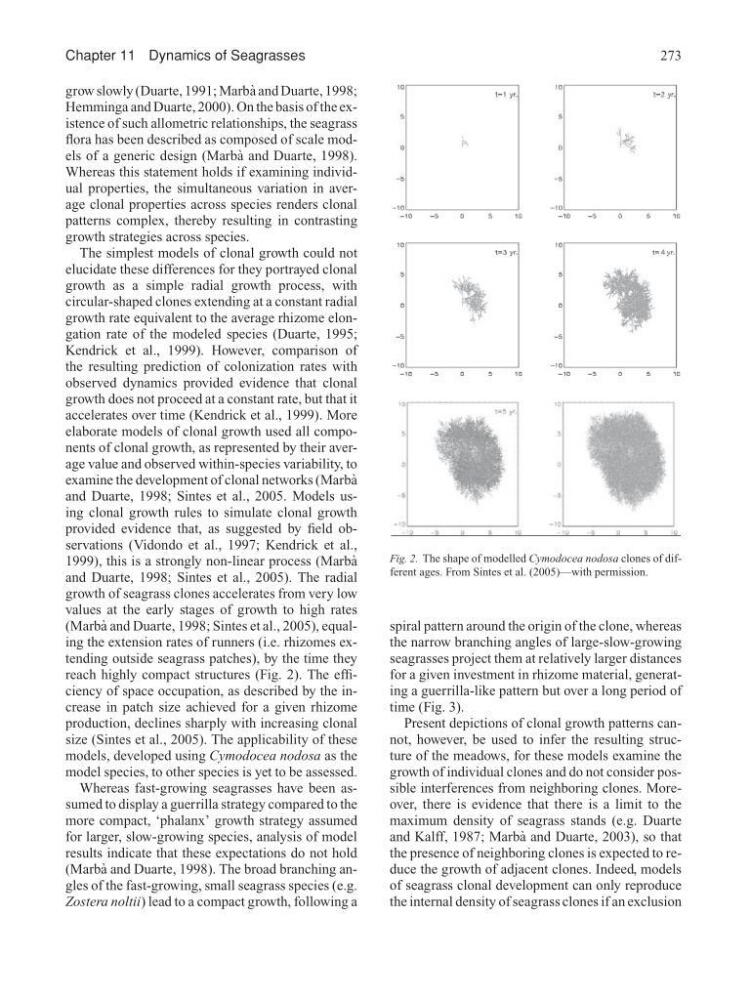
(Marb` a and Duarte, 1998; Sintes et al., 2005), equaling the extension rates of runners (i.e. rhizomes extending outside seagrass patches), by the time they
reach highly compact structures (Fig. 2). The efficiency of space occupation, as described by the increase in patch size achieved for a given rhizome
production, declines sharply with increasing clonal
size (Sintes et al., 2005). The applicability of these
models, developed using Cymodocea nodosa as the
model species, to other species is yet to be assessed.
Whereas fast-growing seagrasses have been assumed to display a guerrilla strategy compared to the
more compact, ‘phalanx’ growth strategy assumed
for larger, slow-growing species, analysis of model
results indicate that these expectations do not hold
(Marb` a and Duarte, 1998). The broad branching angles of the fast-growing, small seagrass species (e.g.
Zostera noltii) lead to a compact growth, following a
Fig. 2. The shape of modelled Cymodocea nodosa clones of different ages. From Sintes et al. (2005)—with permission.
spiral pattern around the origin of the clone, whereas
the narrow branching angles of large-slow-growing
seagrasses project them at relatively larger distances
for a given investment in rhizome material, generating a guerrilla-like pattern but over a long period of
time (Fig. 3).
Present depictions of clonal growth patterns cannot, however, be used to infer the resulting structure of the meadows, for these models examine the
growth of individual clones and do not consider possible interferences from neighboring clones. Moreover, there is evidence that there is a limit to the
maximum density of seagrass stands (e.g. Duarte
and Kalff, 1987; Marb` a and Duarte, 2003), so that
the presence of neighboring clones is expected to reduce the growth of adjacent clones. Indeed, models
of seagrass clonal development can only reproduce
the internal density of seagrass clones if an exclusion
273
grow slowly (Duarte, 1991; Marb` a and Duarte, 1998;
Hemminga and Duarte, 2000). On the basis of the existence of such allometric relationships, the seagrass
flora has been described as composed of scale models of a generic design (Marb` a and Duarte, 1998).
Whereas this statement holds if examining individual properties, the simultaneous variation in average clonal properties across species renders clonal
patterns complex, thereby resulting in contrasting
growth strategies across species.
The simplest models of clonal growth could not
elucidate these differences for they portrayed clonal
growth as a simple radial growth process, with
circular-shaped clones extending at a constant radial
growth rate equivalent to the average rhizome elongation rate of the modeled species (Duarte, 1995;
Kendrick et al., 1999). However, comparison of
the resulting prediction of colonization rates with
observed dynamics provided evidence that clonal
growth does not proceed at a constant rate, but that it
accelerates over time (Kendrick et al., 1999). More
elaborate models of clonal growth used all components of clonal growth, as represented by their average value and observed within-species variability, to
examine the development of clonal networks (Marb` a
and Duarte, 1998; Sintes et al., 2005. Models using clonal growth rules to simulate clonal growth
provided evidence that, as suggested by field observations (Vidondo et al., 1997; Kendrick et al.,
1999), this is a strongly non-linear process (Marb` a
and Duarte, 1998; Sintes et al., 2005). The radial
growth of seagrass clones accelerates from very low
values at the early stages of growth to high rates
(Marb` a and Duarte, 1998; Sintes et al., 2005), equaling the extension rates of runners (i.e. rhizomes extending outside seagrass patches), by the time they
reach highly compact structures (Fig. 2). The efficiency of space occupation, as described by the increase in patch size achieved for a given rhizome
production, declines sharply with increasing clonal
size (Sintes et al., 2005). The applicability of these
models, developed using Cymodocea nodosa as the
model species, to other species is yet to be assessed.
Whereas fast-growing seagrasses have been assumed to display a guerrilla strategy compared to the
more compact, ‘phalanx’ growth strategy assumed
for larger, slow-growing species, analysis of model
results indicate that these expectations do not hold
(Marb` a and Duarte, 1998). The broad branching angles of the fast-growing, small seagrass species (e.g.
Zostera noltii) lead to a compact growth, following a
Fig. 2. The shape of modelled Cymodocea nodosa clones of different ages. From Sintes et al. (2005)—with permission.
spiral pattern around the origin of the clone, whereas
the narrow branching angles of large-slow-growing
seagrasses project them at relatively larger distances
for a given investment in rhizome material, generating a guerrilla-like pattern but over a long period of
time (Fig. 3).
Present depictions of clonal growth patterns cannot, however, be used to infer the resulting structure of the meadows, for these models examine the
growth of individual clones and do not consider possible interferences from neighboring clones. Moreover, there is evidence that there is a limit to the
maximum density of seagrass stands (e.g. Duarte
and Kalff, 1987; Marb` a and Duarte, 2003), so that
the presence of neighboring clones is expected to reduce the growth of adjacent clones. Indeed, models
of seagrass clonal development can only reproduce
the internal density of seagrass clones if an exclusion