

274
Carlos M. Duarte, James W. Fourqurean, Dorte Krause-Jensen, and Birgit Olesen
1.4
0.9
0.4
-0.1
1.4
0.9
0.4
-0.1
0.9
0.4
-0.6
-0.6
-0.1
-0.1
0.4
0.9
1.4
1.4
distance to X origin (m)
distance to Y origin (m)
produced alive
rhizome (m)
number of
shoots
5.3
1.7
191
38
time = 55 yr
produced alive
rhizome (m)
number of
shoots
201
59
5.5
3.5
time = 6 yr
time = 0.10 yr
produced alive
rhizome (m)
number of
shoots
5.7
5.4
336
262
Halophila ovalis
Thalassodendron ciliatum
Posidonia oceanica
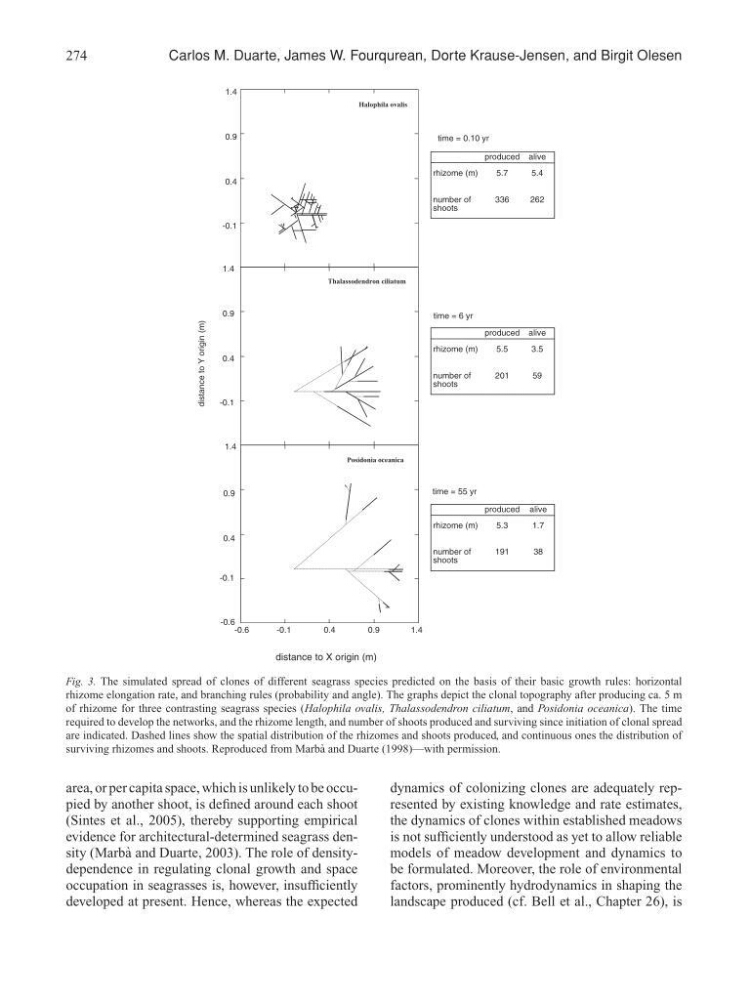
Fig. 3. The simulated spread of clones of different seagrass species predicted on the basis of their basic growth rules: horizontal
rhizome elongation rate, and branching rules (probability and angle). The graphs depict the clonal topography after producing ca. 5 m
of rhizome for three contrasting seagrass species (Halophila ovalis, Thalassodendron ciliatum, and Posidonia oceanica). The time
required to develop the networks, and the rhizome length, and number of shoots produced and surviving since initiation of clonal spread
are indicated. Dashed lines show the spatial distribution of the rhizomes and shoots produced, and continuous ones the distribution of
surviving rhizomes and shoots. Reproduced from Marb` a and Duarte (1998)—with permission.
area, or per capita space, which is unlikely to be occupied by another shoot, is defined around each shoot
(Sintes et al., 2005), thereby supporting empirical
evidence for architectural-determined seagrass density (Marb` a and Duarte, 2003). The role of densitydependence in regulating clonal growth and space
occupation in seagrasses is, however, insufficiently
developed at present. Hence, whereas the expected
dynamics of colonizing clones are adequately represented by existing knowledge and rate estimates,
the dynamics of clones within established meadows
is not sufficiently understood as yet to allow reliable
models of meadow development and dynamics to
be formulated. Moreover, the role of environmental
factors, prominently hydrodynamics in shaping the
landscape produced (cf. Bell et al., Chapter 26), is
Carlos M. Duarte, James W. Fourqurean, Dorte Krause-Jensen, and Birgit Olesen
1.4
0.9
0.4
-0.1
1.4
0.9
0.4
-0.1
0.9
0.4
-0.6
-0.6
-0.1
-0.1
0.4
0.9
1.4
1.4
distance to X origin (m)
distance to Y origin (m)
produced alive
rhizome (m)
number of
shoots
5.3
1.7
191
38
time = 55 yr
produced alive
rhizome (m)
number of
shoots
201
59
5.5
3.5
time = 6 yr
time = 0.10 yr
produced alive
rhizome (m)
number of
shoots
5.7
5.4
336
262
Halophila ovalis
Thalassodendron ciliatum
Posidonia oceanica
Fig. 3. The simulated spread of clones of different seagrass species predicted on the basis of their basic growth rules: horizontal
rhizome elongation rate, and branching rules (probability and angle). The graphs depict the clonal topography after producing ca. 5 m
of rhizome for three contrasting seagrass species (Halophila ovalis, Thalassodendron ciliatum, and Posidonia oceanica). The time
required to develop the networks, and the rhizome length, and number of shoots produced and surviving since initiation of clonal spread
are indicated. Dashed lines show the spatial distribution of the rhizomes and shoots produced, and continuous ones the distribution of
surviving rhizomes and shoots. Reproduced from Marb` a and Duarte (1998)—with permission.
area, or per capita space, which is unlikely to be occupied by another shoot, is defined around each shoot
(Sintes et al., 2005), thereby supporting empirical
evidence for architectural-determined seagrass density (Marb` a and Duarte, 2003). The role of densitydependence in regulating clonal growth and space
occupation in seagrasses is, however, insufficiently
developed at present. Hence, whereas the expected
dynamics of colonizing clones are adequately represented by existing knowledge and rate estimates,
the dynamics of clones within established meadows
is not sufficiently understood as yet to allow reliable
models of meadow development and dynamics to
be formulated. Moreover, the role of environmental
factors, prominently hydrodynamics in shaping the
landscape produced (cf. Bell et al., Chapter 26), is