

Chapter 10 Oxygen Movement in Seagrasses
265
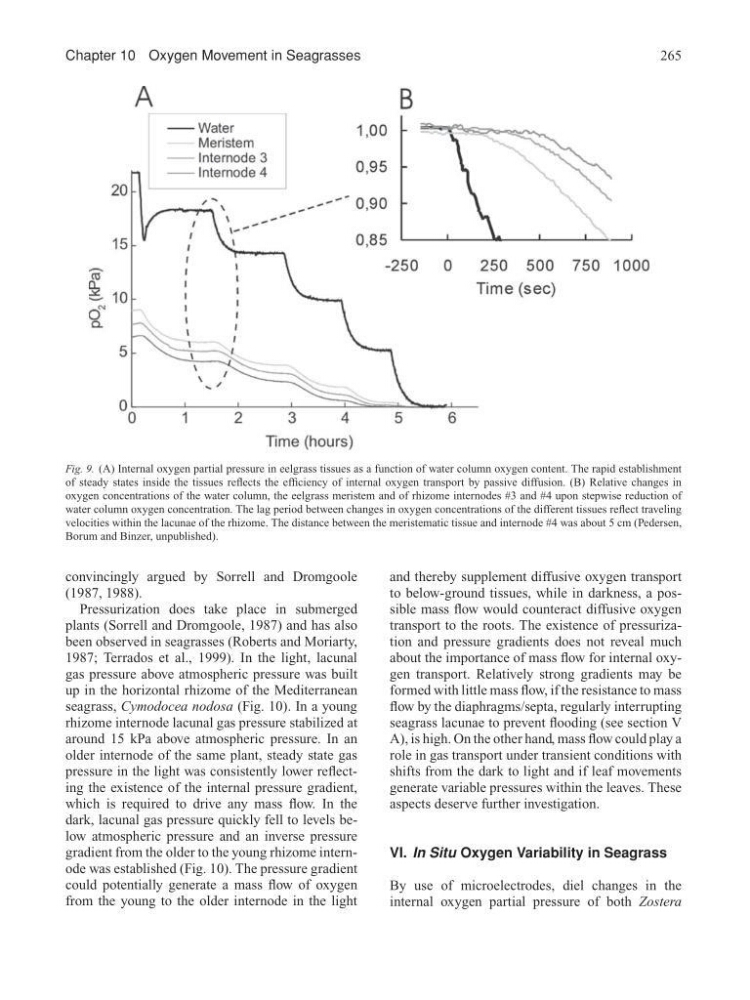
Fig. 9. (A) Internal oxygen partial pressure in eelgrass tissues as a function of water column oxygen content. The rapid establishment
of steady states inside the tissues reflects the efficiency of internal oxygen transport by passive diffusion. (B) Relative changes in
oxygen concentrations of the water column, the eelgrass meristem and of rhizome internodes #3 and #4 upon stepwise reduction of
water column oxygen concentration. The lag period between changes in oxygen concentrations of the different tissues reflect traveling
velocities within the lacunae of the rhizome. The distance between the meristematic tissue and internode #4 was about 5 cm (Pedersen,
Borum and Binzer, unpublished).
convincingly argued by Sorrell and Dromgoole
(1987, 1988).
Pressurization does take place in submerged
plants (Sorrell and Dromgoole, 1987) and has also
been observed in seagrasses (Roberts and Moriarty,
1987; Terrados et al., 1999). In the light, lacunal
gas pressure above atmospheric pressure was built
up in the horizontal rhizome of the Mediterranean
seagrass, Cymodocea nodosa (Fig. 10). In a young
rhizome internode lacunal gas pressure stabilized at
around 15 kPa above atmospheric pressure. In an
older internode of the same plant, steady state gas
pressure in the light was consistently lower reflecting the existence of the internal pressure gradient,
which is required to drive any mass flow. In the
dark, lacunal gas pressure quickly fell to levels below atmospheric pressure and an inverse pressure
gradient from the older to the young rhizome internode was established (Fig. 10). The pressure gradient
could potentially generate a mass flow of oxygen
from the young to the older internode in the light
and thereby supplement diffusive oxygen transport
to below-ground tissues, while in darkness, a possible mass flow would counteract diffusive oxygen
transport to the roots. The existence of pressurization and pressure gradients does not reveal much
about the importance of mass flow for internal oxygen transport. Relatively strong gradients may be
formed with little mass flow, if the resistance to mass
flow by the diaphragms/septa, regularly interrupting
seagrass lacunae to prevent flooding (see section V
A), is high. On the other hand, mass flow could play a
role in gas transport under transient conditions with
shifts from the dark to light and if leaf movements
generate variable pressures within the leaves. These
aspects deserve further investigation.
VI. In Situ Oxygen Variability in Seagrass
By use of microelectrodes, diel changes in the
internal oxygen partial pressure of both Zostera
265
Fig. 9. (A) Internal oxygen partial pressure in eelgrass tissues as a function of water column oxygen content. The rapid establishment
of steady states inside the tissues reflects the efficiency of internal oxygen transport by passive diffusion. (B) Relative changes in
oxygen concentrations of the water column, the eelgrass meristem and of rhizome internodes #3 and #4 upon stepwise reduction of
water column oxygen concentration. The lag period between changes in oxygen concentrations of the different tissues reflect traveling
velocities within the lacunae of the rhizome. The distance between the meristematic tissue and internode #4 was about 5 cm (Pedersen,
Borum and Binzer, unpublished).
convincingly argued by Sorrell and Dromgoole
(1987, 1988).
Pressurization does take place in submerged
plants (Sorrell and Dromgoole, 1987) and has also
been observed in seagrasses (Roberts and Moriarty,
1987; Terrados et al., 1999). In the light, lacunal
gas pressure above atmospheric pressure was built
up in the horizontal rhizome of the Mediterranean
seagrass, Cymodocea nodosa (Fig. 10). In a young
rhizome internode lacunal gas pressure stabilized at
around 15 kPa above atmospheric pressure. In an
older internode of the same plant, steady state gas
pressure in the light was consistently lower reflecting the existence of the internal pressure gradient,
which is required to drive any mass flow. In the
dark, lacunal gas pressure quickly fell to levels below atmospheric pressure and an inverse pressure
gradient from the older to the young rhizome internode was established (Fig. 10). The pressure gradient
could potentially generate a mass flow of oxygen
from the young to the older internode in the light
and thereby supplement diffusive oxygen transport
to below-ground tissues, while in darkness, a possible mass flow would counteract diffusive oxygen
transport to the roots. The existence of pressurization and pressure gradients does not reveal much
about the importance of mass flow for internal oxygen transport. Relatively strong gradients may be
formed with little mass flow, if the resistance to mass
flow by the diaphragms/septa, regularly interrupting
seagrass lacunae to prevent flooding (see section V
A), is high. On the other hand, mass flow could play a
role in gas transport under transient conditions with
shifts from the dark to light and if leaf movements
generate variable pressures within the leaves. These
aspects deserve further investigation.
VI. In Situ Oxygen Variability in Seagrass
By use of microelectrodes, diel changes in the
internal oxygen partial pressure of both Zostera