

262
Jens Borum, Kaj Sand-Jensen, Thomas Binzer, Ole Pedersen and Tina Maria Greve
0
1
2
3
4
Distance behind root tip (cm)
0
20
40
60
80
100
Radial O
2 loss
(ng cm
-2
root surface min
-1
)
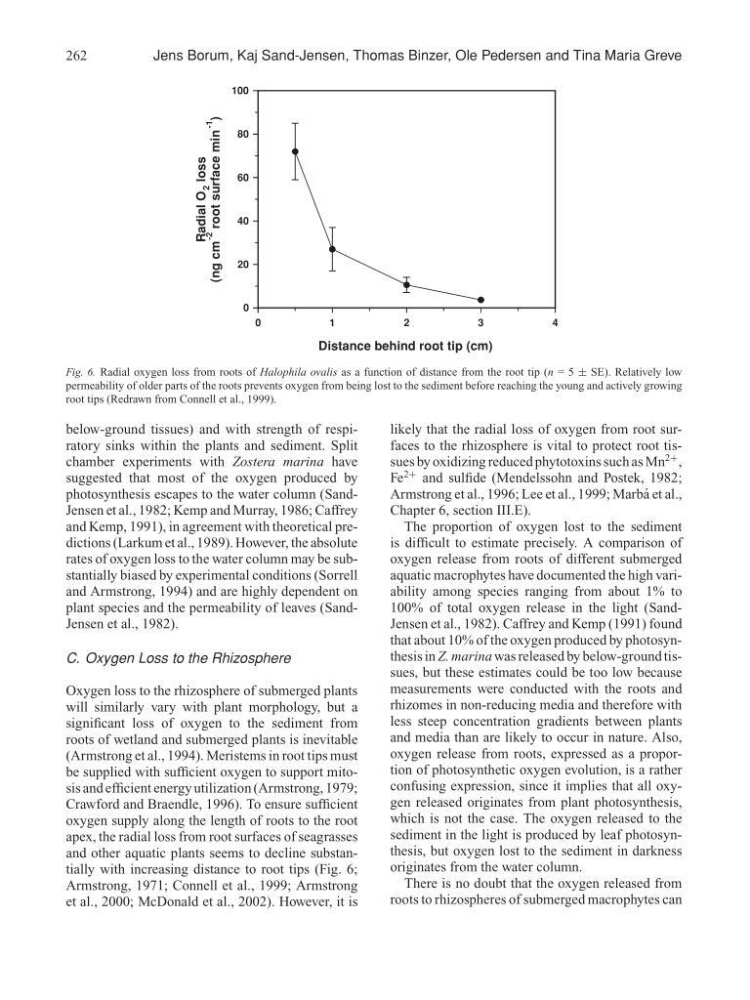
Fig. 6. Radial oxygen loss from roots of Halophila ovalis as a function of distance from the root tip (n = 5 ± SE). Relatively low
permeability of older parts of the roots prevents oxygen from being lost to the sediment before reaching the young and actively growing
root tips (Redrawn from Connell et al., 1999).
below-ground tissues) and with strength of respiratory sinks within the plants and sediment. Split
chamber experiments with Zostera marina have
suggested that most of the oxygen produced by
photosynthesis escapes to the water column (SandJensen et al., 1982; Kemp and Murray, 1986; Caffrey
and Kemp, 1991), in agreement with theoretical predictions (Larkum et al., 1989). However, the absolute
rates of oxygen loss to the water column may be substantially biased by experimental conditions (Sorrell
and Armstrong, 1994) and are highly dependent on
plant species and the permeability of leaves (SandJensen et al., 1982).
C. Oxygen Loss to the Rhizosphere
Oxygen loss to the rhizosphere of submerged plants
will similarly vary with plant morphology, but a
significant loss of oxygen to the sediment from
roots of wetland and submerged plants is inevitable
(Armstrong et al., 1994). Meristems in root tips must
be supplied with sufficient oxygen to support mitosis and efficient energy utilization (Armstrong, 1979;
Crawford and Braendle, 1996). To ensure sufficient
oxygen supply along the length of roots to the root
apex, the radial loss from root surfaces of seagrasses
and other aquatic plants seems to decline substantially with increasing distance to root tips (Fig. 6;
Armstrong, 1971; Connell et al., 1999; Armstrong
et al., 2000; McDonald et al., 2002). However, it is
likely that the radial loss of oxygen from root surfaces to the rhizosphere is vital to protect root tissues by oxidizing reduced phytotoxins such as Mn
2+ ,
Fe
2+ and sulfide (Mendelssohn and Postek, 1982;
Armstrong et al., 1996; Lee et al., 1999; Marb´ a et al.,
Chapter 6, section III.E).
The proportion of oxygen lost to the sediment
is difficult to estimate precisely. A comparison of
oxygen release from roots of different submerged
aquatic macrophytes have documented the high variability among species ranging from about 1% to
100% of total oxygen release in the light (SandJensen et al., 1982). Caffrey and Kemp (1991) found
that about 10% of the oxygen produced by photosynthesis in Z. marina was released by below-ground tissues, but these estimates could be too low because
measurements were conducted with the roots and
rhizomes in non-reducing media and therefore with
less steep concentration gradients between plants
and media than are likely to occur in nature. Also,
oxygen release from roots, expressed as a proportion of photosynthetic oxygen evolution, is a rather
confusing expression, since it implies that all oxygen released originates from plant photosynthesis,
which is not the case. The oxygen released to the
sediment in the light is produced by leaf photosynthesis, but oxygen lost to the sediment in darkness
originates from the water column.
There is no doubt that the oxygen released from
roots to rhizospheres of submerged macrophytes can
Jens Borum, Kaj Sand-Jensen, Thomas Binzer, Ole Pedersen and Tina Maria Greve
0
1
2
3
4
Distance behind root tip (cm)
0
20
40
60
80
100
Radial O
2 loss
(ng cm
-2
root surface min
-1
)
Fig. 6. Radial oxygen loss from roots of Halophila ovalis as a function of distance from the root tip (n = 5 ± SE). Relatively low
permeability of older parts of the roots prevents oxygen from being lost to the sediment before reaching the young and actively growing
root tips (Redrawn from Connell et al., 1999).
below-ground tissues) and with strength of respiratory sinks within the plants and sediment. Split
chamber experiments with Zostera marina have
suggested that most of the oxygen produced by
photosynthesis escapes to the water column (SandJensen et al., 1982; Kemp and Murray, 1986; Caffrey
and Kemp, 1991), in agreement with theoretical predictions (Larkum et al., 1989). However, the absolute
rates of oxygen loss to the water column may be substantially biased by experimental conditions (Sorrell
and Armstrong, 1994) and are highly dependent on
plant species and the permeability of leaves (SandJensen et al., 1982).
C. Oxygen Loss to the Rhizosphere
Oxygen loss to the rhizosphere of submerged plants
will similarly vary with plant morphology, but a
significant loss of oxygen to the sediment from
roots of wetland and submerged plants is inevitable
(Armstrong et al., 1994). Meristems in root tips must
be supplied with sufficient oxygen to support mitosis and efficient energy utilization (Armstrong, 1979;
Crawford and Braendle, 1996). To ensure sufficient
oxygen supply along the length of roots to the root
apex, the radial loss from root surfaces of seagrasses
and other aquatic plants seems to decline substantially with increasing distance to root tips (Fig. 6;
Armstrong, 1971; Connell et al., 1999; Armstrong
et al., 2000; McDonald et al., 2002). However, it is
likely that the radial loss of oxygen from root surfaces to the rhizosphere is vital to protect root tissues by oxidizing reduced phytotoxins such as Mn
2+ ,
Fe
2+ and sulfide (Mendelssohn and Postek, 1982;
Armstrong et al., 1996; Lee et al., 1999; Marb´ a et al.,
Chapter 6, section III.E).
The proportion of oxygen lost to the sediment
is difficult to estimate precisely. A comparison of
oxygen release from roots of different submerged
aquatic macrophytes have documented the high variability among species ranging from about 1% to
100% of total oxygen release in the light (SandJensen et al., 1982). Caffrey and Kemp (1991) found
that about 10% of the oxygen produced by photosynthesis in Z. marina was released by below-ground tissues, but these estimates could be too low because
measurements were conducted with the roots and
rhizomes in non-reducing media and therefore with
less steep concentration gradients between plants
and media than are likely to occur in nature. Also,
oxygen release from roots, expressed as a proportion of photosynthetic oxygen evolution, is a rather
confusing expression, since it implies that all oxygen released originates from plant photosynthesis,
which is not the case. The oxygen released to the
sediment in the light is produced by leaf photosynthesis, but oxygen lost to the sediment in darkness
originates from the water column.
There is no doubt that the oxygen released from
roots to rhizospheres of submerged macrophytes can