

Chapter 7 Carbon Flux in Seagrasses
175
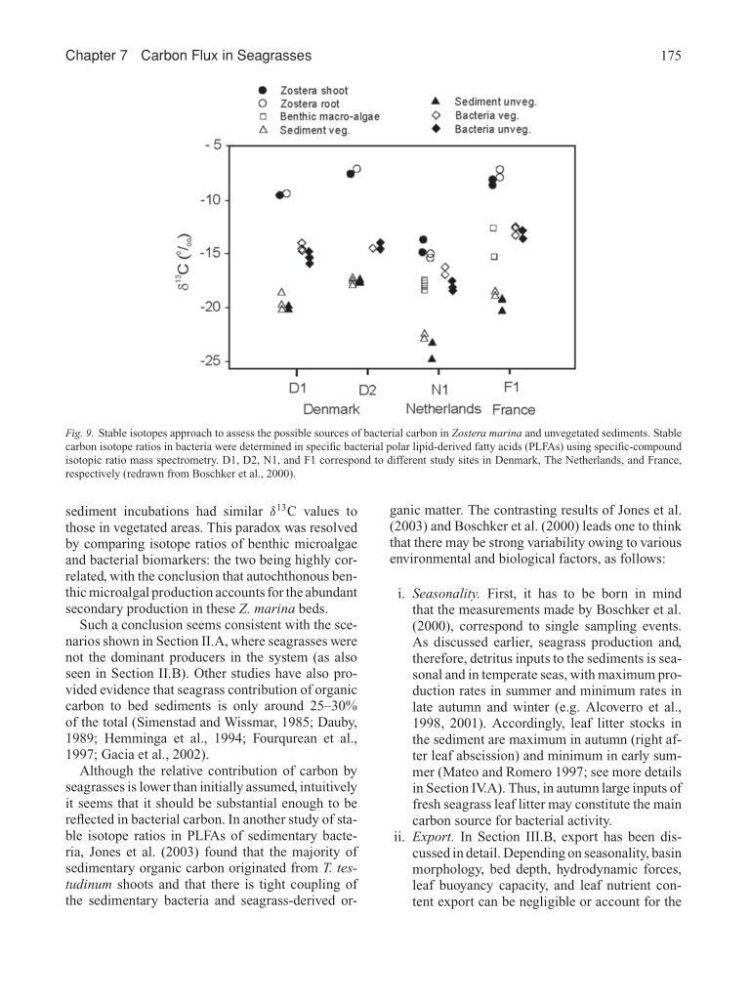
Fig. 9. Stable isotopes approach to assess the possible sources of bacterial carbon in Zostera marina and unvegetated sediments. Stable
carbon isotope ratios in bacteria were determined in specific bacterial polar lipid-derived fatty acids (PLFAs) using specific-compound
isotopic ratio mass spectrometry. D1, D2, N1, and F1 correspond to different study sites in Denmark, The Netherlands, and France,
respectively (redrawn from Boschker et al., 2000).
sediment incubations had similar δ
13 C values to
those in vegetated areas. This paradox was resolved
by comparing isotope ratios of benthic microalgae
and bacterial biomarkers: the two being highly correlated, with the conclusion that autochthonous benthic microalgal production accounts for the abundant
secondary production in these Z. marina beds.
Such a conclusion seems consistent with the scenarios shown in Section II.A, where seagrasses were
not the dominant producers in the system (as also
seen in Section II.B). Other studies have also provided evidence that seagrass contribution of organic
carbon to bed sediments is only around 25–30%
of the total (Simenstad and Wissmar, 1985; Dauby,
1989; Hemminga et al., 1994; Fourqurean et al.,
1997; Gacia et al., 2002).
Although the relative contribution of carbon by
seagrasses is lower than initially assumed, intuitively
it seems that it should be substantial enough to be
reflected in bacterial carbon. In another study of stable isotope ratios in PLFAs of sedimentary bacteria, Jones et al. (2003) found that the majority of
sedimentary organic carbon originated from T. testudinum shoots and that there is tight coupling of
the sedimentary bacteria and seagrass-derived organic matter. The contrasting results of Jones et al.
(2003) and Boschker et al. (2000) leads one to think
that there may be strong variability owing to various
environmental and biological factors, as follows:
i. Seasonality. First, it has to be born in mind
that the measurements made by Boschker et al.
(2000), correspond to single sampling events.
As discussed earlier, seagrass production and,
therefore, detritus inputs to the sediments is seasonal and in temperate seas, with maximum production rates in summer and minimum rates in
late autumn and winter (e.g. Alcoverro et al.,
1998, 2001). Accordingly, leaf litter stocks in
the sediment are maximum in autumn (right after leaf abscission) and minimum in early summer (Mateo and Romero 1997; see more details
in Section IV.A). Thus, in autumn large inputs of
fresh seagrass leaf litter may constitute the main
carbon source for bacterial activity.
ii. Export. In Section III.B, export has been discussed in detail. Depending on seasonality, basin
morphology, bed depth, hydrodynamic forces,
leaf buoyancy capacity, and leaf nutrient content export can be negligible or account for the
175
Fig. 9. Stable isotopes approach to assess the possible sources of bacterial carbon in Zostera marina and unvegetated sediments. Stable
carbon isotope ratios in bacteria were determined in specific bacterial polar lipid-derived fatty acids (PLFAs) using specific-compound
isotopic ratio mass spectrometry. D1, D2, N1, and F1 correspond to different study sites in Denmark, The Netherlands, and France,
respectively (redrawn from Boschker et al., 2000).
sediment incubations had similar δ
13 C values to
those in vegetated areas. This paradox was resolved
by comparing isotope ratios of benthic microalgae
and bacterial biomarkers: the two being highly correlated, with the conclusion that autochthonous benthic microalgal production accounts for the abundant
secondary production in these Z. marina beds.
Such a conclusion seems consistent with the scenarios shown in Section II.A, where seagrasses were
not the dominant producers in the system (as also
seen in Section II.B). Other studies have also provided evidence that seagrass contribution of organic
carbon to bed sediments is only around 25–30%
of the total (Simenstad and Wissmar, 1985; Dauby,
1989; Hemminga et al., 1994; Fourqurean et al.,
1997; Gacia et al., 2002).
Although the relative contribution of carbon by
seagrasses is lower than initially assumed, intuitively
it seems that it should be substantial enough to be
reflected in bacterial carbon. In another study of stable isotope ratios in PLFAs of sedimentary bacteria, Jones et al. (2003) found that the majority of
sedimentary organic carbon originated from T. testudinum shoots and that there is tight coupling of
the sedimentary bacteria and seagrass-derived organic matter. The contrasting results of Jones et al.
(2003) and Boschker et al. (2000) leads one to think
that there may be strong variability owing to various
environmental and biological factors, as follows:
i. Seasonality. First, it has to be born in mind
that the measurements made by Boschker et al.
(2000), correspond to single sampling events.
As discussed earlier, seagrass production and,
therefore, detritus inputs to the sediments is seasonal and in temperate seas, with maximum production rates in summer and minimum rates in
late autumn and winter (e.g. Alcoverro et al.,
1998, 2001). Accordingly, leaf litter stocks in
the sediment are maximum in autumn (right after leaf abscission) and minimum in early summer (Mateo and Romero 1997; see more details
in Section IV.A). Thus, in autumn large inputs of
fresh seagrass leaf litter may constitute the main
carbon source for bacterial activity.
ii. Export. In Section III.B, export has been discussed in detail. Depending on seasonality, basin
morphology, bed depth, hydrodynamic forces,
leaf buoyancy capacity, and leaf nutrient content export can be negligible or account for the